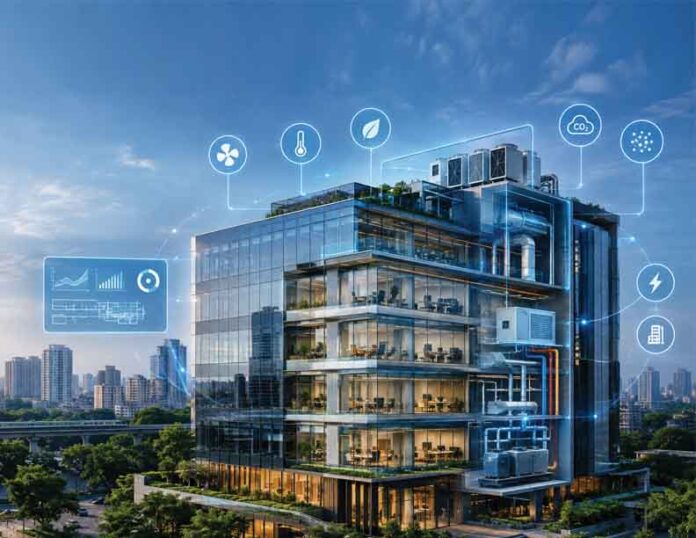
The BMS market is seeing a strong shift towards data-driven HVAC control, and several 2026 developments indicate where the technology is heading. ABB launched BuildingPro Suites as a unified platform connecting building automation, HVAC, energy, IT and IoT data. Johnson Controls expanded OpenBlue with AI-based predictive control for HVAC airside systems, while Trane continued to develop connected HVAC and AI solutions through its Cloud BMS and BrainBox AI platforms. Schneider Electric’s latest research has also put a figure on the potential: AI-enabled building optimisation reduced whole-building energy consumption by up to 22% in the building scenarios studied.
These developments put BMS at the centre of three closely connected areas: HVAC performance, indoor air quality and energy management. Temperature, occupancy, equipment status, weather, energy consumption and IAQ measurements can be brought into a common data environment and used for optimisation. The direction of development is therefore less about adding another layer of monitoring and more about using building data to influence HVAC operation.
A Common Data Layer
ABB’s BuildingPro Suites, launched at Light + Building 2026, is a clear example of this approach. The platform connects building automation, HVAC, energy, IT, OT and IoT systems within a common environment. ABB says the platform includes six suites and more than 20 specialised modules, with capabilities covering dashboards, analytics, predictive tools and AI-enabled functions. It can also integrate third-party systems and operate across on-premise, edge and cloud environments.
One important element is the way data from different building systems is structured. A temperature reading, valve position, fan speed or energy meter value becomes more useful when it can be associated with a particular AHU, zone or piece of equipment. BuildingPro also includes an optional AI Copilot that allows users to interact with building information through natural-language queries. In June 2026, ABB extended this connected-building approach through an integration with Samsung SmartThings Pro, further connecting building automation with enterprise IoT systems.
For HVAC operators, this creates a larger operating dataset. Equipment performance, energy consumption and indoor conditions can be examined together rather than as separate systems, allowing optimisation decisions to be based on multiple operating parameters.
AI Moves into HVAC Control
Johnson Controls has taken AI further into the actual control environment through its OpenBlue Energy and Comfort Intelligence solution. The system uses historical zone behaviour, current conditions and occupancy schedules to predict temperature trajectories and adjust HVAC operating parameters. Its technical documentation states that the system can issue BACnet commands and make adjustments at intervals of up to 15 minutes.
The significance is that AI is being used for supervisory control rather than simply reporting information. The system can learn how individual spaces respond thermally and determine when HVAC equipment needs to operate and at what level. For airside systems, this can involve fan operation, occupancy modes and zone temperature setpoints.
This type of control is particularly relevant to buildings with varying occupancy. Offices, retail spaces, airports and institutional buildings can have substantial differences in thermal demand across zones and throughout the day. When occupancy and temperature data are available to the BMS, HVAC operation can be adjusted according to actual building conditions.
The Numbers Behind AI
Schneider Electric’s September 2026 research provides some of the latest quantitative evidence on AI-enabled building optimisation. Its study found that AI-enabled buildings could reduce whole-building energy consumption by up to 22% in the scenarios examined. The research estimated annual utility savings of $13,600 to $49,300 per building under the electricity rates used in the study, with some scenarios delivering more than 200 MWh of annual energy savings..

The study also separated the contribution of AI from conventional smart controls. Schneider reported an additional 7.2–12.7% building-energy saving from the AI optimisation layer, depending on the scenario. The research used building-energy modelling validated against real-world pilot deployments in Australia, India and the United States. These figures are study-specific and should not be treated as a universal industry benchmark, but they provide a measurable indication of the potential being investigated.
Schneider’s April 2026 work had also identified AI-based HVAC optimisation as a route to reducing heating and cooling energy consumption by up to 15%, using real-time building data, weather forecasts and operating conditions.

IAQ Joins the BMS
Indoor air quality is becoming an increasingly important data stream within connected HVAC systems. CO₂, PM2.5, VOCs, temperature and humidity can be combined with occupancy and HVAC operating data to determine ventilation requirements and indoor conditions.
Demand-controlled ventilation is one direct application. CO₂ sensors can provide an indication of occupancy-related ventilation demand, while humidity, particulate levels and outdoor-air conditions can provide additional inputs. The BMS can then coordinate outdoor-air dampers, fan operation and cooling capacity according to measured conditions.
This creates a closer connection between IAQ and HVAC energy management. Ventilation requirements can be assessed continuously rather than being based only on fixed schedules. Schneider’s 2026 work on smart buildings identifies CO₂-based ventilation and occupancy-aware HVAC control among the applications where connected sensors and AI can influence building operation.
For large buildings, the resulting dataset can also support diagnostics. A persistent increase in CO₂ in a zone, abnormal humidity, rising fan energy or unusual temperature behaviour can be identified alongside equipment and occupancy information. This gives facility teams additional information for investigating HVAC performance.
Connected HVAC Platforms
Trane is also developing this architecture through its Cloud BMS and AI-based HVAC solutions. The company has positioned Cloud BMS, powered by BrainBox AI, as a platform for real-time visibility into HVAC performance, energy use and equipment health. Its latest announcements also highlighted new AI and digital solutions covering connected controls and thermal management.
The cloud-based approach becomes particularly relevant for organisations operating multiple buildings. Facility teams can access performance information across sites, compare operating conditions and identify equipment or buildings that require attention. At the same time, local controllers continue to perform equipment-level functions while higher-level analytics and optimisation operate through connected platforms.
Interoperability remains an important part of this architecture. Modern commercial buildings often contain equipment from several manufacturers, making protocols such as BACnet, Modbus and KNX important for bringing data into common supervisory systems. ABB, Johnson Controls and Trane are all developing platforms around connected data and open integration, reflecting the growing importance of system-level compatibility.
The Indian Opportunity
India provides a significant application environment for these technologies, particularly across commercial offices, data centres, hospitals, airports, retail buildings and large institutional facilities. HVAC loads vary considerably according to climate, occupancy, building use and operating schedules, creating a large number of parameters for automated optimisation.
The development of AI-ready BMS platforms also places greater emphasis on the quality of field data. Accurate sensors, reliable communication, correctly mapped points and properly commissioned HVAC equipment remain fundamental. AI can analyse a large dataset, but poor sensor readings or incorrect equipment information can directly affect the quality.