

Solar-assisted cooling systems have emerged as an innovative solution. These systems utilise renewable solar energy to power cooling processes, significantly reducing reliance on electricity and fossil fuels. The first solar cooling approach involves using a solar energy system, which converts solar energy radiations into electrical energy and applies it to refrigeration like traditional methods. Secondly, solar energy is cooled via thermoelectric and converted into electric energy. Consequently, another scientific approach of frequent use involves using a thermal refrigeration system involving a solar collector to directly heat the refrigerants through collector tubes instead of depending on solar electric power.
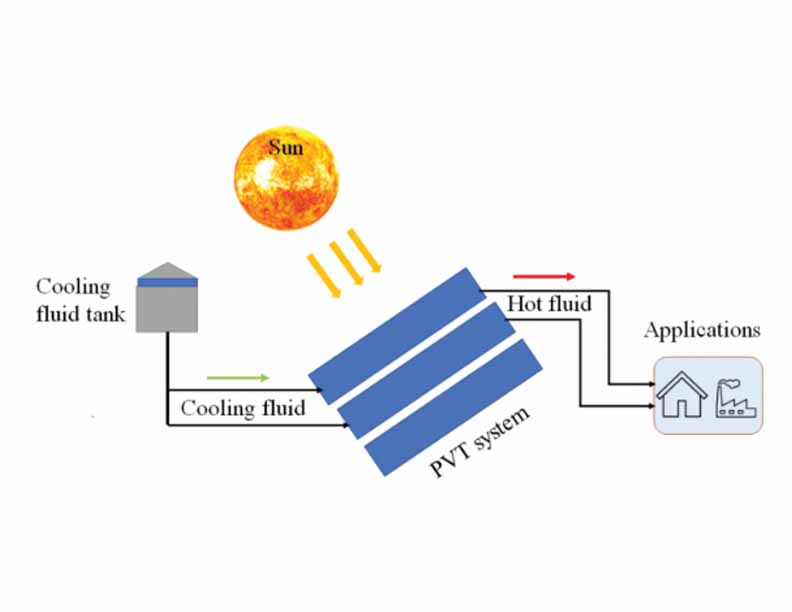
Two prominent technologies in this domain are absorption chillers and adsorption chillers. The ‘absorption chillers’ use heat from solar collectors to drive a thermo chemical process while replacing the traditional compressor mechanism. In contrast, ‘adsorption chillers’ utilise solid desiccants, like silica gel, to adsorb refrigerants under specific pressure and temperature conditions. Unlike conventional systems, both technologies demonstrate lower energy consumption and zero refrigerant emissions.
Solar-powered absorption refrigeration systems offer a sustainable and energy-efficient alternative to conventional cooling technologies by utilising solar thermal energy rather than mechanical compression. These systems operate through thermo chemical processes, commonly using lithium bromide-water (LiBr-H2O) or ammonia-water (NH3-H2O) as working fluids to generate cooling without reliance on compressors. Ongoing research aims to enhance heat and mass transfer efficiency, optimise thermodynamic cycles, and integrate hybrid configurations to improve overall performance.
By combining solar thermal collectors with absorption refrigeration, these systems achieve more effective solar-to-cooling conversion, particularly in regions with abundant sunlight. Advancements in heat exchanger design and working fluid selection contribute to higher reliability and efficiency. Hybrid models, such as the integration of the Organic Rankine Cycle (ORC) with absorption cooling, have been developed to improve energy recovery and stabilise performance under varying solar conditions.
Furthermore, advanced control strategies are being implemented to manage energy distribution and ensure continuous operation. These innovations position solar absorption refrigeration as a viable solution for residential, commercial, and industrial cooling applications, promoting sustainability. This study carried out an extensive literature review and discusses recent advancements, highlighting opportunities for future development and potential applications of solar-driven absorption cooling technology.
Types and advancement in solar cooling technologies
Solar thermal cooling technology can be broadly classified into open and closed cycle technology. The comparison of open-cycle cooling technology includes solid and liquid desiccant systems. On the other hand, closed-cycle cooling technology includes the comparison of absorption and adsorption cooling technologies. Solar electrical cooling technologies can be categorised into thermo-electrical (Peltier) and vapour compression cycle technology. These are further compared based on key attributes. In solar thermal cooling technologies, thermal energy generated from solar radiations is transformed to cooling through different chemical and physical processes. Open sorption cycle represents desiccant systems that can be utilised for humidification and de-humidification in air-conditioning applications.
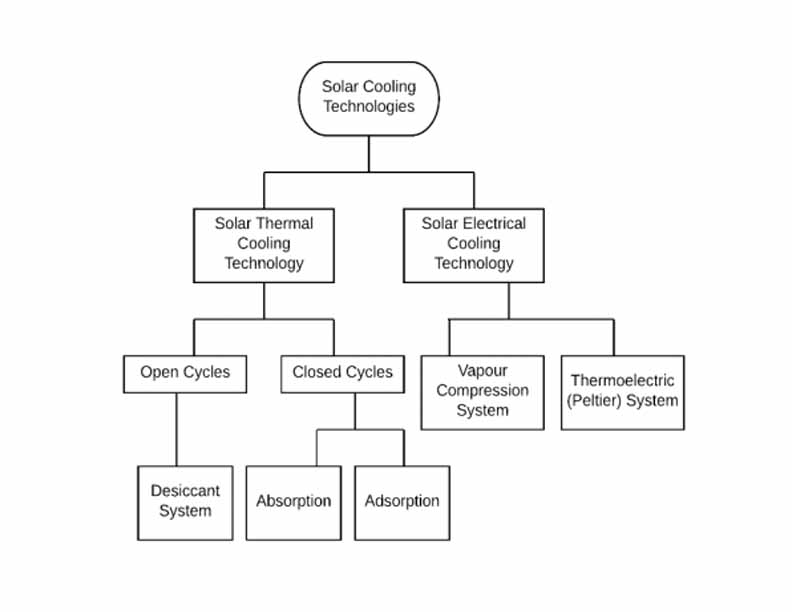
These systems transfer moisture from one air stream to another. The liquid desiccant system uses a conditioner and a regenerator for generating the cooling. dehumidification and regeneration are important processes for a liquid desiccant system. In solid desiccant systems, the air is passed through a solid desiccant such as silica gel for dehumidification and further to decrease its temperature by evaporative cooling. Closed sorption system represents absorption and adsorption cooling systems. Absorption cooling systems use a thermal compressor in its refrigeration cycle. The thermal compressor consists of an absorber and a generator.
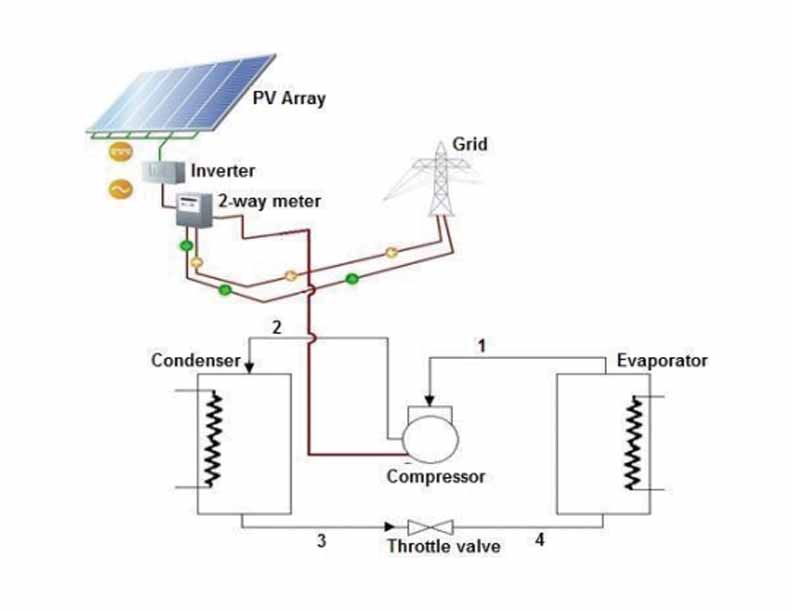
In adsorption cooling system, the refrigerant is absorbed on the surface of the solid sorbent material. The refrigerant thus forms a pair with the solid sorbent. Some commonly used pairs are water-silica gel and water zeolite. Solar electrical cooling systems use electricity obtained from photovoltaic panels for vapour compression systems and thermoelectric systems. Vapour compression systems use electricity generated by photovoltaic panel to drive mechanical compressors. These systems have a higher COP in comparison to other systems. The solar vapour compression cycle is represented in fig. 2.
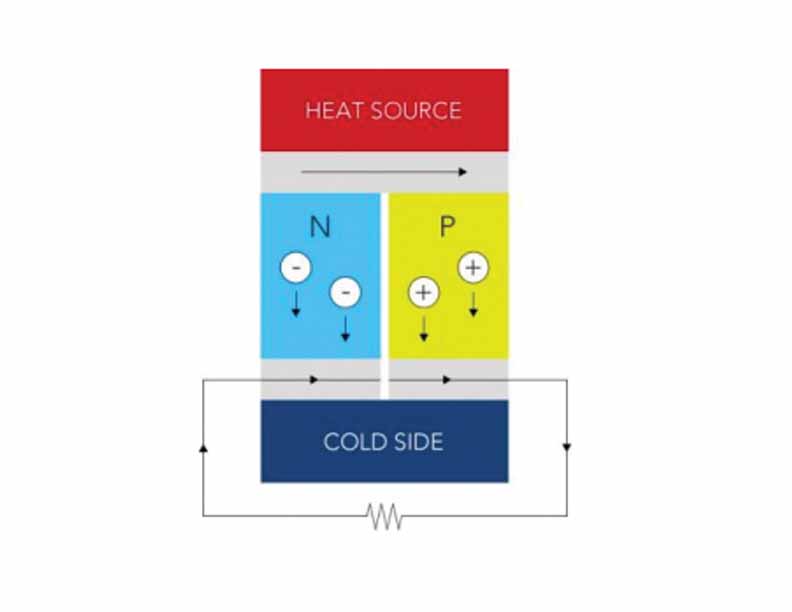
Thermoelectric cooling technology uses the Peltier effect to generate cooling. A temperature difference is created when dissimilar electrodes connected with a semiconductor are given voltage. One side of the plate produces cooling and the other side produces heating. Thermoelectric cooling is less efficient than the compressor-based cooling systems. Fig. 3 represents thermoelectric effect. The efficiency of the whole module and system can be enhanced by using multi-stages.
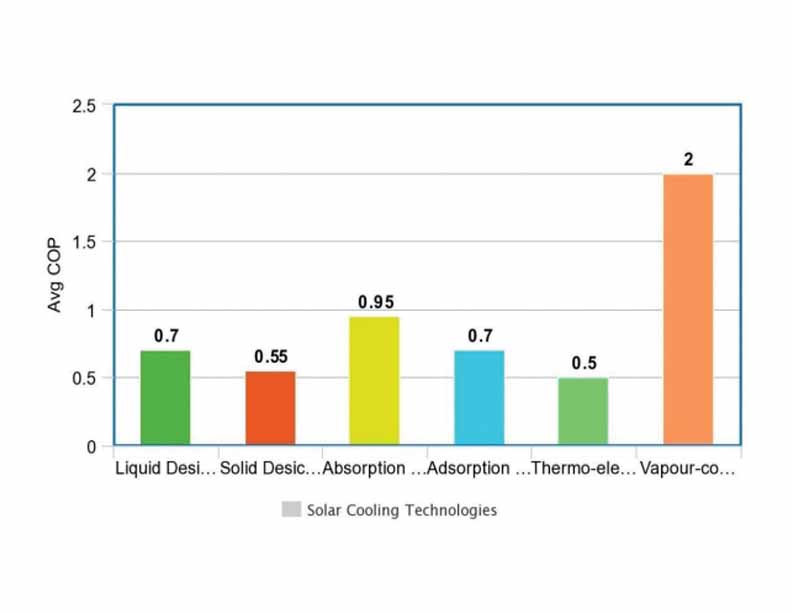
A graphical comparison of the reviewed solar cooling technologies can also be made based on the performance criteria i.e., COP. Fig. 4 represents the graphical comparison between solar cooling technologies.
Conclusions
Solar cooling has a great potential for research and development in future. The cooling demands are increasing due to environmental aspects and need for generation of artificially cooled surroundings for human comfort are also increasing. Several key aspects which are considered in the review can help in better understanding the potential and correct selection of technology for key implementation for specific applications.
COP of adsorption and absorption cooling systems can be further enhanced by using optimum solar collectors and innovation in flat plate collector technology can enhance the overall efficiency of closed systems. Implementation of hybrid systems in case of open-cycle systems can be effective in improving the COP and ability to deal with variations in the operating temperature range.
Also, the need to decrease energy consumption in vapour compression systems can be a great area of research. Future researches are to be made in the region of semiconductor components so that the thermoelectric technology can be enhanced further. Future works and researches can help improve and optimise technologies and make processes cost-effective.

Dr. (Prof.) D. B. Jani received Ph.D. in Thermal Science (Mechanical Engineering) from Indian Institute of Technology (IIT) Roorkee. Currently he is a recognized Ph.D. Supervisor at Gujarat Technological University (GTU). He has published more than 280 Research Articles in reputed International Conferences and Journals. He has also published 25 reputed books/book chapters and patents in area of thermal engineering. He has been working as an Academic Editor for the Journal of Materials Science Research and Reviews. Presently, he is an Associate Professor at GEC, Bhavnagar, Gujarat Technological University, GTU, Ahmedabad (Education Department, State of Gujarat, India). He has obtained his Master of Engineering in Automobile Engineering from Gujarat University, Ahmedabad, Gujarat. He has more than 26 years of experience in teaching at various institutions at undergraduate and postgraduate/PhD level in mechanical engineering. He is a life member in professional societies and bodies like ISTE, ISHRAE, MTTF, REST, Green ThinkerZ etc. He is a recipient of Best Teacher award (2020), Excellent researcher award (2020), Innovative academician award (2024). His area of research is Desiccant cooling, ANN, TRNSYS, and Exergy.