


In the current era of global warming, countless research projects are underway worldwide to reduce the intensity of heating across various sectors. The scope of these research projects is multifaceted, and thanks to them, we are able to uncover information about ongoing events that was previously either unknown or gone unnoticed.
It is highly encouraging that today’s universities are taking the initiative to address many existing challenges by identifying, analysing, and experimenting with the core problems of the industry. In the current context, we can certainly hope that the cumulative success of various such research efforts will one day enable us to bring the trend of the earth’s escalating global warming under control – don’t you think so? Thus, today, here I wish to present two such recent success stories of R&D.
Cooling design to protect electronics from overheating
Researchers at Indian Institute of Technology Madras (IIT Madras) have designed and experimentally tested a new cooling configuration that could improve thermal management in compact electronic devices.
The study introduces a novel design for a Flat Plate Pulsating Heat Pipe (FPPHP), addressing one of the most critical challenges facing modern electronics – managing the heat they generate.
As gadgets get smaller and more powerful – whether consumer phones, enterprise servers, or military systems – excess heat becomes a bottleneck. It can reduce performance and affect component reliability, making efficient thermal management a high priority in compact electronics and data centres.
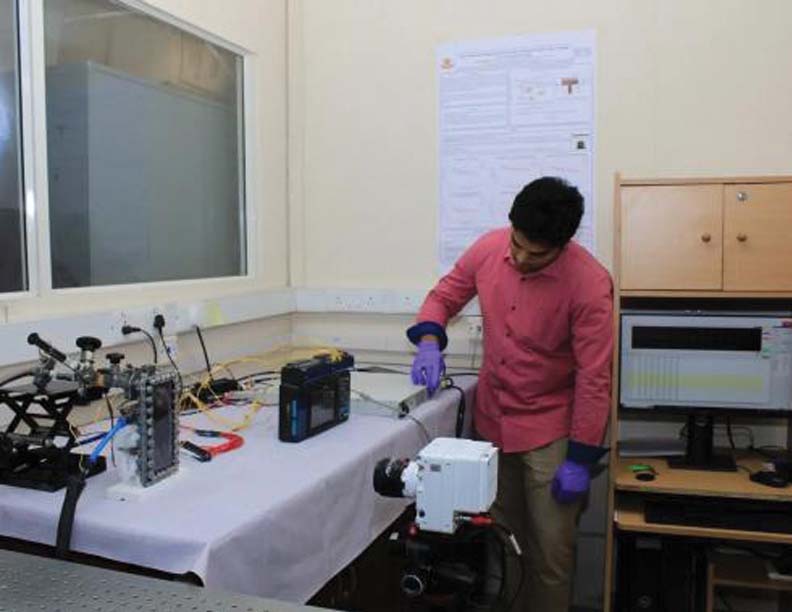
Image Courtesy: IIT Madras
IIT Madras design stands out for its antiparallel arrangement and its use of an O-ring configuration. Tests showed that the O-ring setup delivers 16% lower overall thermal resistance at higher heat inputs when compared with the gasket-based configuration studied in the project. The research team also found that using aluminium instead of copper reduces weight and improves performance in this configuration – aluminium versions showed about 20% lower thermal resistance than copper versions.
The device, called a Flat Plate Pulsating Heat Pipe (FPPHP), works like a miniature cooling system. It consists of a flat plate with tiny channels machined into it, partially filled with a liquid that moves back and forth, carrying heat away from hot components.
The research was led by Prof. Arvind Pattamatta and Dr. Pallab Sinha Mahapatra from the Department of Mechanical Engineering, IIT Madras, in collaboration with Davis T. Vempany and Hemanth Dileep from IIT Madras, Dr. Laxman Kumar Malla from Sri Sivasubramaniya Nadar College of Engineering, Chennai, and Dr. Pankaj Srivastava from the Instruments Research & Development Establishment (IRDE), Dehradun.
Explaining their work, Prof. Arvind Pattamatta said, “Think of it like a small, sealed tube that contains a liquid which sloshes back and forth – when one end gets hot, the liquid evaporates, moves to the cooler end, condenses, and returns, creating a natural cooling cycle.”
Unlike most existing FPPHP designs, where the hot and cold sections are placed on the same side of the plate, the researchers designed a novel ‘antiparallel’ arrangement in which the evaporator (heat-absorbing section) and condenser (heat-releasing section) are placed on opposite faces. This design is suited to compact electronic housings where space is extremely limited.
The researchers tested two configurations of the cooling device – one using a silicon gasket for sealing, and another using O-rings. Although the gasket-based design holds more working fluid, the O-ring design (Configuration 2) showed better overall device performance at higher heat loads because of stronger working-fluid pulsation. At 100 W heat input, the best gasket-based configuration recorded an evaporator temperature of about 75°C, while the best O-ring configuration reduced it to about 69°C and achieved an overall thermal resistance of 0.44 K/W—16% lower than the gasket-based configuration.
Further focusing on their observation, Davis T. Vempany, Research Scholar, Department of Mechanical Engineering, IIT Madras, said, “We noticed that while the gasket design holds more fluid initially, the O-ring version allows that fluid to pulsate much more freely. Think of it like blood circulation – better pulsation means better transport. That’s exactly what we’re achieving here.”
Highlighting the commercial potential of their work, Dr. Pallab Sinha Mahapatra, informed, “Aluminium is lighter and more practical for commercial FPPHP production. Finding that it also outperforms copper in our tests is a strong signal for commercial viability.”
The team also experimented with surface treatments. Making the inner channel walls superhydrophilic – meaning they strongly wet the channel surface – cut thermal resistance by about 16% compared with the untreated surface, since it promotes thin-film evaporation and improves heat transfer.

Image courtesy: National Park Service, U.S
Improving a decades-old method
University of Hawaiʻi at Mānoa atmospheric scientists have found that the century-old yardstick used across many industries to estimate air-conditioning and refrigeration energy demand – called cooling degree days – is missing something fundamental.
Their recent study reports a new, physics-based version of the metric – effective cooling degree days – that captures how temperature and humidity together impact the actual work a cooling system is required to do. Applying it across North America, they found that cooling efficiency has been declining by 2–4% per decade since 1971, and that the old temperature-only metric misjudges how much cooling is required in different regions. This has led to overstating demand in some places and understating it in others.
Briefing on their research, Jake Casselman, Atmospheric Sciences Postdoctoral Researcher in the UH Mānoa School of Ocean and Earth Science and Technology (SOEST), said, “Estimates of cooling degree days are used everywhere. Utility companies, grid operators, energy planners, and engineers use them to anticipate electricity demand, and financial markets trade futures on them to hedge against unusually hot summers. If that yardstick is biased in ways that depend on a region’s climate, then the planning decisions built on it are biased too. That can mean building the wrong amount of power generation in the wrong place, or misjudging where the grid is most at risk during a heat wave.”
The previous approach to estimating cooling requirements assumes every degree of heat takes the same amount of energy to cool, no matter the conditions. But real cooling systems don’t work that way: they get less efficient as it gets hotter, and humidity makes it worse, because the system has to spend energy wringing moisture out of the air, not just lowering the temperature.
The recent study reports a new, physics-based version of the metric – effective cooling degree days – that captures how temperature and humidity together impact the actual work a cooling system is required to do…
Casselman and Christina Karamperidou, an Atmospheric Sciences Professor in SOEST, combined climate science with refrigeration engineering to develop a new cooling demand metric that explicitly accounts for how cooling system efficiency changes with temperature and humidity. Their approach incorporates a simplified model of the refrigeration cycle – the same physics governing every air conditioner and refrigerator– to estimate how efficiently a cooling system can remove heat under different atmospheric conditions. They applied this new cooling demand metric to 50 years of high-resolution weather data (1971–2020) across North America to quantify how climate-driven changes in cooling efficiency have already reshaped cooling demand across regions.
They repeated the analysis using projections from 19 climate models under a high-emissions scenario to assess future changes. Finally, they mapped the results onto the U.S. electricity grid, accounting for where people live, to identify the regions and power systems most likely to experience the largest shifts in cooling demand.
Conclusion
IIT Madras’ research work holds high potential, like: it may help the electronic industry in reducing form factors of laptops and cellphones; it may address cooling constraints in servers and data-centre electronics; it may ensure benefit from more reliable thermal control in high-power radar, avionics, and related electronics etc.
University of Hawaiʻi’s work may help in predicting the regions where cooling demand will be much more than other regions due to variation in humidity. And that will directly help in assessing the right location for setting up power plants or heat-intensive industries.
By P. K. Chatterjee (PK)