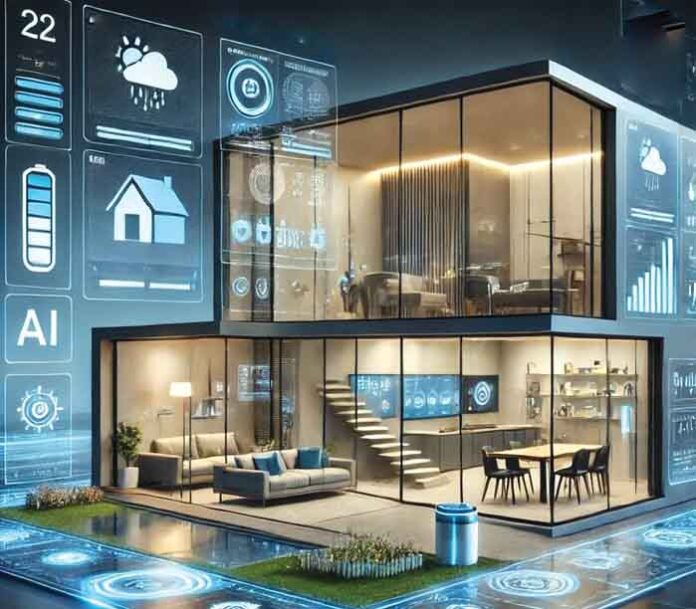
India’s built environment is changing fast. The Bureau of Energy Efficiency (BEE) estimates that buildings account for approximately 33% of the country’s total electricity consumption, of which HVAC systems alone represent 40–60% of a typical commercial building’s energy bill. Against this backdrop, BMS integration, IAQ-linked demand control ventilation, drive-based fan and pump control, and cloud-connected analytics are no longer premium add-ons — they are rapidly becoming the minimum standard for any serious engineering specification.
This article examines the state of BMS and HVAC controls in India in 2025: the technology layers, the integration standards, the role of IAQ in shaping ventilation strategy, the economics of VFDs across the HVAC system, and the emerging trends that will define the next decade of intelligent building design.
Building Management Systems: The Central Nervous System of HVAC
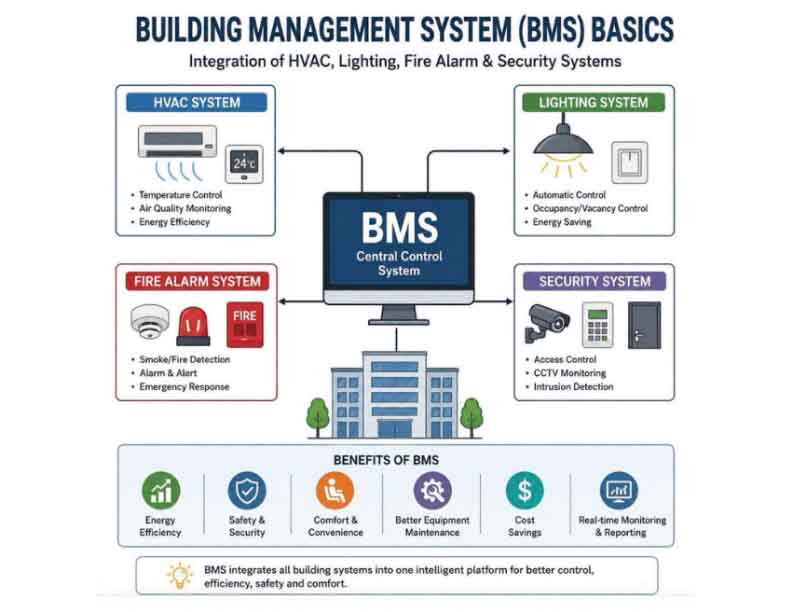
A Building Management System — variously called Building Automation System (BAS) or Building Control System (BCS) — is the supervisory intelligence layer that monitors, controls and optimises all major building services from a centralised platform. For HVAC, this means real-time oversight and control of chillers, AHUs, FCUs, cooling towers, pumps, fans, dampers, VAV boxes, zone temperature sensors and energy meters, all converging into a single graphical user interface accessible from an operator workstation, a tablet or a smartphone.
Architecture: From Field Device to Cloud
Modern BMS architecture operates across three hierarchical layers. The field layer comprises sensors, actuators, thermostats, damper controllers and drives — the physical devices that measure and act. The automation layer hosts Direct Digital Controllers (DDCs) or Programmable Logic Controllers (PLCs) that execute control logic locally, independent of the network. The management layer is the SCADA or BMS server that aggregates data, presents graphical displays (synoptic screens), generates alarms, stores historical trends and exposes APIs for integration with other enterprise systems such as CMMS, BIM platforms and energy reporting dashboards.
“A BMS is not merely an energy saving device — it is the decision-making intelligence that turns a building into an adaptive, self-optimising organism responsive to occupancy, weather and grid signals.”
The communication bridge between these layers relies on industry-standard protocols. BACnet (Building Automation and Control Networks, ASHRAE 135) remains the dominant open protocol for HVAC devices in India, supported by virtually all major BMS vendors. Modbus RTU and TCP/IP are widely used for energy meters, VFDs and simpler field devices. LonWorks, KNX and DALI find application in lighting and room control integration. More recently, MQTT and RESTful APIs have entered the BMS landscape as cloud-edge bridges, enabling real-time telemetry to IoT platforms and energy management cloud services.
HVAC Control Strategies within BMS
The sophistication of BMS-based HVAC control has expanded significantly beyond simple on/off scheduling and setpoint management. Contemporary DDC programming implements:
- Optimum Start / Stop (OSS): The BMS calculates the latest possible start time for HVAC to bring the space to setpoint by occupancy, factoring in outdoor and indoor temperatures. This eliminates the common practice of starting the plant 2–3 hours early as a safety margin and delivers significant energy savings, particularly in variable Indian
climatic conditions. - Chiller Plant Optimisation: Through BACnet or Modbus integration with chiller controllers, the BMS can orchestrate chiller sequencing, chilled water reset (raising the CHW setpoint at partial load to improve chiller COP), condenser water temperature control and cooling tower fan staging — delivering whole-plant efficiency rather than optimising each component in isolation.
- Demand-Controlled Ventilation (DCV): Perhaps the most impactful integration of recent years. BMS receives CO₂ and IAQ signals from sensors in occupied zones and modulates AHU fresh air dampers and FCU fan speeds accordingly, reducing ventilation energy when spaces are partially occupied. This is explored in detail in Section 2.
- Fault Detection and Diagnostics (FDD): Advanced BMS platforms deploy rule-based or AI/ML-assisted FDD algorithms that continuously analyse HVAC operational data to detect faults — a chiller running at elevated kW/TR, a coil with rising approach temperature indicating fouling, or a pump operating beyond its curve — and generate prioritised work orders before comfort is affected.
- Energy Metering and Sub-metering: BMS integrates with kWh, kVAR and BTU meters to provide real-time visibility into HVAC energy consumption by system, floor and zone, enabling Energy Performance Contracts (EPCs), Specific Energy Consumption (SEC) benchmarking and ECBC / GRIHA / LEED compliance reporting.
- Integration with Fire and Life Safety Systems: BMS interfaces with fire alarm panels to implement smoke mode: switching AHUs to 100% exhaust, closing smoke dampers and isolating recirculation — critical for evacuation effectiveness and regulatory compliance.
Key BMS Standards and Certifications Relevant to India
- BACnet / ISO 16484-5: Open protocol for HVAC, lighting and fire integration (ASHRAE 135)
- ECBC 2017 (Energy Conservation Building Code): Mandates BMS for buildings over 100 kW connected load
- NBC 2016 (National Building Code): BAS requirements for HVAC control in commercial buildings
- LEED v4.1 BD+C: BMS-enabled monitoring credits under Energy & Atmosphere category
- GRIHA 4 (Green Rating for Integrated Habitat Assessment): Sub-metering and BMS points for energy rating
- ISO 50001: Energy Management System standard — BMS as data foundation for energy baseline and monitoring
Indoor Air Quality: From Compliance to Health-Centric HVAC
The COVID-19 pandemic accelerated what the built environment industry had long known but rarely acted upon: indoor air quality is not a peripheral amenity — it is a fundamental determinant of occupant health, cognitive performance and wellbeing. In the post-pandemic decade, IAQ monitoring and control has moved from the specification pages of premium buildings to the mainstream requirements of hospitals, schools, offices, retail spaces and residential towers across India.

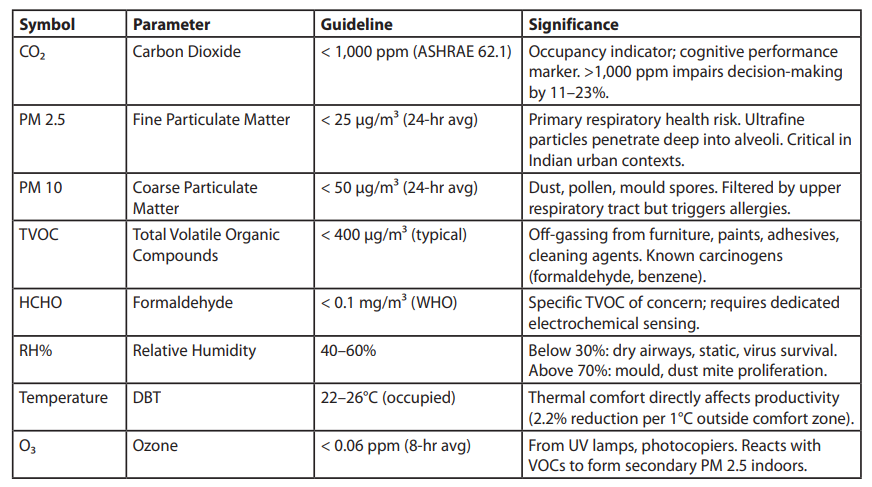
The IAQ Parameter Set
A comprehensive IAQ monitoring system tracks multiple parameters simultaneously:
Demand-Controlled Ventilation: IAQ Meets Energy Efficiency
The single most impactful use of IAQ data in HVAC control is Demand-Controlled Ventilation (DCV). In conventional systems, fresh air is supplied at the design maximum rate regardless of actual occupancy — wasting significant cooling and fan energy in partially occupied spaces. DCV uses CO₂ sensors (and increasingly multi-parameter IAQ controllers) as a proxy for occupancy and modulates the fresh air damper position and fan speed accordingly.
“CO₂-based Demand-Controlled Ventilation turns indoor air quality from a passive health metric into an active energy management tool — reducing ventilation loads by 20–35% without compromising occupant wellbeing.”
The energy arithmetic is compelling. ASHRAE 62.1 requires 10 L/s per person of outdoor air for office occupancies. A conference room designed for 20 persons running at 30% occupancy — a common scenario in modern agile workplaces — could reduce fresh air intake from 200 L/s to 60 L/s with a corresponding 70% reduction in the latent and sensible load on the AHU serving that zone. Across a 50,000 sqft office tower in Chennai or Mumbai operating for 10 hours per day, DCV has been demonstrated to deliver 20–35% ventilation energy savings, with payback periods under 3 years.
IAQ Standards Shaping Indian Commercial HVAC Practice
- ASHRAE 62.1-2022: Ventilation and Acceptable Indoor Air Quality in Residential Buildings
- NBC 2016 Part 8 Clause 3.5: Ventilation requirements for different occupancy types
- MoHFW Guidelines for Healthcare IAQ (2021): PM 2.5, CO2, TVOC limits for hospitals
- WHO IAQ Guidelines 2021: PM 2.5 (15 μg/m³ annual), PM 10, NO2, Radon thresholds
- LEED v4.1 EQ Credit: Enhanced IAQ strategies including air monitoring and CO2 monitoring
- IS 3103 / IS 8183: Indian standard for ventilation and air distribution in occupied buildings
- WELL Building Standard v2: Comprehensive IAQ requirements across Air, Thermal Comfort and Mind concepts
IAQ and Filtration: The MERV / HEPA Imperative
PM 2.5 is perhaps the most urgent IAQ challenge in the Indian context. India’s outdoor PM 2.5 concentrations in major cities routinely exceed WHO guidelines by 5–10 times, making the AHU filter specification a direct health decision.
The transition from the common EU-3 / G4 washable mesh filter (which removes approximately 50% of particles above 10 microns) to MERV-13 or F7 fine fibre filters (capturing 85–95% of PM 2.5) is increasingly specified in hospitals, schools and premium commercial buildings.
The BMS plays a critical role here: filter differential pressure sensors connected to the DDC trigger alerts when filter loading causes pressure drop to exceed design limits, ensuring timely filter replacement that maintains both IAQ and AHU energy efficiency (a loaded filter increases fan static pressure and energy consumption by 15–25%).
To be continued…

Aman Taluja is the Operations Head at Brightflow Engineers Pvt. Ltd. With hands-on experience in executing complex commercial and industrial projects, he specializes in delivering practical, performance-oriented HVAC solutions. At Brightflow, the focus is on the design, manufacturing, and execution of Air Handling Units (AHUs), Air Washers, ventilation systems, and air quality solutions, catering to a wide range of industries including hospitality, manufacturing, healthcare, and infrastructure. Over the years, he has been associated with reputed projects such as Le Méridien Hyderabad, NTPC Dadri, HAL Nashik, and Marriott Amritsar, delivering projects on time, within budget, and with a strong emphasis on quality.