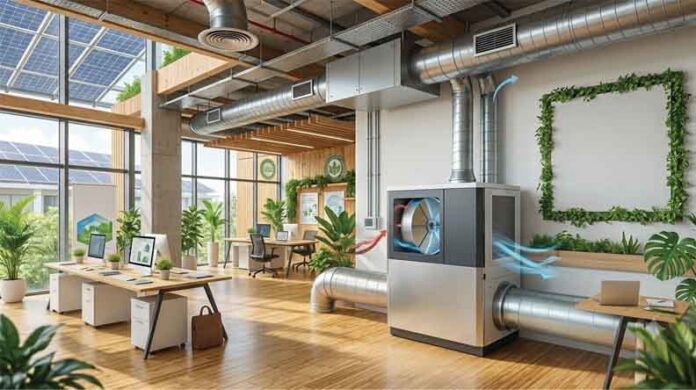
By decoupling latent (moisture) and sensible (temperature) cooling loads, desiccant systems control indoor humidity independently without overcooling the air. Furthermore, these systems utilize low-grade thermal energy—such as solar power or industrial waste heat—for the regeneration phase, drastically reducing overall grid electricity demand and lowering carbon dioxide emissions. It is that desiccant-assisted cooling significantly improves the thermal Coefficient of Performance (COP) in hot and humid climates while fulfilling Net-Zero Energy Building (NZEB) criteria.
The Current Scenario
Buildings require substantial energy to maintain acceptable indoor temperature, humidity, and air quality. The increasing use of air-conditioning systems, particularly in hot and humid climates, has intensified the need for efficient cooling technologies. Conventional Vapor-Compression Refrigeration (VCR) systems provide effective cooling but may consume considerable electricity when both sensible and latent loads are high. The latent cooling load is associated with the removal of water vapor from indoor or outdoor air, whereas the sensible cooling load is associated with reducing air temperature. In conventional air-conditioning systems, both loads are frequently handled by cooling air below its dew-point temperature. Although this approach is widely used, it can result in unnecessary sensible cooling, condensation, and subsequent reheating. The growing demand for air-conditioning in residential, commercial, and institutional buildings has increased the need for energy-efficient and environmentally friendly cooling technologies. Green buildings aim to reduce energy consumption, minimize environmental impacts, and provide a healthy and comfortable indoor environment. Conventional vapor-compression air-conditioning systems are widely used for cooling, but they consume significant electrical energy, particularly in hot and humid climates where both temperature and humidity must be controlled. In conventional systems, air is cooled below its dew-point temperature to remove moisture, which may increase compressor energy consumption and sometimes require additional reheating. Desiccant dehumidifiers provide an alternative approach by separating moisture removal from sensible cooling. These systems use hygroscopic materials that absorb or adsorb water vapour from the air, thereby reducing indoor humidity while supporting efficient cooling. Their integration with conventional air-conditioning systems and renewable energy sources makes them a promising technology for sustainable cooling in green buildings. Desiccant dehumidification provides a means of separating moisture removal from sensible cooling. A desiccant is a hygroscopic substance that attracts and retains water vapor from surrounding air. When the material becomes saturated, it can be regenerated by supplying heat, releasing the accumulated moisture into a separate air stream. Recent investigation has highlighted the potential of desiccant technologies to improve building energy efficiency through independent humidity control and integration with renewable or waste-heat sources. However, experimental performance depends on desiccant properties, system configuration, climate, and regeneration requirements. Desiccant cooling technology has developed through research into hygroscopic materials, heat and mass transfer, and integration with conventional cooling systems. Earlier investigations focused on open-cycle solid desiccant systems, while subsequent studies explored liquid desiccants, hybrid HVAC configurations, and renewable thermal regeneration. More recent system-level research has examined the integration of desiccants into building energy systems, including humidity pumps and thermal energy storage. Despite this progress, commercialisation remains affected by material limitations, flow maldistribution, regeneration requirements, and system cost. With this aim, alternative approach is needed in confronting massive energy consumption and, large scale greenhouse and pollutant gases emissions in the environment. Alternative approach such as utilisation of alternative energy resources are one of the most prospects. Development of efficient and clean or green technologies solves the issue of large gases emissions (greenhouse gases and ozone layer depleting substances). Policies on energy conservation and environmental protections such as use of renewable energy or industrial waste heat etc. portfolios are one of the best startup for tackling this global problem. As building air conditioning sector is one of the primary energy consumers accounted to more than 60% inclusive of commercial and industrial buildings. The sector energy consumption is used to support electrical appliances, thermal comfort produced by use of traditional air conditioners and others such as lighting. As global population grows, urbanisation taking place, and standard of living becoming higher, it is expected that the building sector energy consumption will increase furthermore. The past study showed that population size and age structure may effect on energy consumption in building in residential or industrial applications. The sector electric energy consumption will increase by 122% from 2002 to 2030.
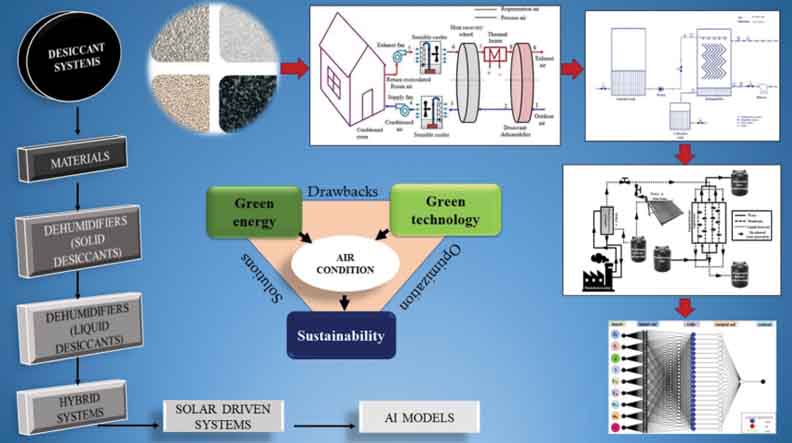
Working of Desiccant Cooling System
A desiccant is a material that has a strong affinity for water vapour. When humid air comes into contact with the desiccant, moisture is transferred from the air to the material due to the difference in water-vapour pressure. This process reduces the humidity ratio of the air. However, moisture absorption or adsorption generally releases heat, which may increase the temperature of the dehumidified air. Therefore, the dry air is usually passed through a cooling coil to achieve the desired indoor temperature. Once the desiccant becomes saturated with moisture, its dehumidification capacity decreases. It must then be regenerated by supplying heat, which drives the absorbed moisture out of the material. The released moisture is carried away by a separate regeneration air stream. This continuous process allows the desiccant to be reused for further dehumidification. Depending on the material used, desiccant dehumidifiers are broadly classified into solid and liquid systems.
Solid desiccant systems commonly use materials such as silica gel, zeolites, and other porous hygroscopic substances. A rotary desiccant wheel is one of the most widely used configurations. The wheel rotates slowly between two air streams: the process air, from which moisture is removed, and the regeneration air, which is heated to restore the desiccant’s moisture-absorbing capacity. Liquid desiccant systems use hygroscopic solutions, such as lithium chloride or lithium bromide, to absorb moisture from the air. The diluted solution is subsequently heated in a regeneration unit to release the absorbed water vapour and restore its concentration. Both types of systems can provide effective humidity control, although their performance depends on material properties, operating temperature, airflow rate, and regeneration conditions.
Desiccant dehumidification is based on the transfer of water vapor from moist air to a hygroscopic material. This transfer occurs because of a difference in water-vapor pressure between the air and the desiccant. The moisture-removal process may involve adsorption in porous solid materials or absorption into liquid desiccants. During dehumidification, the water vapor is transferred from the air to the desiccant, and heat is released. Consequently, the outlet air may have a lower humidity ratio but a higher temperature. The desiccant is subsequently regenerated by supplying thermal energy. The absorbed moisture is released into a separate regeneration air stream, restoring the desiccant’s moisture-removal capacity.
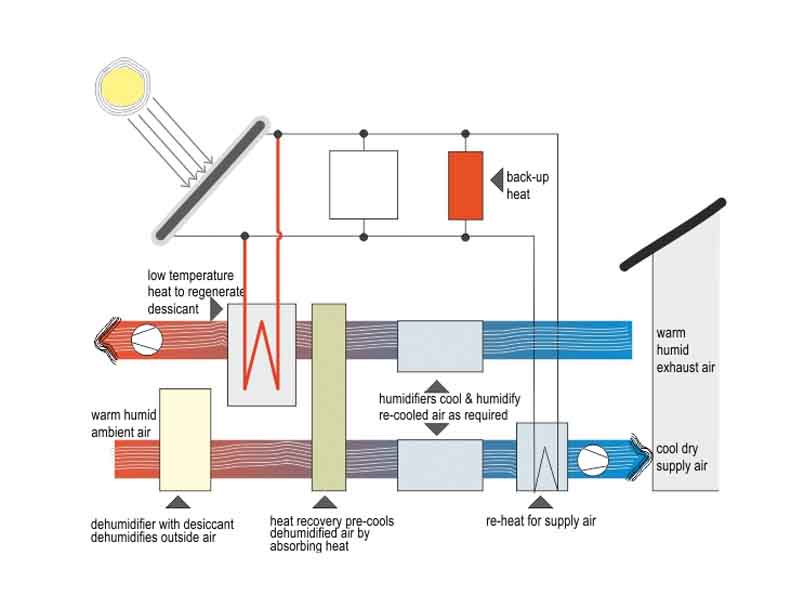
This unit (Fig. 1) consists of desiccant wheel along with heater and cooler. In dehumidification and cooling process removal of moisture from air takes place. When air is passing through desiccant wheel granules of silica gel absorb moisture from air. This air then passes through heater. When this air is passing through heater moisture is removing from desiccant wheel, so that we can use the desiccant material again from the process. The temperature of heater is maintain about 55-68°C. After this, moisture is carried out from the room with the help of duct. This cycle is repeated.
Role of Desiccant based Dehumidification in Sustainable Cooling and Green Buildings
Desiccant dehumidifiers play an important role in sustainable cooling by reducing the latent cooling load of air-conditioning systems. In conventional HVAC systems, the cooling coil is responsible for both reducing air temperature and removing moisture. When a desiccant dehumidifier is installed before the cooling coil, a major portion of the moisture can be removed independently. Consequently, the cooling coil primarily handles the sensible cooling load. Under suitable operating conditions, this arrangement can reduce compressor energy consumption and improve the overall performance of the air-conditioning system. Hybrid desiccant–vapor compression systems are particularly promising for green buildings because they combine the reliable cooling capacity of conventional refrigeration with independent humidity control. Research reviews have identified these hybrid configurations as an important development in energy-efficient building cooling.
Another significant advantage of desiccant dehumidification is its ability to maintain comfortable indoor humidity conditions. Excessive indoor humidity can cause discomfort, condensation, and conditions favourable to mould growth. By controlling moisture independently, desiccant systems can support a healthier and more comfortable indoor environment. This is particularly important in buildings such as hospitals, laboratories, educational institutions, offices, and hotels, where indoor environmental conditions must be maintained within appropriate limits. In addition, desiccant systems can be used for treating outdoor ventilation air before it enters the occupied space. This helps manage the moisture introduced through ventilation while maintaining the required indoor air quality. However, effective humidity control must be combined with suitable ventilation, filtration, and temperature control to achieve good indoor environmental quality.
Integration with Renewable Energy Sources
The sustainability of desiccant dehumidifiers can be further improved by integrating them with renewable energy sources and waste-heat recovery systems. Regeneration requires thermal energy to remove moisture from the desiccant. Solar thermal collectors can provide this heat, making solar-assisted desiccant cooling an attractive option for buildings located in regions with good solar availability. During periods of high solar radiation, collected thermal energy can be used to regenerate the desiccant, reducing dependence on conventional heating sources. Waste heat from industrial processes, refrigeration equipment, and other building systems can also be utilized for regeneration when the available temperature is suitable. The use of low-grade thermal energy is particularly valuable because it allows energy that might otherwise be wasted to contribute to the building’s cooling requirements. Studies of solar-powered desiccant systems have highlighted the potential of renewable thermal energy integration for reducing conventional energy demand.
In green building design, the integration of desiccant dehumidifiers with solar photovoltaic systems, solar thermal collectors, energy-efficient cooling equipment, and building automation systems can improve overall energy management. Temperature and humidity sensors can be used to regulate the operation of the dehumidifier, regeneration heater, fans, and cooling coil according to actual building requirements. Such intelligent control can avoid unnecessary operation and reduce energy wastage. Thermal energy storage may also be incorporated to store available heat for regeneration when solar radiation is insufficient. Nevertheless, the energy required for regeneration, air circulation, and auxiliary equipment must be considered carefully. A system that consumes excessive regeneration energy may not provide the expected environmental benefits, even if it uses an efficient dehumidification process.
Applications and Environmental Benefits
Desiccant dehumidifiers can be applied in a wide range of green buildings, including residential complexes, commercial offices, educational campuses, healthcare facilities, hotels, and industrial buildings. In humid climates, they are particularly useful for treating fresh outdoor air and maintaining indoor humidity. In buildings with high latent cooling loads, they can reduce the burden on conventional cooling equipment. Their application can also support better control of indoor moisture and reduce the need for excessive cooling and reheating. From an environmental perspective, lower electricity consumption can reduce operational carbon emissions when the electricity supply has a significant carbon intensity. The use of solar heat or recovered waste heat for regeneration can provide additional environmental advantages. However, these benefits depend on the overall system design, the source of regeneration energy, the efficiency of the cooling equipment, and the climatic conditions of the building.
For green buildings in India, desiccant dehumidification has considerable potential because many regions experience high outdoor temperatures and seasonal humidity variations. In coastal and humid regions of Gujarat, for example, the combination of high temperature and moisture can increase the cooling and dehumidification requirements of buildings. A hybrid system using a solid desiccant wheel, an efficient cooling coil, and solar-assisted regeneration may provide an effective solution for suitable applications. The design should consider seasonal weather conditions, ventilation requirements, operating schedules, and the availability of renewable thermal energy. Proper selection of desiccant material and regeneration temperature is essential to achieve reliable performance.
Challenges and Future Scope
Despite its advantages, the use of desiccant dehumidifiers in green buildings faces several technical and economic challenges. The regeneration process requires a reliable source of thermal energy, and the overall system performance may decrease if this energy is supplied inefficiently. The initial cost of equipment, installation, and control systems may also be higher than that of conventional air-conditioning systems. In addition, desiccant materials must maintain their moisture-removal capacity over repeated operating cycles. Solid desiccant systems require effective sealing and airflow distribution, while liquid desiccant systems require appropriate measures to prevent corrosion and solution carryover. Further research is needed to develop advanced desiccant materials with high moisture capacity, rapid moisture transfer, low regeneration temperature, and long-term durability. The integration of artificial intelligence, advanced sensors, thermal energy storage, and renewable energy systems also offers opportunities to improve the efficiency and reliability of desiccant-assisted cooling.
Conclusion
Desiccant dehumidifiers are a promising technology for achieving sustainable cooling in green buildings. Their ability to separate moisture removal from sensible cooling provides an opportunity to improve indoor humidity control and reduce the energy demand of conventional air-conditioning systems. The integration of solid or liquid desiccant systems with vapor-compression cooling, solar thermal energy, and waste-heat recovery can further enhance their sustainability. However, the actual energy and environmental benefits depend on the selection of suitable materials, regeneration methods, operating conditions, and system configuration. With proper design, intelligent control, and comprehensive energy assessment, desiccant dehumidifiers can contribute significantly to energy-efficient, comfortable, and environmentally responsible green buildings.

Dr. (Prof.) D.B. Jani received Ph.D. in Thermal Science (Mechanical Engineering) from Indian Institute of Technology (IIT) Roorkee. Currently he is recognized Ph.D. Supervisor at Gujarat Technological University (GTU). Published more than 300 Research Articles in reputed International Conferences and Journals. He has also published 25 reputed books/book chapters and patents in area of thermal engineering. Working as Academic Editor for the Journal of Materials Science Research and Reviews. Presently, he is an Associate Professor at GEC, Bhavnagar, Gujarat Technological University, GTU, Ahmedabad (Education Department, State of Gujarat, India). He has obtained his Master of Engineering in Automobile Engineering from Gujarat University, Ahmedabad, Gujarat. He has more than 27 years of experience in teaching at various institutions at undergraduate and postgraduate/PhD level in mechanical engineering. He is a life member in professional societies and bodies like ISTE, ISHRAE, MTTF, REST, Green ThinkerZ etc. He is recipient of Best Teacher award (2020), Excellent researcher award (2020), Innovative academician award (2024), Best Associate Professor Award (2025), Innovative Teaching Award (2025), Life Time Achievement Award (2025), Best Educationist Award (2026). His area of research is Desiccant cooling, ANN, TRNSYS and Exergy analysis.