
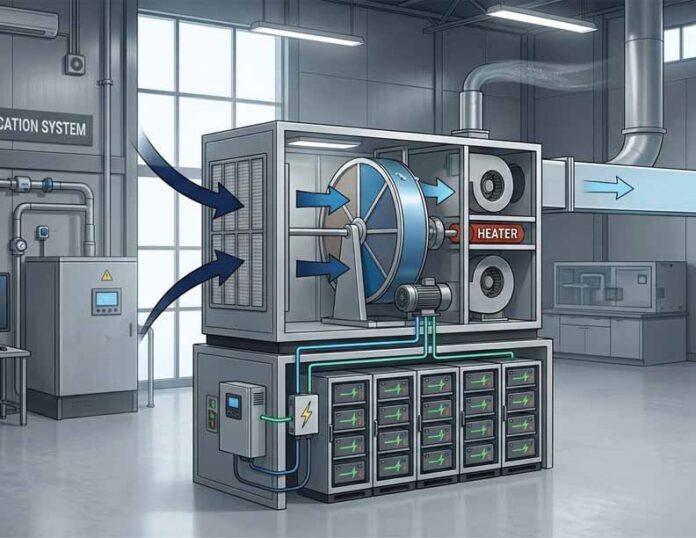
Conditioning the built environment consumes significant amounts of energy. The energy used to remove water vapour from the air in buildings accounts for 30% of carbon emissions related to global space cooling. Conventional dehumidification is performed by cooling air below its dew point to condense water vapour out of the air. Afterward, the air is typically reheated to ensure occupant comfort. While relatively simple, this method of dehumidification is inefficient compared to more advanced dehumidification techniques.
Desiccant systems have been increasingly explored for performing high-efficiency dehumidification in space-conditioning systems. In addition to handling dehumidification loads, desiccant systems have also been combined with evaporative cooling to provide both sensible and latent load management in buildings.
Desiccants are materials that readily absorb water vapour from the air when they come into equilibrium with water vapour at low vapor pressures. They generally take the form of solid materials or liquid solutions. Solid desiccants are typically utilized in desiccant wheel configurations. In these systems, the desiccant is first rotated into a region where it is saturated with water vapour; then, it is rotated into a region where it is regenerated to release the moisture outside of the conditioned space.

Solid desiccants can also be used in batch operations where alternating heating and cooling cycles are used to drive moisture adsorption and release. Liquid Desiccants (LDs) dehumidify in a similar manner but can continuously flow through a system to provide dehumidification. Unlike solid desiccants, LDs can be easily pumped to heat and mass exchangers that contact a stream of flowing desiccant with air in either an absorber or desorber. The concentrated or diluted LD can then be stored in tanks, is common to regenerate LD thermally often using fuel combustion. In this process the LD is heated to increase the vapour pressure of the water in solution until the water evaporates. Due to large enthalpies of vaporization, thermal regeneration of LD can be energy intensive.
Electrically driven regeneration methods have been explored as more efficient approaches to LD regeneration. These methods include heat pumping, electro-dialysis, reverse osmosis, and ultrasonics. Demand flexibility in buildings can allow for reduced costs and emissions associated with electrically driven energy services. If paired with energy storage, electrically driven dehumidification processes can further reduce costs and carbon emissions associated with maintaining occupant comfort through providing demand flexibility.
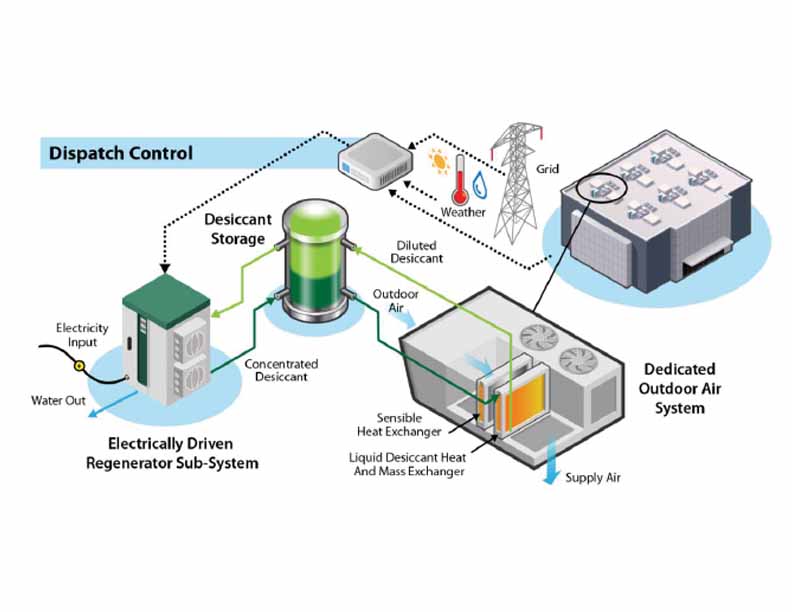
A potential application of LD energy storage is depicted in Figure 1. Here the LD solution is stored in a tank. A controller directs the charging or discharging of the storage tank in response to relevant grid signals or weather forecasts. To charge the LD storage system, a dilute solution is sent to an electrically driven regenerator. Water is removed and a concentrated desiccant solution is returned to the storage tank. To discharge the storage, concentrated desiccant solution is sent to the LD heat and mass exchanger to dehumidify air. This effectively shifts the energy required to dehumidify air in buildings.
The tank was connected to a regeneration system to increase the concentration of the desiccant solution in the tank. When properly stratified the denser concentrated LD solution will reside at the bottom of the tank while the less dense diluted solution will reside at the top portions of the tank.
A float was used to pull the dilute LD from the top of the tank to deliver to the regenerator. This allows for increased concentrations changes across the regenerator. Separately a deionized water source and a mass flow controller were used to simulate the absorption process that would result from concentrated desiccant contacting humid air.
The concentrated LD at the bottom of the tank was extracted from a port at the bottom of the tank and sent to a mixing section for simulating absorption. In a similar fashion to the regenerator this allows for greater concentration change to be achieved across the absorber. A temperature-controlled bath was used to regulate the temperature of the desiccant solution returning to the tank after the absorption process.
Types of Solid Desiccant Materials
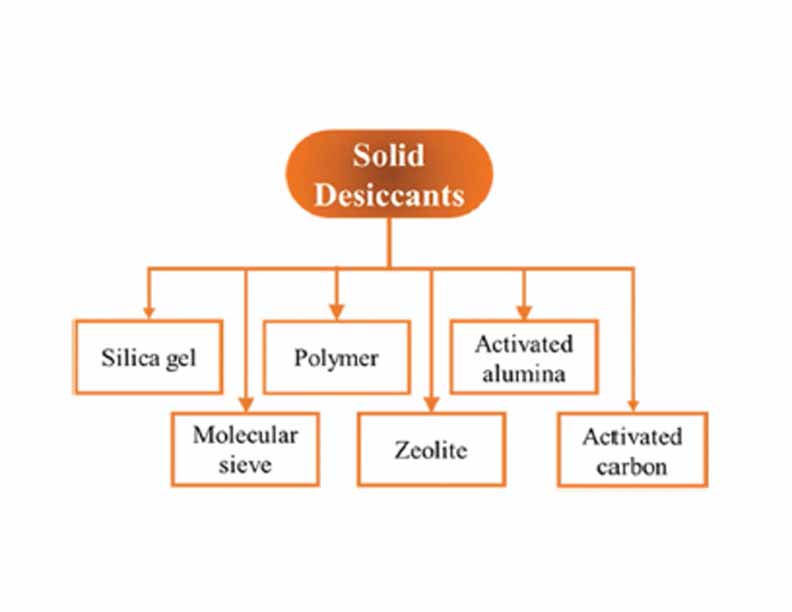
Many factors influence the choice of desiccant, including low cost, low regeneration temperature, high water vapour adsorption rate, and good stability after several years of use. In general, solid desiccants used for air dehumidification are divided into six types as shown in Fig. 2.
Among available above all desiccants, silica gel is the most widely used choice for drying applications. However, the use of superabsorbent polymers in the drying remains rare. It represents a research gap that future researchers could explore. A series of findings reported by previous researchers indicates that dehumidification drying systems can dry under lower conditions than other drying methods, such as hot-air drying.
Interestingly, dehumidification systems can minimize degradation of active compounds and even increase concentrations of active ingredients during vegetable drying. Like other unit operations, the drying of vegetables and fruits using a dehumidification drying system is influenced by many factors, such as the type of desiccant, temperature, air flow rate, material thickness, and the amount of desiccant.
All of these parameters affect drying time and rate differently. Because the primary goal of a dehumidification drying system is to reduce moisture content while maintaining active compounds, compromises are necessary in the operating conditions used. Therefore, optimizing drying operating conditions can help determine the best drying conditions.
Furthermore, existing studies still focus on the influence of drying operating conditions on final quality of dried vegetables and fruits by employing solid desiccant-based dehumidification system. In contrast, fundamental aspects such as drying mechanisms, kinetics, and mass transfer phenomena have not been fully explored. This is an interesting research topic for future studies to gain a comprehensive understanding of herbal drying using this innovative system. Particularly, kinetic modelling is important for predicting drying times and for scaling up drying equipment to the industrial level.
Finally, another aspect worth considering is the use of renewable energy to heat the drying air. This renewable energy can be used entirely or in combination with conventional energy. Another approach is the reuse of waste heat in the drying system to support environmental sustainability and reduce the carbon footprint, particularly in industrial-scale drying units.
Various types of desiccants have been applied, with silica gel being the most commonly used material due to its high adsorption capacity, good dehumidification efficiency, and ease of regeneration. Operating parameters, such as drying air temperature, flow rate, desiccant mass, and material thickness, have been shown to influence drying rate and efficiency.
Conclusions
This study described the use of stratified LD thermal energy storage for building dehumidification. Rigid return tubes with a bend were used to facilitate stratification within the LD tank. By maintaining high stratification, LD storage can maximize the chemical energy within the desiccant solution.
The LD storage tank successfully maintained stratification and storage capacity over a specific period. LD based energy storage systems benefit from the use of liquid storage materials that can easily be pumped to charge and discharge the system. In this manner stratified LD energy storage systems are expected to have lower costs associated with thermal power delivery than solid PCM or thermo-chemical-based storage technologies.
Another advantage of liquid based thermal energy storage materials is that internal heat exchangers displace volume and reduce the energy storage density of solid thermal energy storage materials.
Future Scope
Future studies can explore alternative stratification methods to further increase the energy density of the stratified storage tank. The stratified tank model can also be coupled with detailed absorber and vapour compression system models to evaluate how system arrangements and other design parameters impact the energy density achievable with stratified LD energy storage tanks.
Further, the experiments at higher salt concentrations representative of practical LD dehumidification systems can be performed to quantify potential improvements in stratification characteristics. The selection of the liquid desiccant solution used in the storage device is another design decision that should be evaluated. The investigation of the techno-economic outcomes of using alternative desiccant solutions should include not only energy storage density characteristics but also system material costs to account for varying material cost and compatibility requirements between desiccant formulations.

Dr. (Prof.) D. B. Jani received Ph.D. in Thermal Science (Mechanical Engineering) from Indian Institute of Technology (IIT) Roorkee. Currently he is a recognized Ph.D. Supervisor at Gujarat Technological University (GTU). He has published more than 280 Research Articles in reputed International Conferences and Journals. He has also published 25 reputed books/book chapters and patents in area of thermal engineering. He has been working as an Academic Editor for the Journal of Materials Science Research and Reviews. Presently, he is an Associate Professor at GEC, Bhavnagar, Gujarat Technological University, GTU, Ahmedabad (Education Department, State of Gujarat, India). He has obtained his Master of Engineering in Automobile Engineering from Gujarat University, Ahmedabad, Gujarat. He has more than 26 years of experience in teaching at various institutions at undergraduate and postgraduate/PhD level in mechanical engineering. He is a life member in professional societies and bodies like ISTE, ISHRAE, MTTF, REST, Green ThinkerZ etc. He is a recipient of Best Teacher award (2020), Excellent researcher award (2020), Innovative academician award (2024). His area of research is Desiccant cooling, ANN, TRNSYS, and Exergy.