
According to a report by Mordor Intelligence, the market is projected to reach USD 24.85 billion in 2026 and USD 33.12 billion by 2031, registering a CAGR of 5.91% during 2026-2031. Refrigerated storage, transportation and value-added services form the core of the market, while regional infrastructure gaps and high capital costs remain important considerations.
Storage Leads
Refrigerated storage accounted for 41.24% of the market in 2025, making it the largest service segment. Potato storage accounts for a significant share of traditional capacity, particularly across Uttar Pradesh and Punjab. Demand is also coming from fruits and vegetables, dairy, frozen foods, pharmaceuticals and other temperature-sensitive products.
Value-added services represent a smaller part of the market but are projected to record the fastest growth, with a 5.34% CAGR through 2031. These services include ripening chambers, kitting, blast freezing, packaging and export documentation.
For HVAC&R companies, this creates opportunities across refrigeration systems, cold rooms, insulation, temperature controls, monitoring equipment and energy-management solutions. Facilities handling several product categories also require refrigeration systems capable of maintaining different temperature conditions within the same operation.
Chilled Demand
Frozen facilities accounted for 51.47% of cold-chain capacity in 2025, supported by demand from ice cream, frozen desserts, meat and seafood. Chilled facilities operating between 0°C and 5°C are projected to register the faster growth rate of 6.13% CAGR through 2031.
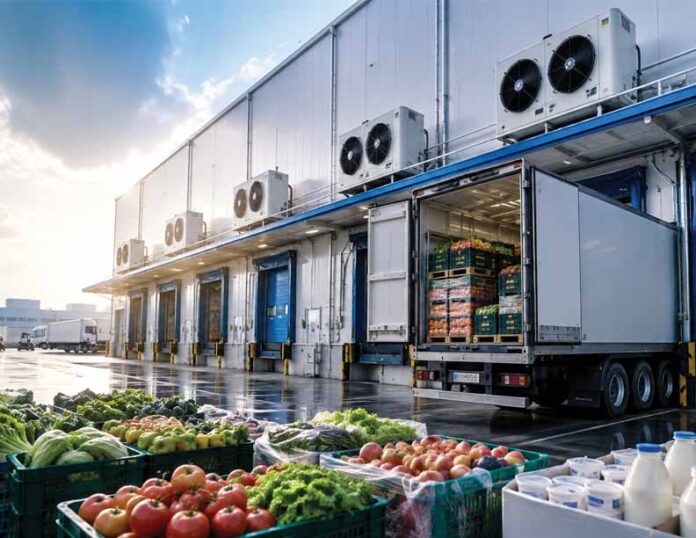
Fresh produce, dairy beverages, ready-to-eat meals and pharmaceutical products are contributing to this demand. Horticulture presents a substantial application area. Fruits and vegetables require temperature management at several stages, including collection, pre-cooling, storage, transportation and distribution. Better integration between these stages can help maintain quality and extend market reach.
The requirement also extends to premium produce, fresh-cut vegetables, berries and other products that require controlled conditions during handling and distribution.
Pharma Gains
Pharmaceuticals and biologics are expected to record the highest growth among the major application segments, with a 6.20% CAGR through 2031. Vaccine manufacturing, pharmaceutical exports and biologics production are supporting the requirement for specialised temperature-controlled logistics.
Pharmaceutical cold chains require validated transportation, continuous temperature monitoring, data logging and traceability. These requirements place greater emphasis on system reliability and operational control.
The market opportunity therefore covers specialised cold rooms as well as refrigerated vehicles, monitoring systems, data loggers, sensors and digital platforms. Facilities serving pharmaceutical customers also require dependable backup power and documented temperature performance.
Retail Drives Demand
Organised retail and frozen FMCG distribution are generating additional requirements for cold-chain infrastructure. Packaged-food sales are projected to rise from USD 122.7 billion in FY2024 to nearly USD 206.3 billion by FY2029, according to the market study. Frozen ready-to-eat meals are also showing strong growth.
Quick-commerce platforms are adding another requirement: cold storage close to urban consumers. Chilled and frozen products are being handled through dark stores and smaller fulfilment centres, creating demand for compact cold rooms and refrigerated last-mile transportation.
Short delivery windows also place greater importance on temperature monitoring. IoT-enabled systems can provide continuous visibility across storage and transportation, helping operators identify temperature deviations and maintain records.
Energy Matters
Energy consumption remains a major factor in cold-chain economics. Electricity can account for 30-40% of operating costs for cold-storage facilities, making refrigeration efficiency an important consideration for new projects.
High capital expenditure presents another challenge. Multipurpose cold-storage facilities require investment in insulated structures, refrigeration equipment, electrical systems, material handling and backup power. Refrigerated transportation also requires significant investment in specialised vehicles.
Energy-efficient compressors, improved insulation, automation and rooftop solar can help reduce operating costs. Solar integration has particular relevance for facilities located close to agricultural production areas, where grid availability and electricity costs can influence project viability.
Regional Growth
West India accounted for 22.78% of market revenue in 2025, supported by industrial activity, ports, food processing and pharmaceutical manufacturing. Maharashtra and Gujarat remain important markets because of their logistics infrastructure and access to major consumption and export centres.
East India is projected to register the fastest regional growth, with a 6.01% CAGR between 2026 and 2031. Port development, improving road connectivity and investment in warehousing are supporting the region.
Central India and parts of the Northeast continue to offer significant development potential. Cold-storage infrastructure remains concentrated across a limited number of states, creating opportunities for facilities closer to agricultural production centres and emerging consumption markets.
A hub-and-spoke model can support this expansion by connecting larger regional cold stores with smaller collection and distribution facilities.
Technology Builds
Digital technology is becoming an important part of cold-chain operations. Temperature sensors, GPS tracking, automated controls, IoT platforms and digital documentation can provide visibility across storage and transportation.
Route and load planning can also improve vehicle utilisation, while remote monitoring allows operators to track equipment performance and temperature conditions without depending entirely on physical inspections.
The HVAC&R industry stands to benefit from this technology adoption. Refrigeration equipment, controls, sensors and energy-management systems can be integrated into a single operating platform, giving facility operators better control over energy consumption and product conditions.
Market Opportunity
India’s cold chain market presents opportunities across storage, transportation and specialised services. Dairy and frozen desserts accounted for 23.89% of market value in 2025, while pharmaceuticals and biologics are recording the strongest projected growth. Fruits and vegetables, meat, seafood, bakery products and ready-to-eat meals add further demand across the temperature-controlled supply chain.
The market also remains fragmented. The study identifies Snowman Logistics, ColdEx Logistics, TCI Express, DHL Supply Chain India and Mahindra Logistics among the leading companies. The presence of regional operators leaves room for specialised providers across different geographies and applications.
Investment opportunities extend beyond conventional cold storage. Multi-temperature facilities, refrigerated transportation, pharmaceutical-grade infrastructure, automated warehouses, IoT monitoring and energy-efficient refrigeration offer several avenues for market participation.
For horticulture, the impact can be particularly significant. Better temperature-controlled infrastructure can support produce quality, improve access to distant markets and strengthen the link between agricultural production and organised distribution.
With the market projected to reach USD 33.12 billion by 2031, cold-chain infrastructure represents a sizeable opportunity for the HVAC&R industry. The strongest growth areas are likely to emerge where refrigeration, logistics, digital monitoring and energy efficiency come together to meet the requirements of India’s expanding temperature-sensitive supply chains.
For more info: https://shorturl.at/LK3q8