

The global environmental problem is a serious worldwide issue. The depleting conventional energy resources are other major issues that are threat to the developing world. The world population is increasing day by day. The human demand for better and comfortable condition is getting exponential rise. Urbanisation is happening around the world. Industrialisation is taking place in every part of the world.
The above problems are complex as there are many parameters and considerations to be deeply looked into. These situations have become globally political, economic, and technological issues that are concern to everyone in this planet. Hand in hand solutions for these problems are a must to attain a common goal. Hence these issues of energy, environment, and technology are interrelated to each other and must be treated with interconnectivity – if we have to attain clean and greener environmental conditions for humanity’s survival.
The technological innovation is needed for better future and sustainable energy systems. From this, greenhouse gases emission such as CO2 can be reduced or maintained. This will involve both political and technological will in tackling the issue of carbon-based energy sources.
For example, developed countries have cut the carbon dioxide emission by 27% in less than 10 years, despite increasing overall energy consumption. The present environmental condition is complex due to the problems of greenhouse gases emission, ozone layer depleting substances, particulate matters in the air, heavy metals, air borne chemical and biological contents due to industrialisation.
Furthermore, are the increasing greenhouse gases in the air. These large-scale emissions of gases and matters in the air due to human activities have detrimental effects to human health – and to the civilization’s sustainability. In the case of air particulate matter such as biological and chemical compounds, they cause human health hazard directly.
Studies show that the global warming and climate change are really due to the large amount of greenhouse gases present in the atmosphere by use of conventionally used vapour compression based air conditioners. Since the start of industrial revolution, large amounts of greenhouse gases were deposited in the atmosphere. Hence, the increase of global pollutants is due to human activities (urbanisation, industrialisation, and others).
Greenhouse gases are the primary cause of global warming. The ozone layer depleting substance is the cause of ozone layer thinning. Hence, all of these have consequences to the increase of global temperature that has serious effect to climate pattern–flooding, cyclones, and other weather disturbances in major part of the world.
The above situation has serious effect to global sustainability as concluded by numerous modern environmental studies, which have been carried out by different researchers in many parts of the world. With this aim, alternative approach is needed in confronting massive energy consumption and, large scale greenhouse and pollutant gases emissions in the environment.
Alternative approach, such as utilisation of alternative energy resources, is one of the most prospects. Development of efficient and clean or green technologies solves the issue of large gases emissions (greenhouse gases and ozone layer depleting substances). Policies on energy conservation and environmental protections such as use of renewable energy or industrial waste heat etc., portfolios are one of the best startup for tackling this global problem.
As building air conditioning sector is one of the primary energy consumers accounted to more than 60% inclusive of commercial and industrial buildings. The sector energy consumption is used to support electrical appliances, thermal comfort produced by use of traditional air conditioners and others such as lighting.
As global population grows, urbanisation is taking place, and standard of living becoming higher, it is expected that the building sector energy consumption will increase furthermore. The past study showed that population size and age structure have effect on energy consumption in buildings in residential or industrial applications. The sector electric energy consumption will increase by 122% from 2002 to 2030.
Innovations in desiccant assisted HVAC technologies
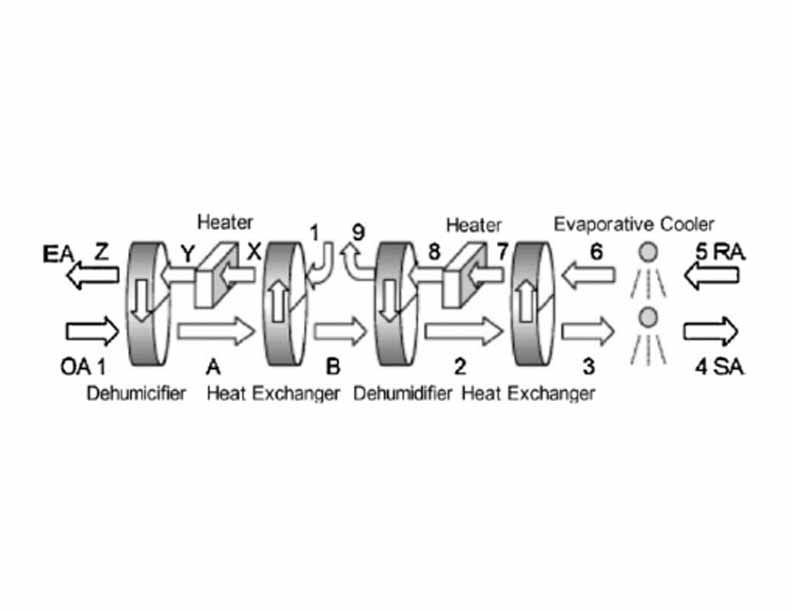
In the two-stage dehumidification process, two desiccant wheels are employed (Fig. 1). The main purpose of the double stage dehumidification is to reduce the air moisture content in the case of humid air with lower regeneration temperature requirements. It shows it has lower regeneration temperature requirements with higher COP. It depicted that the four-wheel cycles (two desiccant wheels and two heat wheel) can be used for the hot and humid climatic condition. In addition, the 3-wheel cycle (desiccant wheel, 1 heat wheel and 1 total heat exchanger) is better than the 4- wheel cycle.
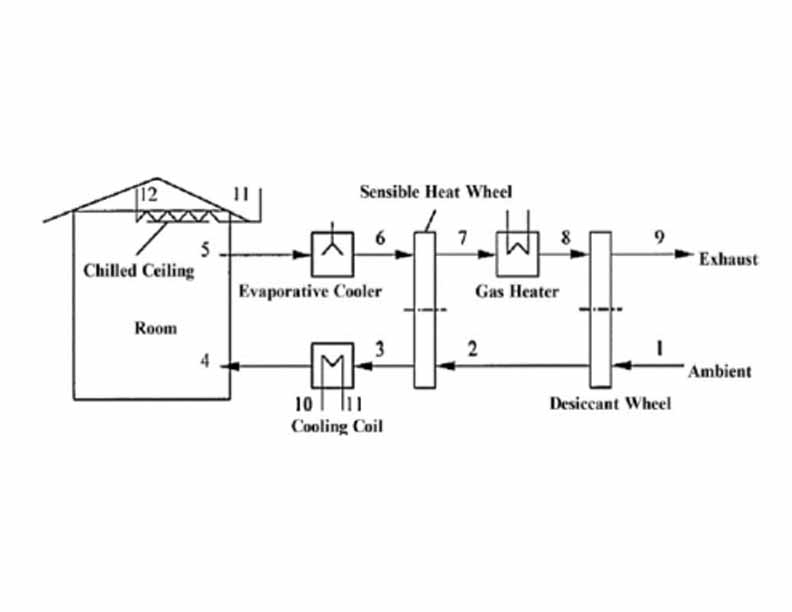
The desiccant cooling system is highly energy efficient, it can supply the required fresh air to the building resulting to the good indoor air quality and ventilation effectiveness. The application of the desiccant dehumidification is integrated with chilled ceiling and displacement ventilation. It shows it is feasible to be applied in the hot and humid climate due to its capability to respond consistently to cooling demand. In addition, it reduces building energy consumption to 87.2% compared to conventional systems. The main application of the desiccant assisted dehumidification by desiccant wheel with chilled ceiling (Fig. 2). The aim of the installation is for the desiccant to reduce the air moisture content and thus avoid the condensation of moisture in the ceiling panel and at the same time cool the air by means of the chilled-ceiling for space cooling purpose.
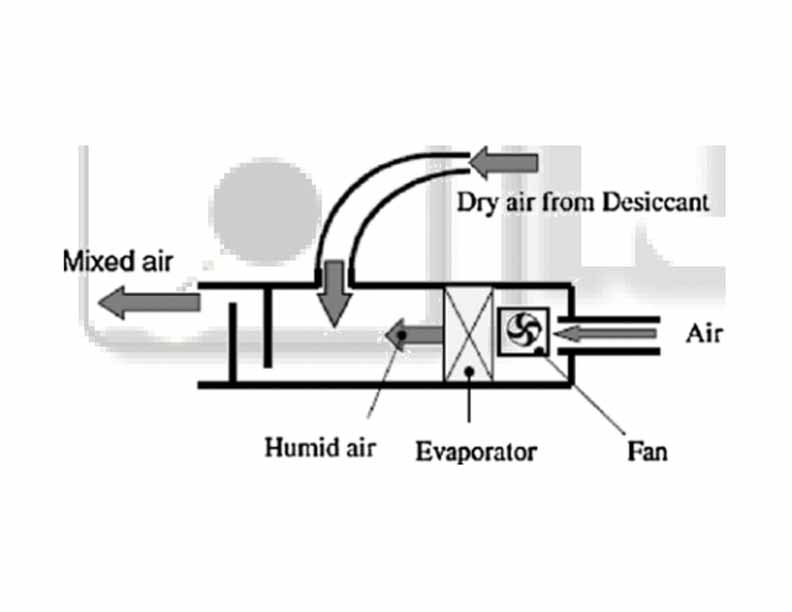
Another application of the solid desiccant wheel in the automobile air-conditioning system is shown in Fig. 3. It shows that the system is energy efficient compared to the conventional vapour compression based automobile air-conditioning system. One of the problems encountered is the difficult control of the air humidity and temperature due to the heat exchange and coolant flow to the evaporator.
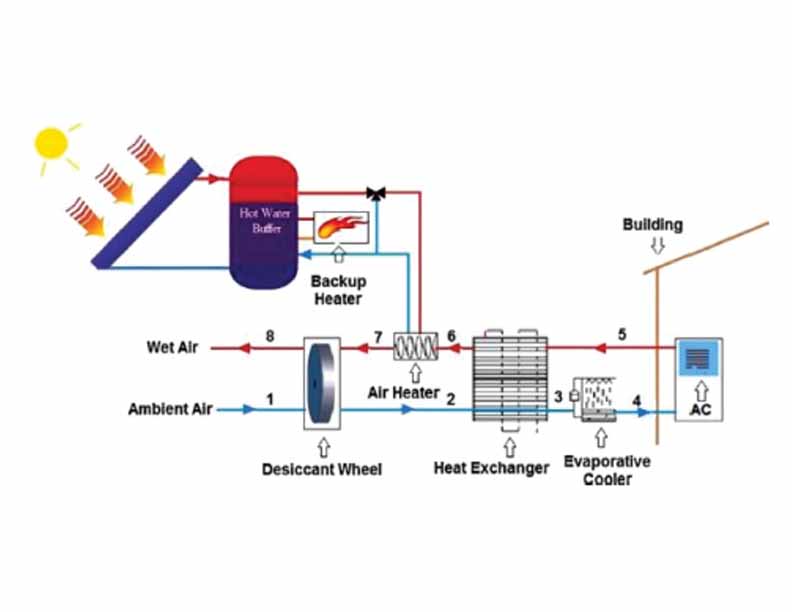
A single-stage solar powered hybrid desiccant cooling system has been shown in the schematic diagram in Fig. 4. The system mainly consists of a desiccant wheel, a heat exchanger, an evaporative cooler, flat plate solar collector, two backup heaters, and a vapour compression cooling unit. The cooling load for the building was with a maximum during the summer period will have at the same time for cooling available.
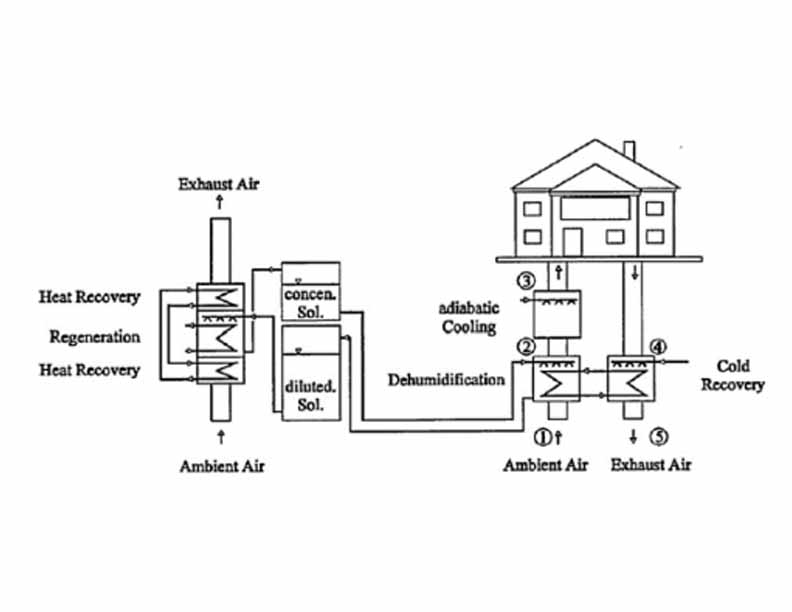
The application of liquid desiccant cooling in thermal storage is shown in Fig. 5. The important factors for efficient absorption process are the inlet concentration of the liquid desiccant and the temperature during the absorption process. For a high energy storage capacity, high ratio of air to solution is required to achieve great difference between the solution inlet and outlet concentration ratio.
Conclusions
The desiccant assisted innovative HVAC cooling is a novel space cooling technique in built cooling environment – and is a promising alternative to traditionally used vapour compression-based cooling, especially in hot and humid climatic conditions for efficiently controlling of indoor moisture – but less familiar as compared to that of the traditional cooling systems in market.
Desiccant cooling advances and Montreal Protocol developments that phase out the use of some fluorocarbons offer alternatives to traditional air conditioning systems. The future requirements for desiccant cooling and the demand for desiccant material that regenerates near ambient conditions lead to the development— should be influenced by rising electrical energy costs, environmental concerns, and legislative requirements.

Dr. (Prof.) D. B. Jani received Ph.D. in Thermal Science (Mechanical Engineering) from Indian Institute of Technology (IIT) Roorkee. Currently he is a recognized Ph.D. Supervisor at Gujarat Technological University (GTU). He has published more than 280 Research Articles in reputed International Conferences and Journals. He has also published 25 reputed books/book chapters and patents in area of thermal engineering. He has been working as an Academic Editor for the Journal of Materials Science Research and Reviews. Presently, he is an Associate Professor at GEC, Bhavnagar, Gujarat Technological University, GTU, Ahmedabad (Education Department, State of Gujarat, India). He has obtained his Master of Engineering in Automobile Engineering from Gujarat University, Ahmedabad, Gujarat. He has more than 26 years of experience in teaching at various institutions at undergraduate and postgraduate/PhD level in mechanical engineering. He is a life member in professional societies and bodies like ISTE, ISHRAE, MTTF, REST, Green ThinkerZ etc. He is a recipient of Best Teacher award (2020), Excellent researcher award (2020), Innovative academician award (2024). His area of research is Desiccant cooling, ANN, TRNSYS, and Exergy.