
Heating, ventilation, air conditioning, and refrigeration – collectively known across the industry as HVAC&R – has quietly become one of the most consequential technology sectors of the twenty-first century. It sits at the intersection of three of the defining pressures of our time: the relentless rise in global cooling demand driven by climate change, the urgent need to decarbonize the built environment, and the broader wave of digital transformation sweeping through industrial equipment and services. In India and across global markets, HVAC&R is no longer a back-of-house utility. It is increasingly a strategic differentiator for building owners, a compliance obligation for regulators, and a frontier for engineering innovation.
This article traces the evolution of HVAC&R technology from its earliest mechanical origins to today’s connected, AI-assisted systems, examines the modern technologies reshaping the industry, explores the often-overlooked service economy that keeps these systems running, and considers the challenges and trends likely to define the sector through 2035.
The Evolution of HVAC&R Technology
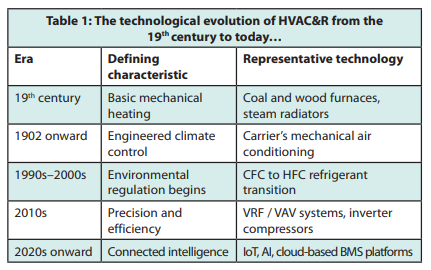
The story of modern climate control begins, in a meaningful sense, in the nineteenth century with rudimentary heating systems – coal- and wood-fired furnaces, steam radiators, and the earliest forms of forced-air heating that allowed buildings to maintain livable temperatures independent of the weather outside. But the true inflection point for the industry arrived in 1902, when engineer Willis Carrier designed the first modern mechanical air conditioning system to control humidity at a Brooklyn printing plant. Carrier’s invention did more than cool air – it introduced the principle of precise, engineered control over an indoor environment, a concept that would eventually expand from factories and printing presses to offices, hospitals, data centres, and homes across the world.
For much of the twentieth century, the pace of innovation in HVAC&R was steady but unspectacular: better compressors, more reliable ductwork, and the gradual electrification of heating and cooling. The real transformation began in the last two decades, driven by three converging forces. The first was energy efficiency – as energy costs rose and climate awareness grew, regulators and consumers alike began demanding systems that delivered the same comfort using a fraction of the power. The second was environmental regulation, particularly around the refrigerants used inside these systems. The third was digitalization, which brought sensors, connectivity, and intelligence into equipment that had previously operated as simple, dumb machines.
Key milestones in the modern era
- The phased transition from ozone-depleting ChloroFluoroCarbons (CFCs) to HydroFluoroCarbons (HFCs), and now to low global-warming-potential refrigerants such as R-32, R-454B, and R-290, reflects a sustained, decades-long effort to decouple cooling comfort from environmental harm.
- The rise of Variable Refrigerant Flow (VRF) and Variable Air Volume (VAV) systems gave building engineers far greater precision in matching cooling output to actual demand across different zones of a building, rather than running entire systems at fixed capacity.
- The integration of Internet of Things (IoT) sensors, artificial intelligence, and cloud-based control platforms turned HVAC&R equipment from isolated mechanical assets into networked, data-generating nodes within a broader smart building ecosystem.
Together, these milestones mark a shift in how the industry defines performance. Where HVAC&R was once judged purely on its ability to heat or cool a space, it is now judged on efficiency, environmental footprint, controllability, and its contribution to a building’s overall intelligence.
Modern Technologies Shaping HVAC&R
Today’s HVAC&R landscape is defined by four interlocking technology categories: smart and connected systems, energy efficiency innovations, sustainable refrigerants, and air quality technologies. Each addresses a distinct pressure facing building owners and facility managers, yet increasingly they overlap and reinforce one another.
Smart and connected systems
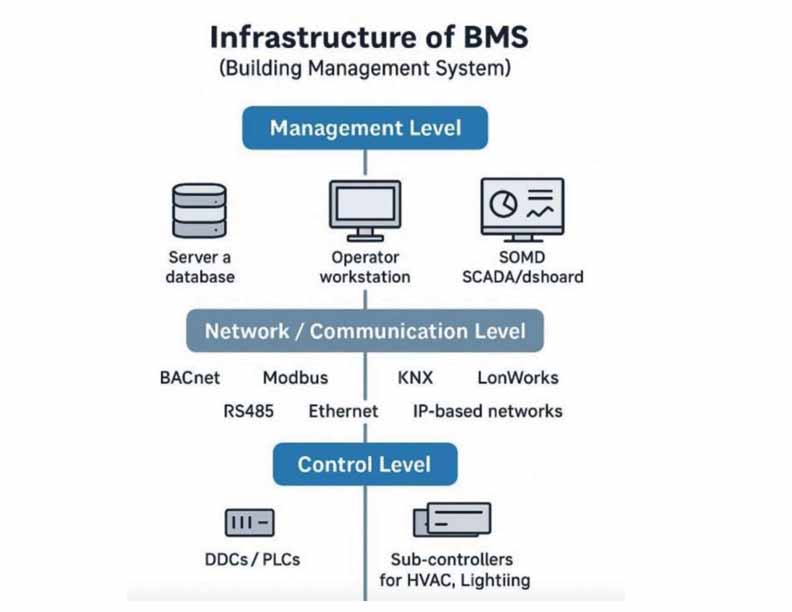
Building Management Systems (BMS), now almost universally IoT-enabled, allow facility operators to monitor temperature, humidity, airflow, and equipment health in real time from a single dashboard, often accessible remotely from a smartphone or laptop. This visibility alone has transformed facility operations, replacing periodic manual inspections with continuous, data-driven oversight.
Perhaps the most commercially significant advance within this category is AI-powered predictive maintenance. By embedding sensors that track vibration, temperature, current draw, and acoustic signatures within compressors, fans, and motors, modern systems can detect the subtle precursors of mechanical failure – a bearing beginning to wear, a refrigerant leak developing, a filter approaching saturation – long before a breakdown occurs. Industry data suggests that predictive maintenance programs can reduce unplanned downtime by 30 to 50% compared to traditional reactive or calendar-based maintenance schedules, a meaningful figure for facilities such as hospitals and data centres where any cooling failure carries severe consequences.
A related and rapidly growing capability is the digital twin: a virtual, continuously updated replica of a physical HVAC system that allows engineers to simulate the effects of a design change, a control adjustment, or an unusual operating condition before applying it to the real equipment. Digital twins are increasingly used not just for troubleshooting but for ongoing optimization, allowing operators to test efficiency improvements virtually before committing capital or risking system disruption.
Energy Efficiency Technologies
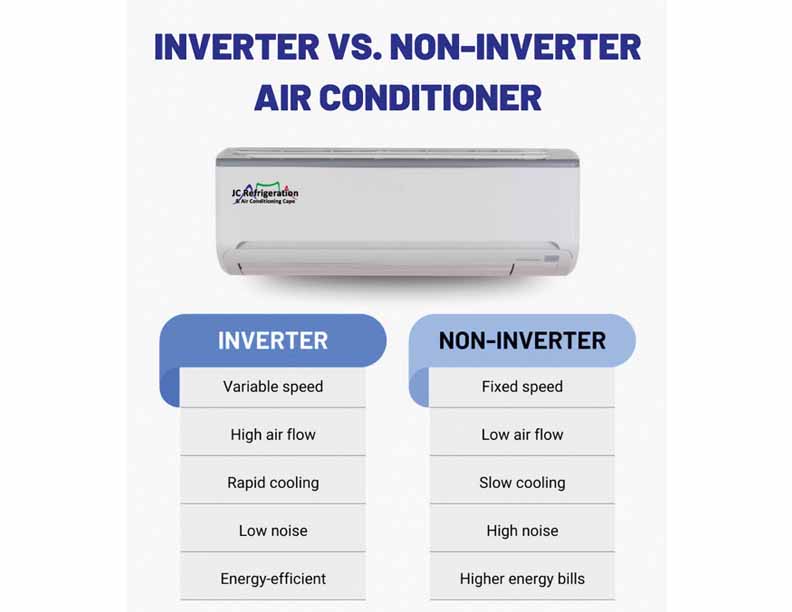
Inverter technology, which allows compressors and fans to vary their speed continuously rather than cycling abruptly between fully on and fully off, has moved from a premium feature to an industry standard. By matching output more precisely to actual cooling or heating demand, inverter-driven systems typically reduce energy consumption by 30 to 40% relative to fixed-speed equivalents, while also reducing the mechanical wear associated with frequent start-stop cycling.
Heat recovery systems – Energy Recovery Ventilators (ERVs) and Heat Recovery Ventilators (HRVs) – capture the thermal energy or coolness in exhaust air before it is expelled from a building and use it to pre-condition incoming fresh air. This single mechanism can meaningfully reduce the energy penalty associated with ventilation, which is otherwise one of the largest sources of HVAC energy loss in tightly sealed modern buildings.
Geothermal heat pumps and air-source heat pumps continue to gain traction as alternatives to conventional combustion-based heating, exploiting the relatively stable temperature of the ground or ambient air to deliver heating and cooling with markedly higher efficiency than traditional boilers or electric resistance heaters. Finally, demand-controlled ventilation, which uses carbon dioxide and occupancy sensors to adjust fresh-air intake based on actual room occupancy rather than fixed schedules, prevents the common inefficiency of over-ventilating empty spaces.
Sustainable Refrigerants and Decarbonization
Refrigerant choice has become one of the most consequential decisions in HVAC&R design, both environmentally and commercially. The Kigali Amendment to the Montreal Protocol, which came into force to phase down high global-warming-potential HFCs, has placed sustained regulatory pressure on manufacturers and building owners to transition toward lower-impact alternatives. This has accelerated interest in natural refrigerants – carbon dioxide (R-744), propane (R-290), and ammonia (R-717) – which, despite requiring careful engineering around flammability or pressure characteristics, offer dramatically lower environmental impact and are increasingly adopted in commercial refrigeration, industrial cooling, and select air conditioning applications.
Air Quality Technologies
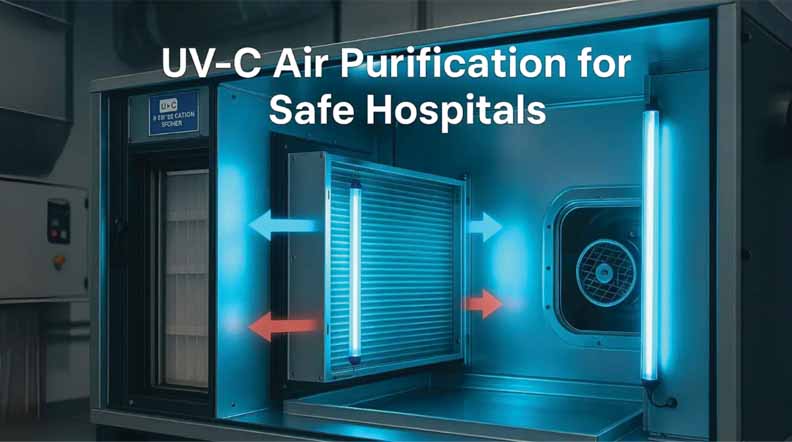
The COVID-19 pandemic permanently elevated indoor air quality from a peripheral concern to a central design consideration. High-Efficiency Particulate Air (HEPA) filtration, combined with Ultraviolet Germicidal Irradiation (UVGI) and photocatalytic oxidation, is now commonly specified in hospitals, schools, and commercial offices to reduce airborne pathogen transmission. Electrostatic precipitators and wet scrubbers continue to play an essential role in commercial kitchens and healthcare facilities, where grease, particulate, and odour control are critical.
Meanwhile, real-time indoor air quality monitoring – tracking PM2.5 particulate matter, Volatile Organic Compounds (VOCs), and carbon dioxide concentrations – has moved from a specialized application into a standard feature of modern building management platforms, giving occupants and facility managers continuous visibility into the air they breathe.
The Service Side of HVAC&R: Beyond Installation
It is tempting to view HVAC&R purely through the lens of equipment and technology, but a substantial share of the industry’s revenue, customer relationships, and long-term value is generated not at the point of installation but throughout the operational life of a system. Maintenance, monitoring, and performance assurance have evolved into a sophisticated service discipline in their own right.
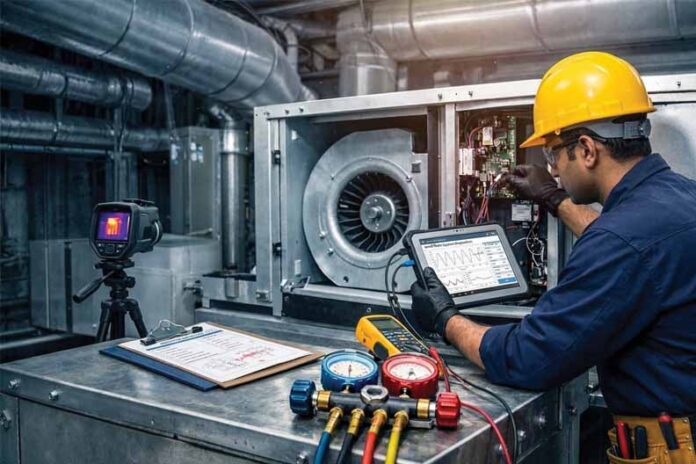
- Predictive and condition-based maintenance now draws on vibration analysis, infrared thermography, and continuous IoT sensor data to identify developing faults well before they manifest as breakdowns, allowing service providers to schedule interventions proactively rather than reactively.
- Remote monitoring centres operating around the clock have become standard for critical facilities such as hospitals, data centres, and pharmaceutical manufacturing sites, where any unplanned cooling interruption carries outsized operational or safety risk.
- Performance contracting and Energy Savings Performance Contracts (ESPCs) represent a structural shift in how HVAC&R services are commercially packaged: rather than simply billing for parts and labour, service providers contractually guarantee a defined level of energy savings, aligning their financial incentives directly with the customer’s operating costs.
- Annual Maintenance Contracts (AMCs), increasingly supported by digitized checklists and mobile field-service applications, have replaced paper-based maintenance logs with transparent, auditable records that both the service provider and the client can review in real time.
- Retro-commissioning – the process of re-tuning and optimizing the controls and operation of an older HVAC system without replacing the underlying equipment – has emerged as a cost-effective route to meaningful efficiency gains in existing building stock, particularly relevant in markets like India where a large proportion of commercial buildings were not originally designed with energy efficiency as a primary goal.
This service-oriented evolution reflects a broader maturation of the industry: HVAC&R is increasingly sold and managed as an ongoing outcome – comfort, air quality, energy savings, uptime – rather than as a one-time capital purchase of equipment.
This shift also changes the commercial relationship between manufacturers, service providers, and end customers. Where the traditional model involved a single transactional sale followed by ad-hoc repairs, the emerging model resembles a long-term partnership in which the service provider retains ongoing visibility into equipment performance and is financially motivated to keep it running efficiently for years, not just through the warranty period. For large institutional customers – hospital chains, data centre operators, manufacturing groups – this shift has become a procurement requirement rather than a value-added option, with tenders increasingly specifying remote monitoring, guaranteed response times, and documented energy outcomes as conditions of award.
Challenges Facing the HVAC&R Industry
Despite the pace of innovation, the industry faces a set of structural challenges that will shape its trajectory over the coming decade.
- High initial cost: Advanced systems incorporating inverter technology, heat recovery, low-GWP refrigerants, and smart controls carry a meaningfully higher upfront cost than conventional equipment, creating an adoption barrier for price-sensitive customers even when the lifecycle economics favour the advanced option.
- Skilled labour shortage: Modern HVAC&R technicians must now be conversant not only in traditional refrigeration mechanics but also in electronics, networked controls, and an expanding range of refrigerant chemistries, each with distinct handling and safety requirements. Training pipelines in many markets, including India, have not kept pace with this expanding skill requirement.
- Market fragmentation: In India particularly, the HVAC&R service market remains highly fragmented, with a large number of small, often informally organized contractors operating alongside a smaller number of large, branded service providers. This fragmentation can create inconsistency in service quality and complicate efforts to standardize safety and performance practices across the industry.
- Climate change and rising cooling demand: As global and Indian temperatures rise, cooling demand is increasing at a pace that strains both electricity grids and the installed base of HVAC&R equipment, creating pressure to scale efficient cooling solutions faster than conventional deployment timelines typically allow.
- Regulatory compliance: Minimum Energy Performance Standards (MEPS) and India’s Energy Conservation Building Code (ECBC) impose increasingly stringent efficiency requirements on new and renovated buildings, requiring manufacturers, designers, and contractors to continuously adapt their product and design specifications to remain compliant.
Future Trends: 2026 to 2035
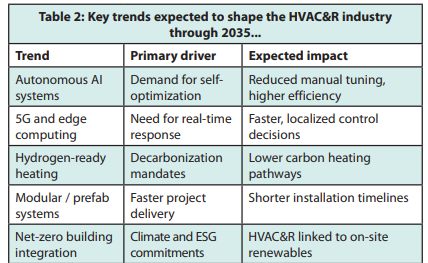
- Looking ahead, several converging trends are likely to define the next decade of HVAC&R innovation.
- AI-driven autonomous HVAC systems capable of self-optimizing their operation in real time, learning from occupancy patterns, weather forecasts, and energy pricing signals without requiring manual recalibration.
- The combination of 5G connectivity and edge computing, enabling ultra-low-latency responses from building systems and supporting increasingly sophisticated, locally processed control algorithms rather than relying solely on centralized cloud computation.
- Hydrogen-ready heating systems and broader electrification of heating, as buildings and industries seek pathways to decarbonize thermal energy use alongside the electricity grid.
- Modular and prefabricated HVAC systems, manufactured and partially assembled off-site, which promise to compress installation timelines and improve quality consistency, particularly valuable in large-scale commercial and infrastructure projects.
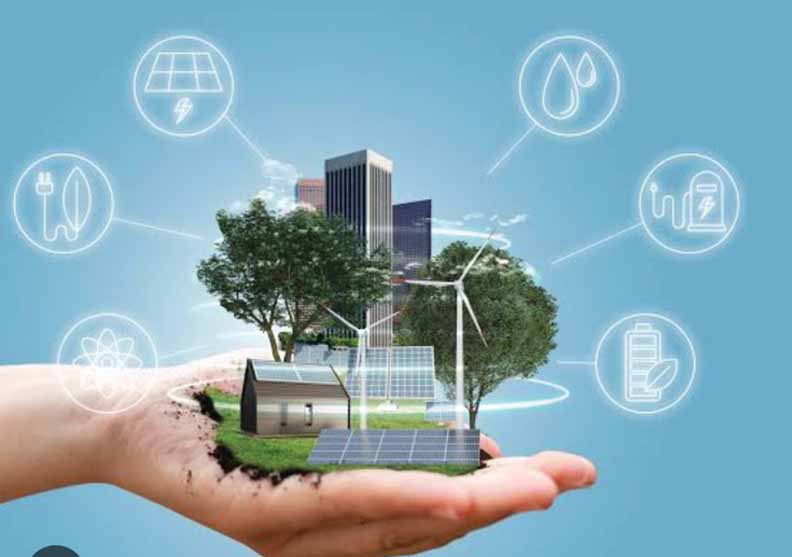
- The mainstreaming of net-zero buildings, where HVAC&R systems are designed from the outset to integrate with on-site renewable energy generation and battery storage, rather than being treated as an isolated mechanical subsystem.
The India Opportunity: Why Does This Market Matter?
India occupies a distinctive position in the global HVAC&R conversation, one that is likely to grow more prominent rather than less over the coming decade. The country’s combination of a hot and humid climate across most of its populated regions, rapid urbanization, an expanding base of commercial and IT office space, and a fast-growing data centre industry has created sustained, structural demand for cooling capacity that shows few signs of slowing.
Unlike mature Western markets, where HVAC&R demand is largely a replacement cycle driven by aging building stock, India’s demand is substantially driven by new construction and rising per-capita affordability of air conditioning. This creates an unusual opportunity: India can, in principle, build its cooling infrastructure with efficient, low-GWP, digitally enabled technology from the outset, rather than retrofitting an existing installed base. Government initiatives such as the India Cooling Action Plan, alongside the broader implementation of ECBC and state-level energy codes, are explicitly designed to steer this new demand toward higher-efficiency outcomes rather than allowing the market to default to the cheapest available equipment.
At the same time, the fragmented nature of India’s service market – described earlier as a challenge – is also an opportunity for consolidation. Organized, well-capitalized service providers that can offer digitized maintenance contracts, predictive monitoring, and performance guarantees are increasingly able to differentiate themselves from the large population of informal, single-technician contractors that have traditionally dominated residential and small-commercial service. As large institutional customers professionalize their procurement processes, this organized segment of the market is likely to capture a disproportionate share of future growth.

Aman Taluja is the Operations Head at Brightflow Engineers Pvt. Ltd. With hands-on experience in executing complex commercial and industrial projects, he specializes in delivering practical, performance-oriented HVAC solutions. At Brightflow, the focus is on the design, manufacturing, and execution of Air Handling Units (AHUs), Air Washers, ventilation systems, and air quality solutions, catering to a wide range of industries including hospitality, manufacturing, healthcare, and infrastructure. Over the years, he has been associated with reputed projects such as Le Méridien Hyderabad, NTPC Dadri, HAL Nashik, and Marriott Amritsar, delivering projects on time, within budget, and with a strong emphasis on quality.