
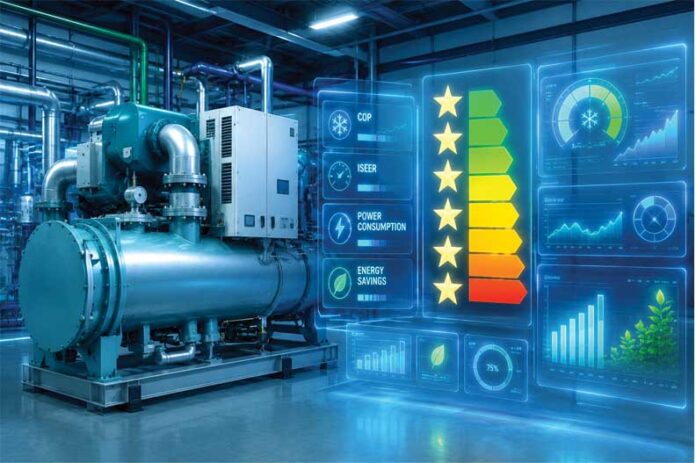
Chillers are widely utilized across commercial, industrial, and institutional sectors for air conditioning and refrigeration. Due to their large-scale operations and extensive operating hours, they account for a significant portion of electricity consumption; within the HVAC sector, chillers are estimated to consume approximately 40% of the total energy used by HVAC plants and HVAC plants consume approximately 60% of the building’s electrical energy. In India, where electricity demand is high and power infrastructure is under pressure, improving the energy efficiency of this equipment is essential to addressing both economic and environmental challenges.
To address this, the ‘Chiller Labelling Program’ was established by the “Bureau of Energy Efficiency” to increase consumer awareness regarding energy-efficient cooling systems and promote the adoption of high-performance equipment. This initiative follows a similar framework to other Indian energy labelling schemes, such as the ‘BEE Star Labelling Program’ for household appliances and lighting. Formulated by the Bureau of Energy Efficiency (BEE) in 2018 under the direction of the Ministry of Power, Government of India, the program assigns star ratings to chillers based on their energy performance. While initially voluntary, as of July 1, 2024, star labelling has become mandatory for all chillers sold in India, regardless of whether they are domestically manufactured or imported.
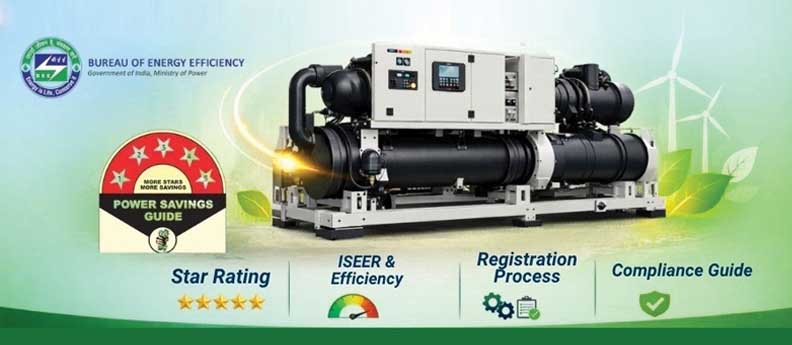
BEE Registration for chillers is an official certification issued under India’s energy conservation framework. It verifies that a specific chiller model complies with the energy efficiency standards established by the Bureau of Energy Efficiency. Upon registration, the product is authorized to display a star rating label denoting its level of efficiency.
This rating system enables businesses and consumers to compare chiller models based on power consumption and cooling performance. Units with higher star ratings demonstrate superior energy efficiency and lower electricity consumption, providing greater long-term cost-effectiveness. Furthermore, this framework incentivizes manufacturers to develop advanced, energy-saving cooling solutions for the Indian market.
The Chiller Star Labelling Program is estimated to save over 500 million units of electricity annually, resulting in a reduction of 0.5 million tons of CO₂ equivalent in greenhouse gas emissions. By 2030, the program is projected to save more than 4 billion units of electricity and reduce CO₂ emissions by 3.5 million tons. By providing transparent energy performance data, the BEE enables consumers to make informed purchasing decisions, thereby reducing operational costs and contributing to India’s national energy-saving goals.
Objective of the Chiller Labelling Program
The key objectives of the Chiller Labelling Program are to:
- Promote Energy Efficiency: Encourage the adoption of high-performance chillers among customers and end-users to reduce overall electricity consumption.
- Provide Transparency: Enable consumers to easily compare chiller models based on energy efficiency, facilitating more cost-effective and sustainable procurement.
- Reduce Greenhouse Gas Emissions: Lower the carbon footprint of the cooling industry by improving overall energy efficiency.
- Enhance Competitiveness: Incentivize manufacturers to innovate in design and technology to meet higher efficiency standards, fostering greater competition in the market.
- Support National Energy Saving Goals: Contribute to India’s energy-saving targets under the Perform, Achieve, and Trade (PAT) scheme and other national energy efficiency initiatives.
BEE Energy Labelling Scope
This scope defines the energy-labelling requirements for vapor-compression cycle chillers manufactured in or imported to India for central cooling and similar applications. It encompasses all types and capacities with rated voltages up to and including 250V, 50Hz AC for single-phase, and up to and including 415V, 50Hz AC for three-phase power supplies, as defined under the IS 16590 standards.
Within this scope, star ratings are determined based on the Indian Seasonal Energy Efficiency Ratio (ISEER), with the full load COP serving as the prequalification criterion. For star labelling, testing, and all other program purposes, the BEE scope shall be read in conjunction with IS 16590: 2023 (Liquid Chilling Package Units—Specifications). This standard was originally published in 2017, with subsequent modifications to the title and content introduced via the first amendment.
This standard applies to all positive-temperature comfort cooling applications ranging from 5°C to 10°C. The following are excluded from this scope:
- Packages with condensing units featuring heat reclaim
- Systems with remote condensing units
- Systems with evaporatively cooled condensers
- Condenser-less chillers
- Heat pumps
- Liquid chilling package units used in process industries
- Defence or marine applications
- Any applications other than comfort cooling within the built environment
Chillers Classification
All vapor compression liquid chilling packages (Chillers) falling within the scope of IS 16590 (including all amendments) and used for space cooling shall be subject to the ‘star labelling program’. This applies to all units manufactured, commercially purchased, imported, or sold in India with a rated voltage up to and including 250V, 50Hz AC for single-phase, and up to and including 415V, 50Hz AC for three-phase power supplies. Liquid chilling packages are classified by their condenser cooling method as follows:
- Air-cooled Chillers: These units utilize air to cool the refrigerant. Typically simpler in design, they are commonly used in smaller applications and primarily employ screw compressors.
- Water-cooled Chillers: These units utilize water to absorb heat from the refrigerant, offering higher efficiency and suitability for large commercial and industrial systems. They typically employ screw compressors for lower capacities and centrifugal compressors for higher capacities.
Standards and Testing Procedure
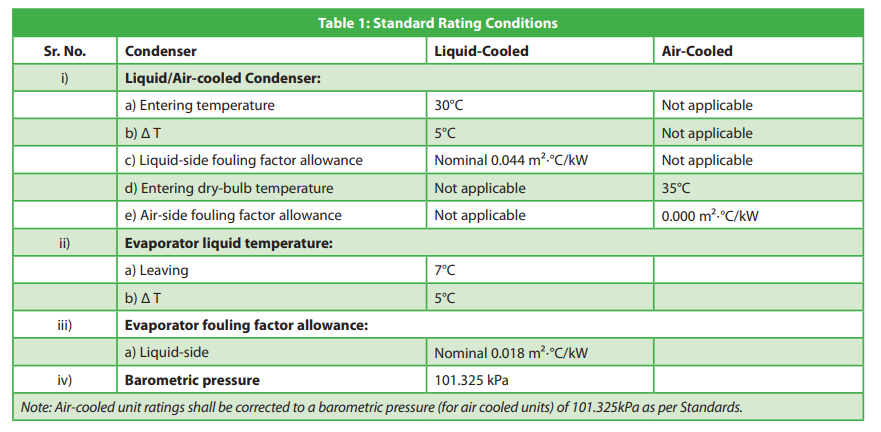
BEE has established performance standards for each chiller category, which manufacturers must meet to qualify for the energy efficiency label. To ensure consistency across different brands and models, these standardized testing procedures evaluate chiller efficiency under specific, controlled conditions. The operating parameters for testing are as follows:
Assessments are typically conducted by accredited laboratories, focusing on key performance indicators that include:
- Energy Efficiency Ratio or Coefficient of Performance: This measures efficiency by comparing cooling capacity against power input; a higher value indicates superior performance.
- Load Conditions: Chillers are evaluated under full load, partial load, and seasonal variations to verify efficiency across various operational environments.
Manufacturers are supposed to submit their products to BEE-approved, NABL, or AHRI certified testing facilities. Upon verification that the products meet the required standards, the corresponding star-rating label is granted based on the unit’s efficiency.
Certification and Quality Standards
BEE Certification for chillers not only focuses on energy efficiency but also ensures compliance with performance and safety standards. These standards guarantee that the equipment operates reliably under different environmental and load conditions.
Key parameters include:
- Coefficient of Performance (COP) and IPLV values
- Power input under full and partial load conditions
- Cooling capacity and efficiency ratio
- Durability and operational stability
- Compliance with Indian and international safety standards
Manufacturers must ensure their chillers meet these requirements before applying for certification. Testing is conducted in BEE-approved laboratories to validate energy performance and safety.
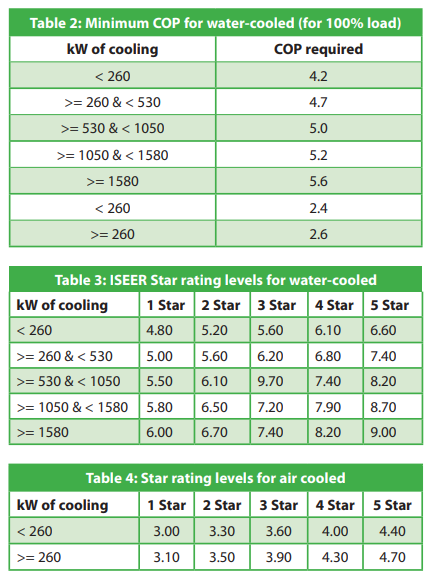
Efficiency Requirement to Get Star Label
Discussions are currently underway between industry representatives and the BEE to revise the efficiency parameters mentioned above; further clarity is expected by early 2026.
Benefits of Star Labelling Program
The Chiller Labelling Program provides several key advantages to various stakeholders:
- Consumers: The program provides transparent information regarding the energy efficiency of chillers. By selecting higher-rated models, consumers can lower their long-term operational costs through reduced energy consumption.
- Manufacturers: The program incentivizes the development of energy-efficient technologies to meet evolving consumer demand, while allowing manufacturers to better differentiate their products in a competitive market.
- Environment: By promoting the adoption of energy-efficient chillers, the program helps reduce overall electricity demand, thereby contributing to a decrease in greenhouse gas emissions from the power sector.
- Economy: Improvements in energy efficiency reduce electricity expenditures for both industrial and residential users, fostering greater overall economic efficiency and cost savings.
Impact and Future Outlook
The BEE program was established to provide transparency for customers by allowing them to compare model performance against the manufacturers’ ISEER documentation. However, this transparency is currently lacking on the BEE portal, where model numbers do not align with those used in the international market. Since its inception, the Chiller Labelling Program has positively impacted India’s energy efficiency landscape by increasing awareness and encouraging the adoption of efficient cooling technologies. As economic growth drives the demand for air conditioning and refrigeration, the need for energy-efficient chillers becomes increasingly critical. The program is expected to expand to include additional equipment types and more stringent standards to further reduce energy consumption and emissions. Moving forward, BEE is expected to refine the program by introducing more advanced performance metrics, ensuring the labelling remains relevant and continues to guide consumers toward the most efficient products on the market.
Conclusion
The BEE Chiller Labelling Program is a cornerstone of India’s energy efficiency initiatives. By incentivizing the adoption of energy-efficient chillers, the program reduces operational costs for businesses and consumers while lowering the nation’s overall energy consumption and environmental impact. Through this initiative, BEE is fostering a sustainable future where energy-efficient cooling technologies become the industry standard.

Y S Rao, the contributor of this article, holds a degree in Mechanical Engineering and has penned several technical books. With a rich background of 28 years in the HVAC field, he has worked both in India and abroad, notably in Bahrain. He has been designated as a Certified Energy Manager by the Bureau of Energy Efficiency and qualified as a Certified Engineering Professional by ISHRAE. In addition to his professional engagements, Mr. Rao has imparted his knowledge and insights through numerous distinguished lectures to various chapters of ISHRAE and AEE Western region focusing on HVAC systems & energy conservation strategies.