
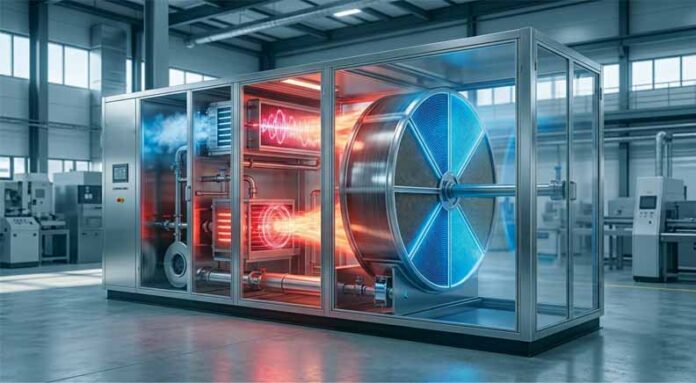
Recent advancements in desiccant regeneration mainly focus on enhancing regeneration effectiveness through solar-assisted heating, heat pump integration, microwave heating, ultrasonic activation, and waste-heat recovery systems etc. These techniques enable lower regeneration temperatures, faster moisture desorption, and improved energy utilization.
By optimizing heat and mass transfer within the desiccant material, advanced regeneration strategies significantly enhance moisture removal capacity and overall drying performance. Integration of renewable and low-grade primary energy sources further reduces dependence on conventional electricity, making the systems environmentally friendly and cost-effective.
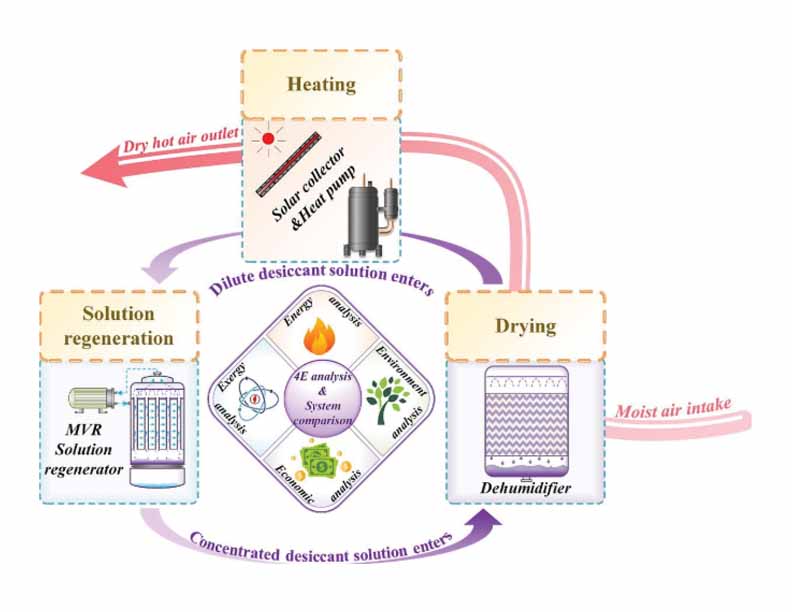
This article highlights the principles, operational benefits, and performance improvements associated with modern regeneration approaches in desiccant-based drying systems. The findings indicate that advanced regeneration technologies offer substantial potential for energy savings, improved system reliability, and wider applicability in industrial and agricultural drying processes.
Foreword
Desiccant-integrated drying systems have emerged as efficient alternatives to conventional high-temperature thermal drying methods, particularly in applications requiring precise moisture control and energy optimization. These systems operate on the principle of adsorption or absorption, where hygroscopic materials remove moisture from process air, thereby enabling controlled drying conditions at relatively low temperatures.
Compared to traditional drying technologies, desiccant-based systems offer improved performance in humid climates, enhanced product quality, and reduced risk of thermal degradation in sensitive materials such as food products, pharmaceuticals, and agricultural commodities. However, the regeneration of desiccant materials remains one of the most critical factors influencing overall system efficiency and operational cost.
Regeneration is the process by which the moisture-laden desiccant is restored to its initial adsorption capacity through the application of heat or other energy sources. Conventional regeneration methods typically rely on high-temperature air generated by fossil fuel-based heaters or electrical resistance systems. These approaches often demand significant energy input, leading to higher operating costs and increased carbon emissions. Additionally, inefficient heat transfer during regeneration can limit system performance and reduce the overall coefficient of performance (COP). Therefore, improving regeneration techniques is essential to enhance the sustainability and competitiveness of desiccant-integrated drying applications.
Recent advancements in regeneration technologies focus on utilizing low-grade and renewable energy sources, such as solar thermal energy, industrial waste heat, heat pump systems, microwave heating, and hybrid energy integration. These advanced methods aim to reduce regeneration temperature requirements, accelerate moisture desorption rates, and improve thermal efficiency. Enhanced heat and mass transfer mechanisms further contribute to better desiccant performance and reduced energy consumption. By integrating innovative regeneration strategies, desiccant drying systems can achieve higher efficiency, lower environmental impact, and improved adaptability across various climatic conditions.
Despite significant progress, challenges remain in optimizing regeneration parameters, selecting suitable desiccant materials, and ensuring system reliability under dynamic operating conditions. Therefore, comprehensive research on advanced regeneration methods is necessary to develop energy-efficient, cost-effective, and sustainable desiccant-integrated drying solutions for modern industrial and environmental applications.
Desiccant Dehumidification Integrated Regeneration and Solar Drying Systems
The hybrid PV/T – assisted desiccant-integrated hot air–infrared (HA-IR) drying system (HPIRD), as shown in Fig. 1, is an advanced energy-efficient drying configuration. The system mainly consists of a PhotoVoltaic Air Collector (PVAC), a Desiccant Silica Gel Bed (DB), and a drying chamber equipped with an infrared heating unit.
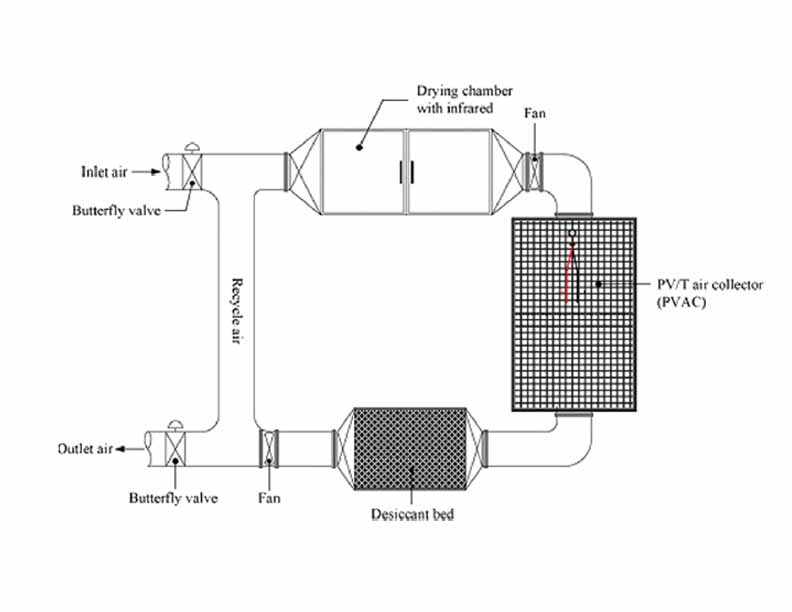
The PVAC performs a dual function: it generates electricity and simultaneously acts as a solar air heater. The produced electricity is utilized to operate the fan and other auxiliary components in the drying chamber, ensuring continuous air circulation.
Two types of PVAC designs were investigated: a single-pass air channel configuration (PVACA) and a modified design incorporating rectangular fins (PVACAF), as illustrated in Fig. 2.
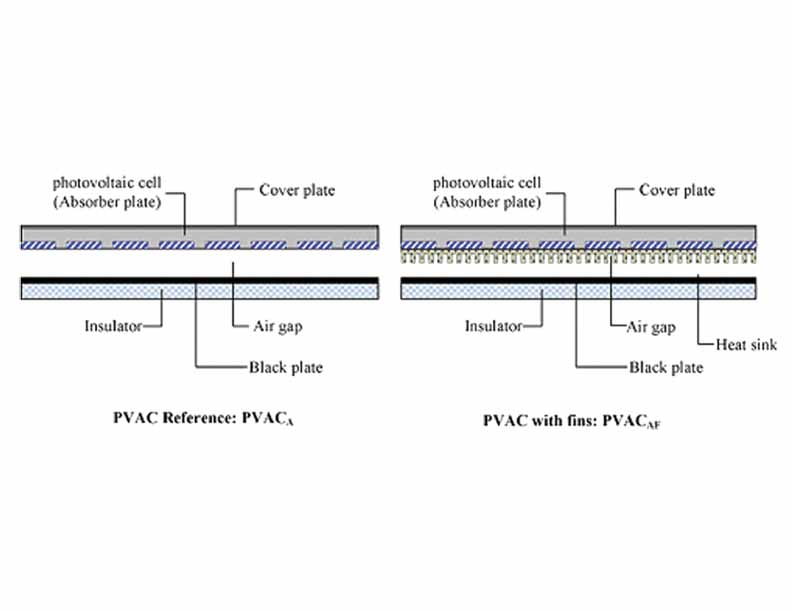
The results demonstrated that the PVACAF system significantly improved both thermal and electrical efficiencies compared to the PVACA system. The presence of fins enhanced the heat transfer rate from the channel wall to the airflow inside the duct, thereby increasing the overall energy utilization and system performance.
The results show that the PVACAF system achieved higher thermal and electrical efficiencies compared to the PVACA configuration. The integration of rectangular fins significantly enhanced heat transfer from the channel walls to the airflow within the duct, thereby improving overall system performance.
Furthermore, the effect of three different Desiccant Bed (DB) shapes on moisture absorption was experimentally investigated (Fig. 3) to evaluate their impact on dehumidification efficiency.
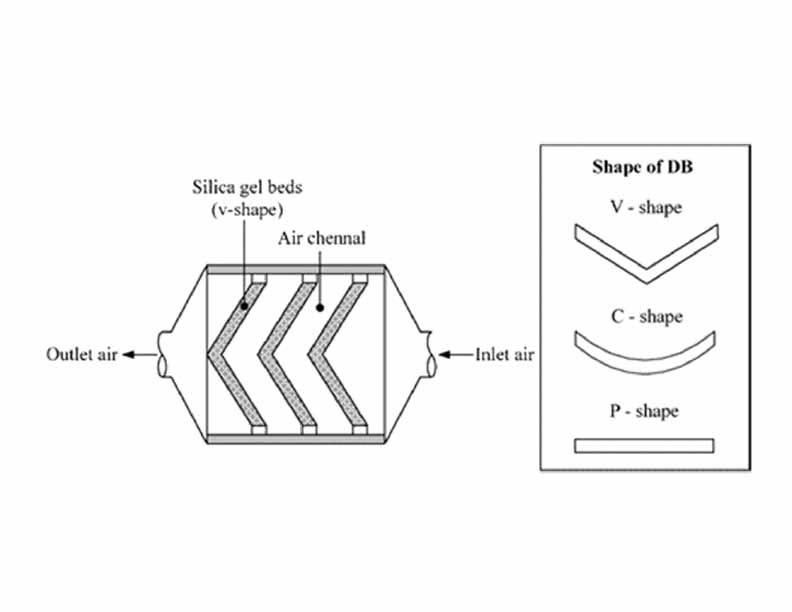
The drying chamber was designed for agricultural product drying using a Hybrid Hot Air–Infrared (HA-IR) approach. A black ceramic Infra-Red (IR) heater was employed as the infrared heat source, while an electrical heater was used to preheat the drying air.
Experimental investigation show reduction in drying time by 44% and consumed 63% less energy compared to conventional hot air drying. Additionally, the hybrid configuration produced superior product quality in comparison to traditional hot air and infrared drying methods.
A Liquid Desiccant-Based Dryer (LDBD) was developed to achieve higher energy efficiency in moisture removal applications. Calcium Chloride (CaCl₂) solution was used as the liquid desiccant due to its strong hygroscopic properties and cost-effectiveness. A specially designed contacting device was employed to enhance mass transfer during both the absorption and regeneration processes.
Compared to conventional packing materials, the surface density of the contacting device was increased by approximately 120% to 185%, significantly improving the contact area and overall heat and mass transfer performance. The regeneration process was implemented in two stages, as illustrated in Fig. 4.
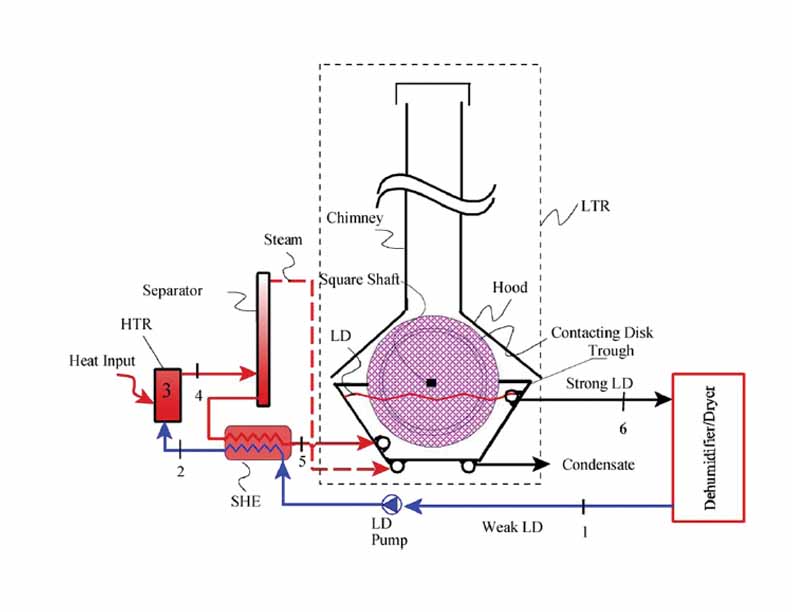
In the first stage, the diluted liquid desiccant was heated using an external heat source and boiled in a High-Temperature Regenerator (HTR). Subsequently, the generated steam and liquid desiccant mixture were separated in a separator unit.
In the second stage, the hot liquid desiccant flowed through a tube to the Low-Temperature Generator (LTR), where condensation occurred. Moisture from the diluted liquid desiccant in the contacting disks was transferred to the air stream due to the vapour pressure difference between the liquid desiccant and the surrounding air, thereby completing the regeneration cycle.
Conclusions
The advanced desiccant drying applications and their regeneration methods have been extensively overviewed. Based on the study, the following conclusions can be drawn: Desiccant-based systems in drying applications offer several advantages, including continuous operation even during off-sunshine hours, increased drying rates due to the supply of hot and dry air, more uniform drying, and improved product quality, particularly for heat-sensitive materials.
Certain challenges in desiccant systems, such as pressure drop in solid desiccant configurations and carryover of liquid desiccant by the air stream, can be minimized through proper system design optimization. Careful design improvements enhance the technical performance and energy-saving potential of desiccant systems.
Regeneration of desiccant materials using conventional heat sources has limitations in terms of energy efficiency. Therefore, desiccant materials requiring lower regeneration temperatures are preferable for improved system performance.
The utilization of solar energy or industrial waste heat for desiccant regeneration can significantly reduce operating costs and enhance system sustainability. The development and application of composite desiccant materials may further improve moisture adsorption capacity and overall drying effectiveness.

Dr. (Prof.) D. B. Jani received Ph.D. in Thermal Science (Mechanical Engineering) from Indian Institute of Technology (IIT) Roorkee. Currently he is a recognized Ph.D. Supervisor at Gujarat Technological University (GTU). He has published more than 280 Research Articles in reputed International Conferences and Journals. He has also published 25 reputed books/book chapters and patents in area of thermal engineering. He has been working as an Academic Editor for the Journal of Materials Science Research and Reviews. Presently, he is an Associate Professor at GEC, Bhavnagar, Gujarat Technological University, GTU, Ahmedabad (Education Department, State of Gujarat, India). He has obtained his Master of Engineering in Automobile Engineering from Gujarat University, Ahmedabad, Gujarat. He has more than 26 years of experience in teaching at various institutions at undergraduate and postgraduate/PhD level in mechanical engineering. He is a life member in professional societies and bodies like ISTE, ISHRAE, MTTF, REST, Green ThinkerZ etc. He is a recipient of Best Teacher award (2020), Excellent researcher award (2020), Innovative academician award (2024). His area of research is Desiccant cooling, ANN, TRNSYS, and Exergy.