
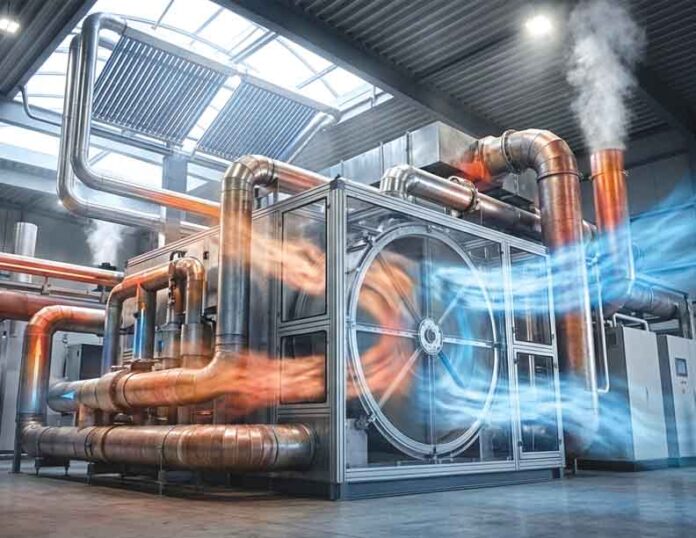
Desiccant cooling is an emerging and energy-efficient air-conditioning technology that addresses both temperature and humidity control in a sustainable manner, making it particularly suitable for hot and humid climates where latent cooling loads dominate conventional HVAC system performance; unlike traditional vapour compression systems that rely heavily on electricity and refrigerants.
The desiccant cooling systems utilise the natural affinity of hygroscopic materials such as silica gel, zeolites, and advanced composites to adsorb moisture from the air, thereby reducing humidity levels before sensible cooling is applied; this separation of latent and sensible cooling processes significantly enhances overall system efficiency and Indoor Air Quality (IAQ) while reducing energy consumption and environmental impact.
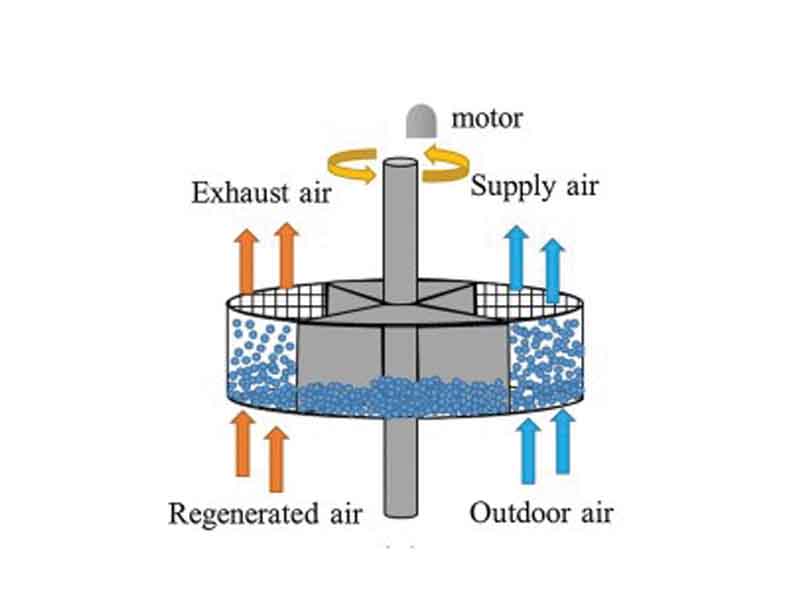
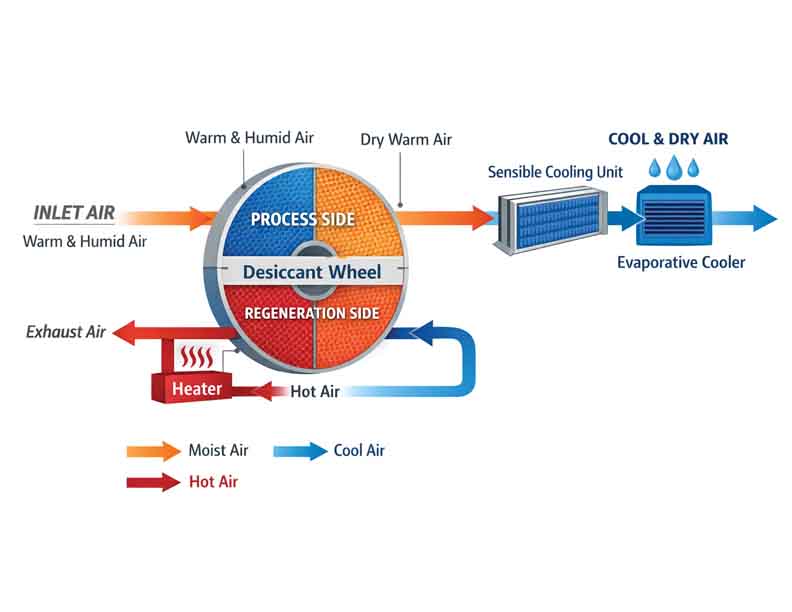
In a typical desiccant cooling system, moist process air is passed through a desiccant wheel or fixed bed where moisture is adsorbed as shown in Fig. 1, resulting in dry but warm air due to the release of adsorption heat, which is then cooled using heat exchangers or evaporative cooling techniques to achieve desired comfort conditions; the desiccant material becomes saturated over time and must be regenerated by passing heated air through it, which drives off the absorbed moisture and restores its drying capacity, enabling continuous cyclic operation. One of the key advantages of desiccant cooling is its ability to operate using low-grade thermal energy sources such as solar heat, waste heat from industrial processes, or exhaust heat from engines, thereby reducing reliance on high-grade electrical energy and making it an attractive option for sustainable building design.
Furthermore, desiccant systems can be effectively integrated with renewable energy technologies and hybrid cooling systems, including evaporative coolers and absorption chillers, to further enhance performance and reduce operational costs.
The technology also plays a vital role in improving indoor air quality by allowing higher ventilation rates without imposing excessive latent loads on the cooling system, which is particularly important in applications such as hospitals, laboratories, pharmaceutical facilities, and commercial buildings where humidity control is critical. In addition, desiccant cooling eliminates or significantly reduces the need for harmful refrigerants that contribute to ozone depletion and global warming, aligning with global environmental regulations and climate change mitigation goals.
The adaptability of desiccant systems to different climatic conditions and their modular design make them suitable for a wide range of applications, from residential buildings to large-scale industrial facilities; recent advancements in desiccant materials, such as metal-organic frameworks and composite desiccants, have further improved adsorption capacity, regeneration efficiency, and durability, thereby overcoming some of the traditional limitations of the technology; despite its numerous advantages, challenges such as initial cost, system complexity, and the need for efficient regeneration methods remain areas of active research and development; ongoing innovations in heat recovery, low-temperature regeneration, and smart control systems are expected to enhance the commercial viability of desiccant cooling systems in the near future.
Overall, desiccant cooling represents a promising pathway toward energy-efficient, environmentally friendly, and high-performance air-conditioning solutions, contributing to sustainable development and improved thermal comfort in modern built environments.
Advanced regeneration methods
Advanced regeneration methods in desiccant cooling systems have emerged as a critical area of research and development aimed at improving energy efficiency, reducing operational costs, and enabling the utilisation of low-grade and renewable heat sources in HVAC applications, particularly in hot and humid climates where latent loads are significant.
The traditional regeneration techniques typically require high-temperature heat input, often in the range of 80–120°C, which limits system efficiency and increases dependence on conventional energy sources, thereby motivating the need for innovative approaches that can regenerate desiccant materials at lower temperatures while maintaining high moisture removal capacity and system performance.
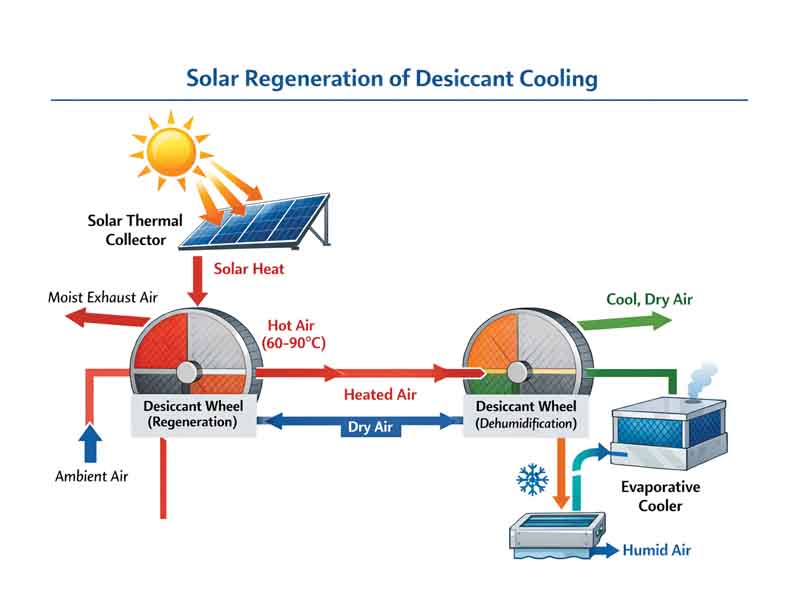
One of the most widely explored advanced methods is solar thermal regeneration, where flat plate collectors, evacuated tube collectors, or concentrating solar collectors are used to provide the necessary heat energy for desorption, allowing systems to operate sustainably with minimal environmental impact and making them particularly attractive for regions with high solar insolation.
In addition to solar energy (Fig. 2), waste heat recovery from industrial processes, power plants, and internal combustion engines is increasingly being utilised as a regeneration heat source, thereby enhancing overall energy utilisation and reducing wastage of thermal energy that would otherwise be dissipated into the environment; another promising technique is heat pump-assisted regeneration, which leverages the ability of heat pumps to upgrade low-temperature heat and reuse it within the system, enabling efficient desorption at relatively low energy input while simultaneously improving system coefficient of performance.
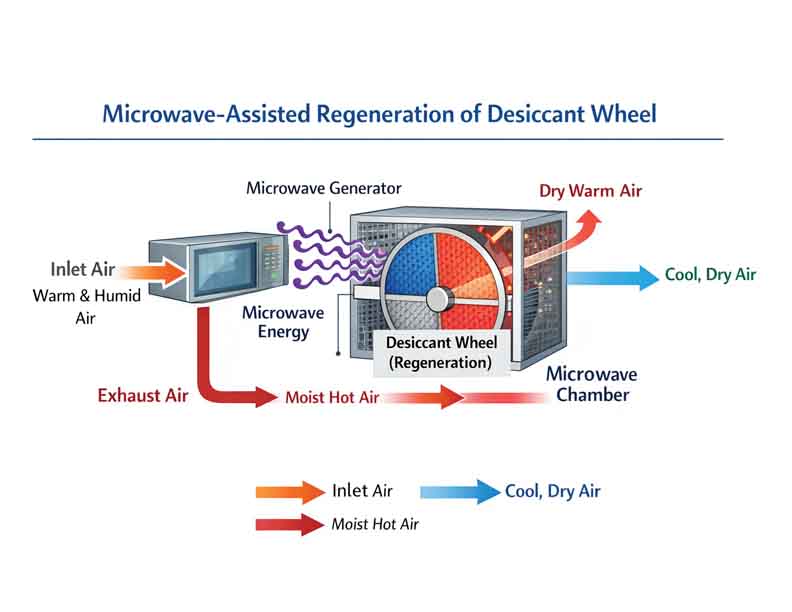
Microwave-assisted regeneration (Fig. 3) is also gaining attention due to its ability to provide volumetric heating directly within the desiccant material, resulting in faster and more uniform moisture removal compared to conventional convective heating methods, thereby reducing regeneration time and improving overall system responsiveness.
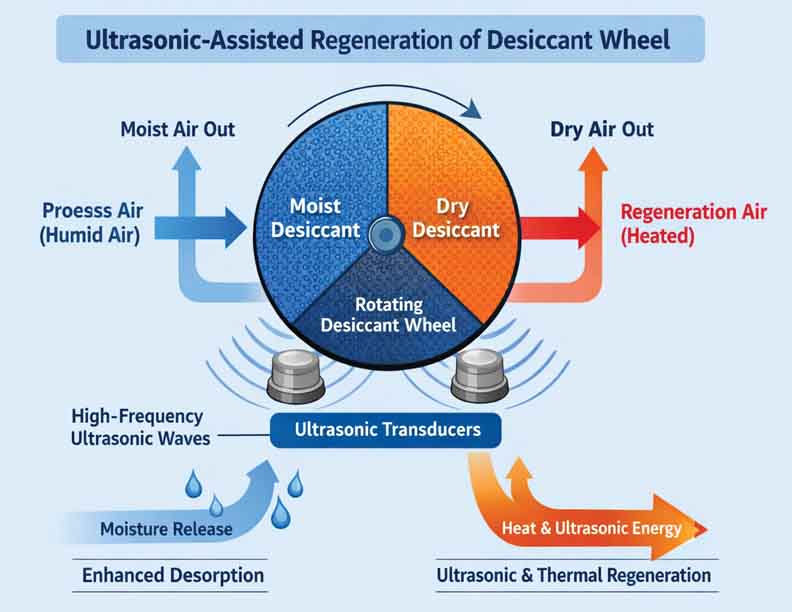
Similarly, ultrasonic-assisted regeneration (Fig.4) enhances mass transfer processes by disrupting boundary layers and facilitating the release of adsorbed moisture, allowing regeneration to occur at lower temperatures and with reduced energy consumption. An advanced heat recovery and regenerative heat exchanger technologies further contribute to improved system efficiency by preheating the regeneration air using exhaust heat from the process stream, thereby minimising the need for external heat input and optimising thermal energy utilization within the system.
The desiccant-coated heat exchangers represent another significant advancement, combining adsorption and heat exchange processes within a single component to enhance heat and mass transfer rates and enable more compact and efficient system designs. The development of novel desiccant materials such as metal-organic frameworks, composite desiccants, and nano-structured adsorbents has also played a crucial role in enabling low-temperature regeneration, as these materials exhibit higher adsorption capacity, improved thermal conductivity, and faster kinetics compared to conventional materials like silica gel and zeolites; liquid desiccant systems have also seen significant advancements in regeneration techniques, including the use of membrane-based regenerators, falling film configurations, and hybrid thermal-electrical regeneration methods that allow continuous operation and improved control over concentration levels.
These advanced regeneration methods not only improve system efficiency but also enhance flexibility in system design and operation, enabling integration with hybrid cooling technologies such as evaporative cooling and absorption refrigeration systems.
Despite these advancements, challenges such as system complexity, higher initial costs, and the need for precise control strategies remain, requiring further research and development to optimise performance and ensure widespread adoption; nevertheless, the ongoing progress in advanced regeneration technologies is expected to significantly transform the landscape of desiccant cooling systems, making them a viable and sustainable alternative to conventional air-conditioning technologies in the near future by reducing energy consumption, lowering greenhouse gas emissions, and improving indoor environmental quality across a wide range of applications.
In addition to the aforementioned techniques, recent advancements in advanced regeneration methods have increasingly focused on integrating intelligent control strategies, hybrid energy systems, and innovative system configurations to further enhance the performance and adaptability of desiccant cooling technologies in modern HVAC applications.
One such development is the use of multi-stage and multi-effect regeneration processes, where the regeneration air is heated and utilised in successive stages to maximise moisture removal while minimising energy input. Thereby significantly improving thermal efficiency and reducing overall energy consumption; hybrid regeneration systems
that combine multiple heat sources, such as solar energy, waste heat, and auxiliary electrical heating, offer greater operational flexibility and reliability by ensuring consistent performance under varying environmental and load conditions.
The incorporation of thermal energy storage systems, including sensible and latent heat storage materials, allows excess thermal energy to be stored during periods of low demand and utilised during peak load conditions, thereby enhancing system stability and reducing dependence on continuous energy supply; advanced control algorithms based on artificial intelligence and machine learning are also being developed to optimise regeneration processes in real time by adjusting operating parameters such as airflow rate, temperature, and humidity levels, resulting in improved efficiency, reduced energy consumption, and enhanced system responsiveness.
The membrane-based regeneration technologies are gaining prominence due to their ability to selectively separate moisture from desiccant solutions or air streams without requiring high temperature, thereby enabling low-energy regeneration and continuous operation in liquid desiccant systems; electro-thermal and resistive heating methods are also being explored as potential regeneration techniques, particularly for compact and decentralised systems, where precise temperature control and rapid response are essential.
Furthermore, the integration of desiccant systems with advanced heat pump cycles, including trans-critical and cascade systems, has shown significant potential in improving regeneration efficiency by utilising waste heat from the cooling cycle itself, thereby creating a highly integrated and energy-efficient system.
The use of nanotechnology in desiccant materials has opened new avenues for enhancing adsorption-desorption characteristics, improving thermal conductivity, and reducing regeneration temperature, which in turn contributes to overall system performance improvement; research is also being conducted on the development of bio-based and environmentally friendly desiccant materials that offer comparable or superior performance to conventional materials while reducing environmental impact and improving sustainability; compact and modular system designs enabled by advanced regeneration technologies are facilitating easier integration into existing HVAC infrastructure, making it possible to retrofit conventional systems with desiccant-based solutions without significant modifications.
Despite these promising developments, challenges such as material stability, long-term performance degradation, and economic feasibility need to be addressed through continued research, pilot-scale demonstrations, and industrial collaboration.
The future of advanced regeneration methods in desiccant cooling lies in the successful integration of these technologies into smart and sustainable building systems, where energy efficiency, environmental impact, and occupant comfort are optimised simultaneously; as global demand for energy-efficient cooling solutions continues to rise, particularly in developing regions.
Also, advanced regeneration technologies are expected to play a pivotal role in shaping the next generation of HVAC systems by providing reliable, efficient, and environmentally friendly alternatives to traditional cooling methods while contributing to global efforts toward energy conservation and climate change mitigation.
Conclusions
Advanced desiccant regeneration methods represent a crucial advancement in improving the performance, efficiency, and sustainability of desiccant-based HVAC cooling and dehumidification systems. By moving beyond conventional high-temperature regeneration techniques, these modern approaches – such as solar thermal regeneration, waste heat recovery, heat pump-assisted systems, microwave and ultrasonic-assisted regeneration, and advanced heat recovery units – enable effective desorption at lower temperatures while significantly reducing energy consumption.
The integration of innovative materials like metal-organic frameworks and composite desiccants further enhances adsorption capacity and regeneration efficiency, making the systems more compact and reliable.
Additionally, hybrid configurations and intelligent control strategies allow better utilisation of available energy resources and improve overall system responsiveness under varying climatic and load conditions.
Despite some challenges related to initial cost, system complexity, and long-term material stability, the benefits of advanced regeneration methods far outweigh their limitations, particularly in the context of growing global demand for energy-efficient and environmentally friendly cooling technologies.
These methods not only reduce dependence on electricity and fossil fuels but also facilitate the use of renewable and low-grade thermal energy sources, aligning well with sustainability goals and climate change mitigation efforts. As research continues to focus on low-temperature regeneration, durable materials, and smart system integration, advanced desiccant regeneration technologies are expected to play a transformative role in the future of HVAC systems, especially in hot and humid regions, by delivering high performance, improved indoor air quality, and substantial energy savings.

Dr. (Prof.) D. B. Jani received Ph.D. in Thermal Science (Mechanical Engineering) from Indian Institute of Technology (IIT) Roorkee. Currently he is a recognized Ph.D. Supervisor at Gujarat Technological University (GTU). He has published more than 280 Research Articles in reputed International Conferences and Journals. He has also published 25 reputed books/book chapters and patents in area of thermal engineering. He has been working as an Academic Editor for the Journal of Materials Science Research and Reviews. Presently, he is an Associate Professor at GEC, Bhavnagar, Gujarat Technological University, GTU, Ahmedabad (Education Department, State of Gujarat, India). He has obtained his Master of Engineering in Automobile Engineering from Gujarat University, Ahmedabad, Gujarat. He has more than 26 years of experience in teaching at various institutions at undergraduate and postgraduate/PhD level in mechanical engineering. He is a life member in professional societies and bodies like ISTE, ISHRAE, MTTF, REST, Green ThinkerZ etc. He is a recipient of Best Teacher award (2020), Excellent researcher award (2020), Innovative academician award (2024). His area of research is Desiccant cooling, ANN, TRNSYS, and Exergy.
……………………….