
Greenhouse gas emissions and rising consumption of power resulting from the use of building cooling and heating systems are one of the most important challenges of the next decade, where energy consumption rates in HVAC systems reached 35% of energy consumption in commercial and residential buildings. Therefore, performance improvement of building cooling and heating systems is an urgent and necessary task to minimise greenhouse gas emissions and power consumption.
In recent decades, various technologies for heating and cooling systems in buildings have been invented and developed, for example, heat/enthalpy recovery, desiccant dehumidification, adsorption system, and absorption system to mitigate greenhouse gas emissions and increase energy consumption. A desiccant air conditioner is considered a promising alternative to a traditional vapour-compression system, as well as takes advantage of solar energy and waste heat in the operation of the desiccant air conditioners.
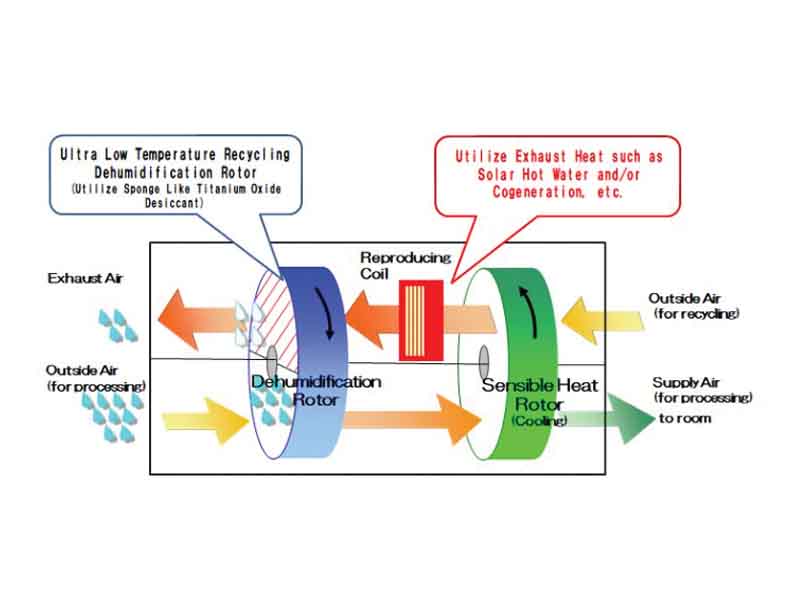
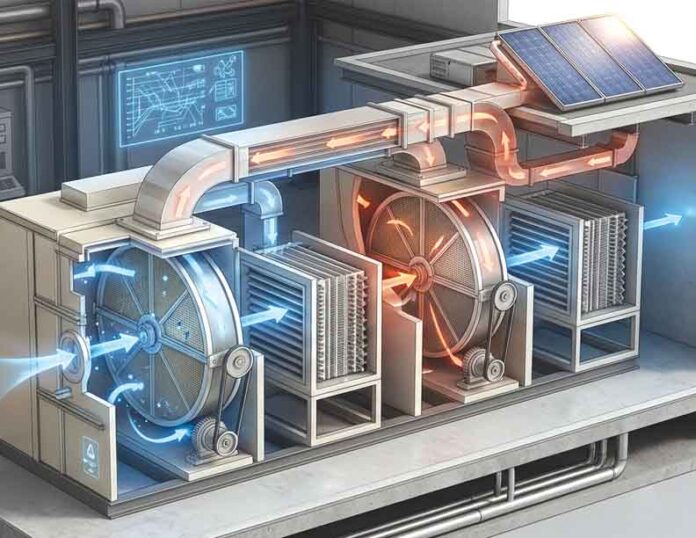
In contrast to a vapour-compression system, a desiccant air conditioner is therefore environmentally friendly. The desiccant air conditioning system uses sorbent to remove air moisture. This method differs from the traditional method utilised in traditional vapour-compression refrigeration systems, which works to condense moisture by cooling below dew point temperature, and then the air is reheated to the required temperature.
In a desiccant air conditioner, sensible cooling was achieved through various methods, for example, cooling towers, evaporative coolers, and absorption chillers. The use of desiccant air conditioners has proven to be highly effective in terms of economic, carbon emissions, and energy performance compared to the vapour-compression systems.
The use of solar-assisted liquid desiccant air conditioners can reduce energy consumption rates by up to 54% and 81% for hotel buildings and office buildings, respectively, compared to traditional vapour-compression refrigeration systems. The solar rotary desiccant wheel air conditioners for institutional buildings were developed in which annual power consumption rates were reduced by 17.8% compared to a vapour-compression refrigeration system.
The outcomes of the comparison showed that the use of liquid desiccant air conditioners reduces annual power consumption by 68% compared to the traditional vapour-compression refrigeration systems.
Advances in solid desiccant-based adsorption cooling and dehumidification systems
Multi-stage cycles
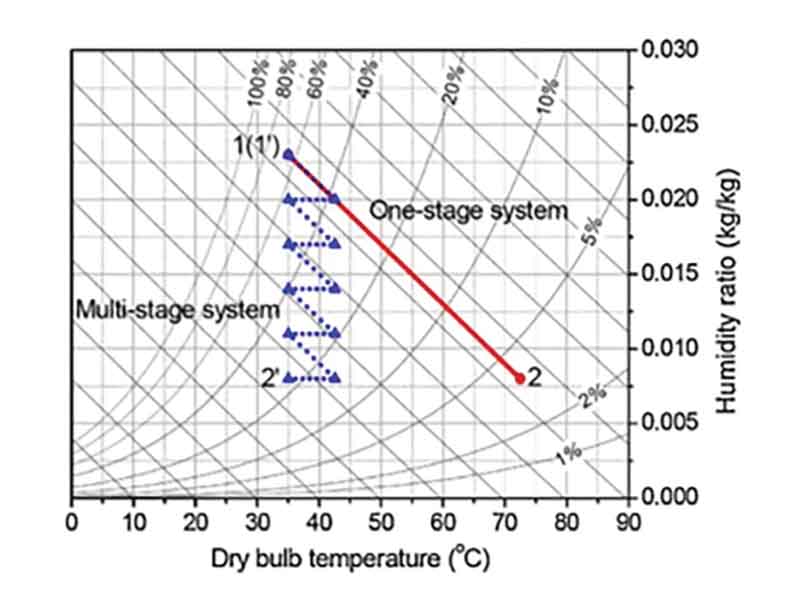
Multi-stage cycles are proposed to compact the adsorption heat effect that increases the process air temperature during the dehumidification process, this is done based on isothermal dehumidification, which decreases the process air temperature, increasing adsorption capacity, and lowers regeneration temperature.
The thermodynamics procedure of the air would be close to isothermal when it flows alternatively over desiccant wheels and intercoolers. Fig. 1 illustrates psychometrically the difference between an ideal multi-stage system and a one-stage system.
Hybrid solid desiccant air conditioners
Different configurations of hybrid desiccant air conditioners are presented to improve a system’s overall performance, for example, the integration of the desiccant air conditioner with a source of renewable energy such as water solar collectors, air solar collectors, and photovoltaic thermal collectors are utilised to heat the regeneration air to reactivate a desiccant material, as a result, the energy consumption decreases and system performance increases.
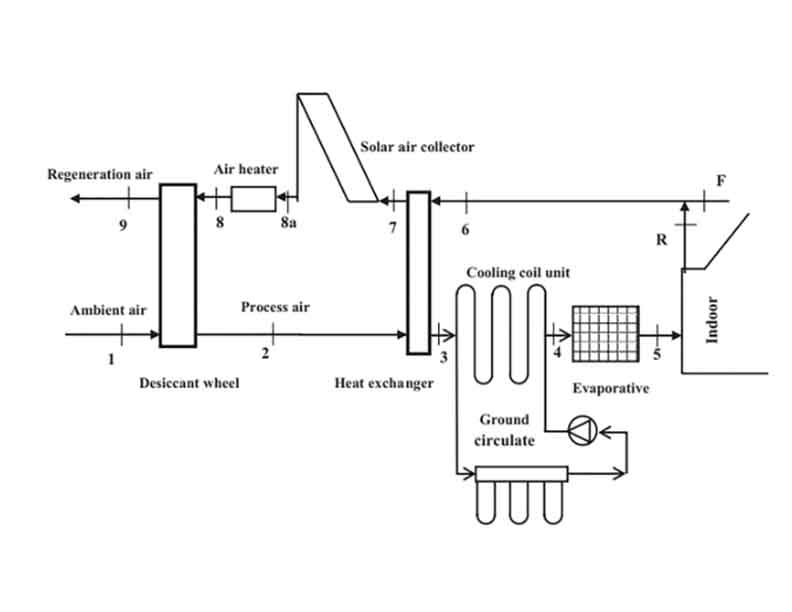
The desiccant system that integrated with an air solar collector and electrical heater as a heat source and geothermal energy for further cooling the process air as shown in Fig. 2, the results confirmed that a supply temperature changed from 12.7 to 21.7 °C for different climate conditions and system performance varied from 0.15 to 1.03.
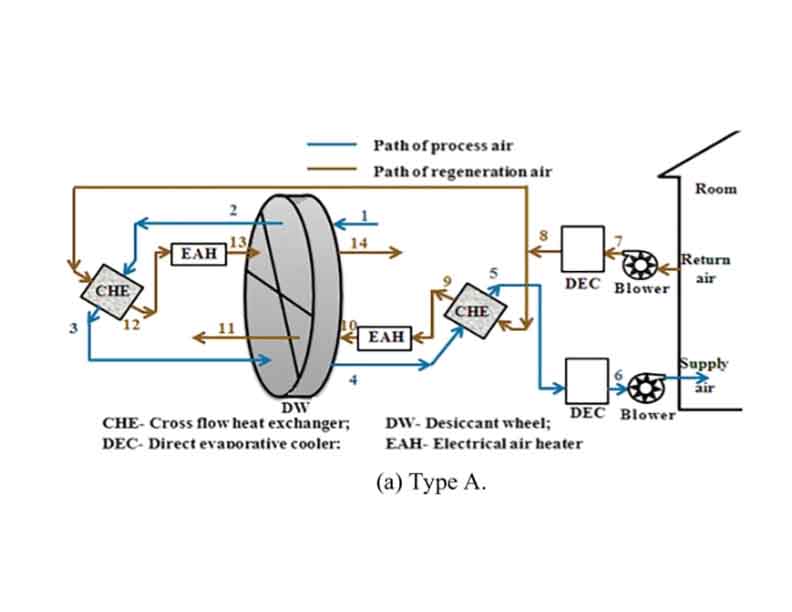
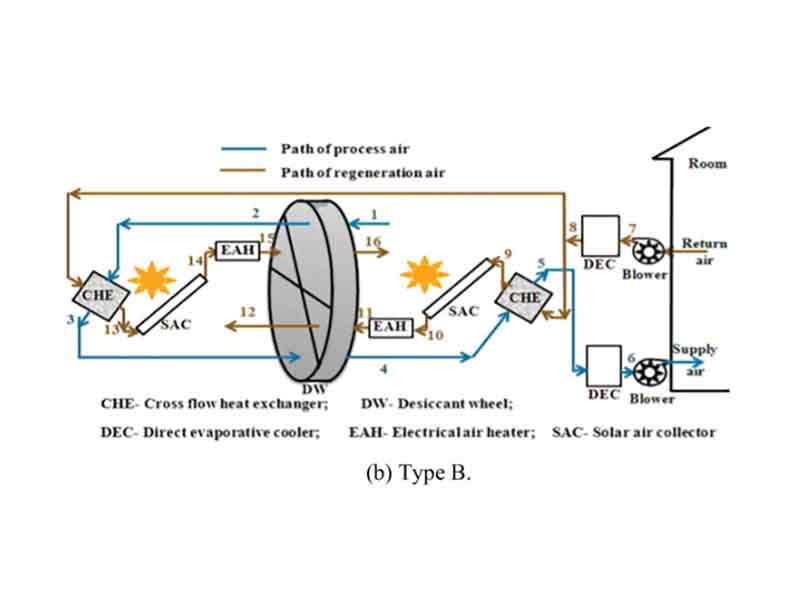
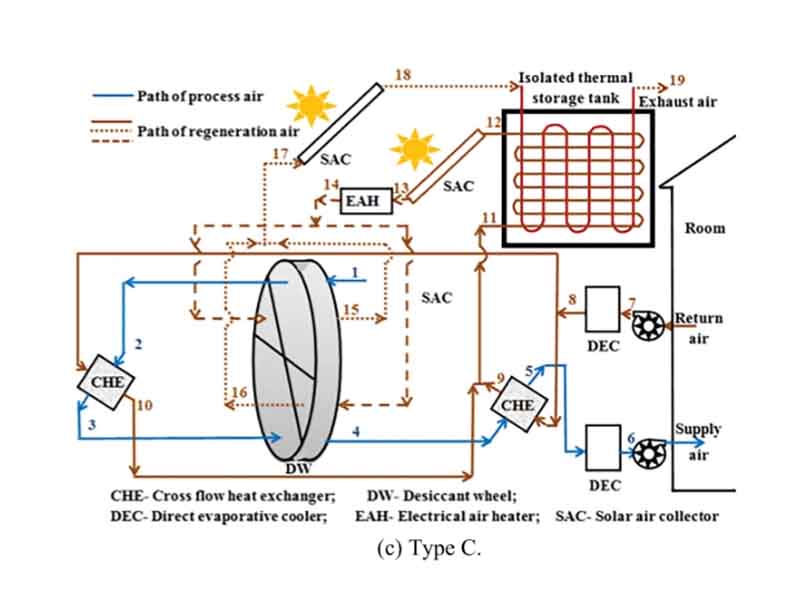
A behaviour of three configurations of a hybrid system, type A used an electric heater as a heat source, type B, used an air solar collector and electrical air heater, and type C used an air solar collector, Phase Change Material (PCM), and electrical air heater as illustrated in Fig. 3 a, b, and c; the results showed that the electricity saving was about 20.85 and 75.82% for type B and type C as compared to type A.
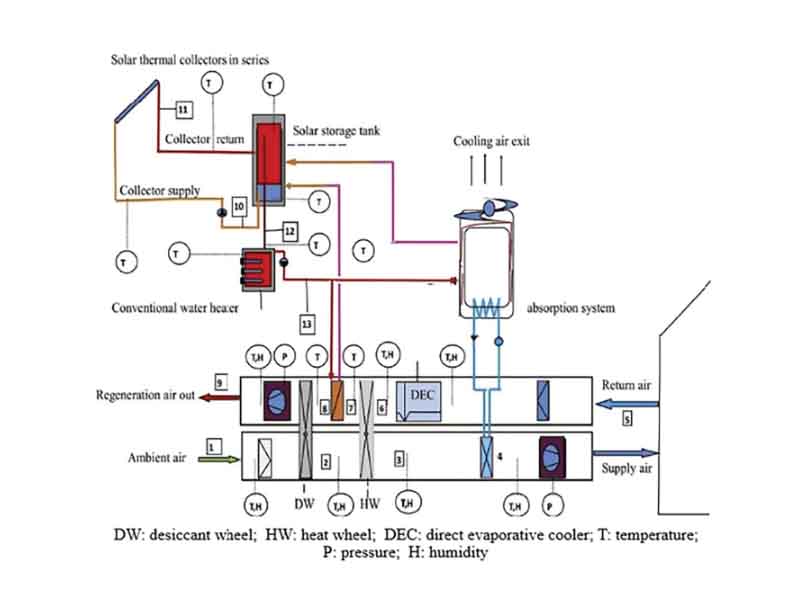
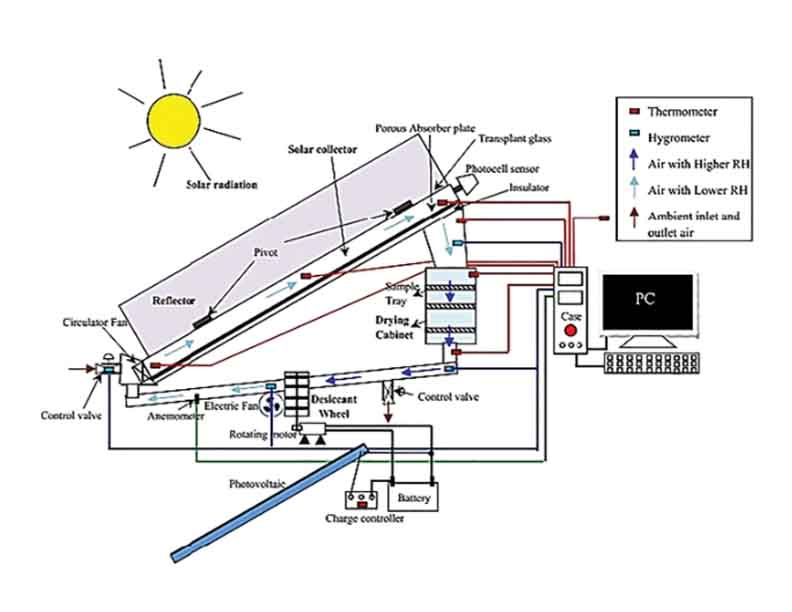
A hybrid absorption-solid desiccant air conditioner as presented in Fig. 4, the outcomes showed that the optimized values of coefficient of performance are 0.55 and 1.52 for standalone and integrated absorption systems, respectively. Moreover, the desiccant system can be coupled with a drying unit to preserve different products in supermarkets and stored cereals. A behaviour of solar-assisted solid desiccant dryer to dry a single layer of oleaster under different conditions as shown in Fig. 5, they found that the electricity consumption for drying decreased by 11.32–30.15% via using the WRD system.
Conclusions
Recently, due to the many advantages of desiccant air conditioners (no use of ozone-depleting refrigerants, highly efficient moisture control, etc.) compared to the traditional vapour-compression refrigeration system, the desiccant air conditioners are attracting increasing interest from HVAC engineers and innovators.
The overall performance of desiccant air conditioners can be ameliorated further by innovating new composite desiccant materials, innovating new system configurations and by improving system designs and controls, and integrating different hybrid energy systems/technologies.

Dr. (Prof.) D. B. Jani received Ph.D. in Thermal Science (Mechanical Engineering) from Indian Institute of Technology (IIT) Roorkee. Currently he is a recognized Ph.D. Supervisor at Gujarat Technological University (GTU). He has published more than 280 Research Articles in reputed International Conferences and Journals. He has also published 25 reputed books/book chapters and patents in area of thermal engineering. He has been working as an Academic Editor for the Journal of Materials Science Research and Reviews. Presently, he is an Associate Professor at GEC, Bhavnagar, Gujarat Technological University, GTU, Ahmedabad (Education Department, State of Gujarat, India). He has obtained his Master of Engineering in Automobile Engineering from Gujarat University, Ahmedabad, Gujarat. He has more than 26 years of experience in teaching at various institutions at undergraduate and postgraduate/PhD level in mechanical engineering. He is a life member in professional societies and bodies like ISTE, ISHRAE, MTTF, REST, Green ThinkerZ etc. He is a recipient of Best Teacher award (2020), Excellent researcher award (2020), Innovative academician award (2024). His area of research is Desiccant cooling, ANN, TRNSYS, and Exergy.