
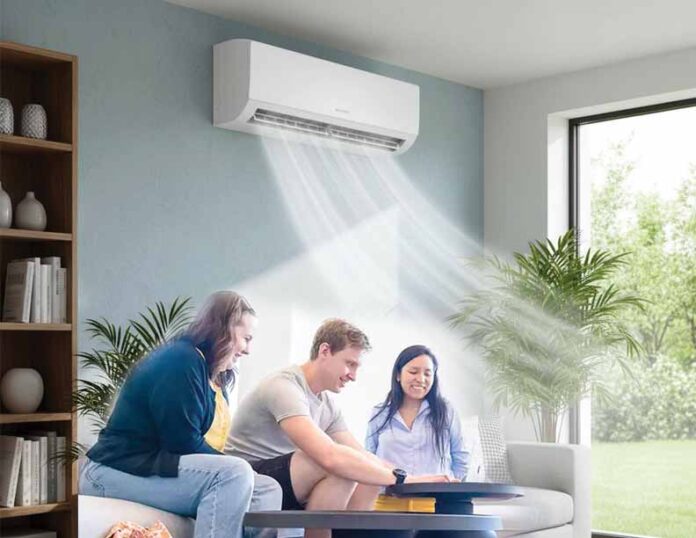
A residential HVAC system is the assembly of equipment, controls, and infrastructure that conditions indoor air in a home, typically providing cooled air in summer, warm air in winter (where needed), and mechanical ventilation year-round.
At its simplest, an HVAC system includes:
- A cooling component (air conditioner or heat pump)
- A heating component (furnace, heat pump, electric resistance heater)
- Ductwork or air distribution
- Controls/thermostats
- Ventilation, either mechanical or mixed with natural airflow
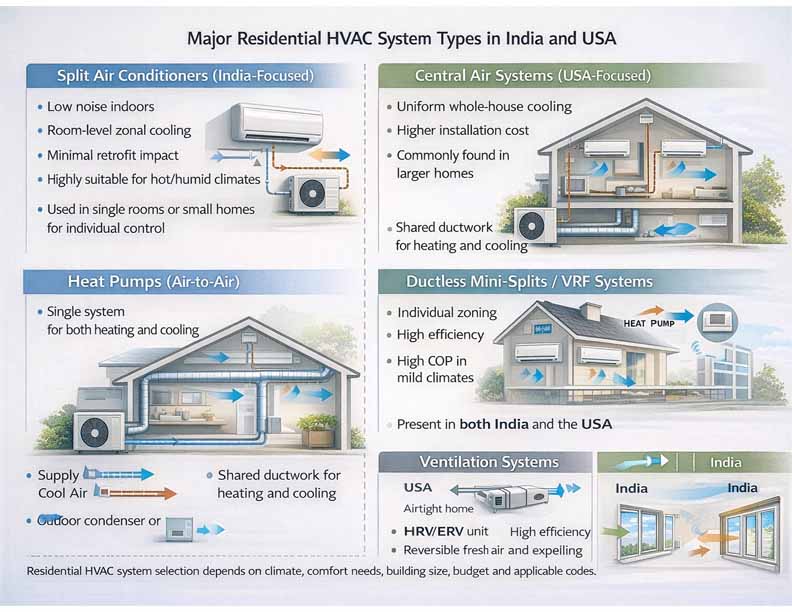
The adoption and complexity of these vary by region, for example, split AC units and ductless heat pumps are ubiquitous in Indian cities, while centralized forced-air systems are more common in many U.S. homes. Specific climate zones and preferences shape the mix of residential HVAC solutions.
Key HVAC System Types in Residential Buildings
Here are common residential HVAC types found in both countries:
Split Air Conditioners
- Most widespread in India due to warmer climates and retrofit realities: India’s predominantly hot and humid climate makes room-level cooling a necessity rather than a luxury. Split ACs suit existing buildings where centralized ducting is impractical or too expensive.
- Indoor evaporator and outdoor condenser: This separation reduces indoor noise and improves thermal comfort inside living spaces. The outdoor unit efficiently rejects heat to the ambient environment, enhancing system performance.
- Simple installation and efficient for single rooms or small homes: Requires minimal structural modification compared to central HVAC systems. Allows zonal cooling, leading to lower energy consumption and better user control.
Central Air Systems
- Central Air Systems: Predominant in the U.S., these systems use a central cooling unit with ductwork to distribute conditioned air throughout the entire house. They are well-suited for larger homes where uniform temperature control across multiple rooms is required. However, installation and retrofit costs can be high due to extensive ducting requirements.
- Often linked to a furnace (gas/electric) or heat pump: The same duct network is commonly shared for both heating and cooling functions. This integration improves year-round comfort and simplifies system control and maintenance.
Heat Pumps
- Electric heat pumps (air-to-air) are growing in both countries for cooling and heating: They offer a single, integrated solution that reduces reliance on separate heating and cooling equipment. Their adoption is also driven by decarbonization goals and improvements in inverter and compressor technology.
- Particularly popular in milder climates for efficiency: In moderate temperatures, heat pumps operate at high COPs, delivering more energy than they consume. This makes them a cost-effective and environmentally favourable option compared to resistance heating.
Ductless Mini-Splits / VRF
- Increasingly common in both markets, especially in high-end and retrofit situations: These systems are favored where flexibility and minimal structural intervention are required. They integrate well with modern architectural designs and renovation projects.
- Provide individual zoning and efficient operation: Each indoor unit can be independently controlled based on occupancy and comfort needs. This reduces unnecessary energy use and improves overall system efficiency.
Ventilation Systems
Mechanical ventilation (HRVs/ERVs) are required in tighter homes for healthy indoor air quality in the U.S.; in India, many homes still rely on passive/natural ventilation supported by code guidance.
System selection is governed by comfort needs, budget, local climate, building size, and code requirements where they exist.
Standards & Codes approach for United States
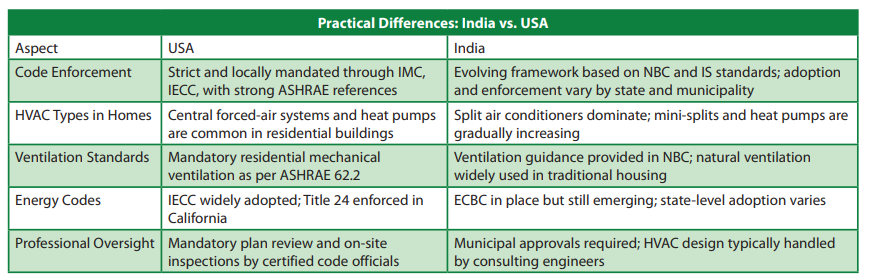
In the U.S., residential HVAC design and installation are governed by a formalized set of model codes, industry standards, and state/local building codes.
Model Codes and Adoption
Most U.S. states and municipalities adopt one or both of the following model codes:
- International Mechanical Code (IMC) — focuses on HVAC system safety, equipment venting, and installation standards. It is widely adopted by jurisdictions across the U.S. and updated every few years for safety + technology improvements.
- International Energy Conservation Code (IECC) — provides minimum requirements for building energy performance, including HVAC efficiency and system commissioning.
ASHRAE Standards
The American Society of Heating, Refrigerating and Air-Conditioning Engineers (ASHRAE) develops many foundational standards used across the U.S., including for residential HVAC:
- ASHRAE 62.2 — Ventilation and acceptable indoor air quality for residential buildings: It defines minimum ventilation rates to dilute indoor pollutants and maintain healthy living conditions. Addresses exhaust, infiltration, and balanced ventilation strategies for homes and apartments.
- ASHRAE 55 — Thermal comfort criteria: This specifies acceptable ranges of temperature, humidity, air speed, and radiant conditions.
It is used to evaluate occupant comfort based on both environmental and personal factors.
- ASHRAE 34 — Refrigerant classification and safety: This classifies refrigerants based on toxicity and flammability characteristics. It supports safe system design, refrigerant selection, and compliance with safety codes.
- ASHRAE 90.2 — Energy standard for residential systems: This sets minimum energy efficiency requirements for residential HVAC equipment and building envelopes. It promotes reduce energy consumption while maintaining acceptable comfort and performance.
ASHRAE standards are consensus technical standards that can be referenced directly in building codes or adopted by local jurisdictions as law.
Standards & Codes — India
India’s HVAC landscape has historically been less codified than the U.S., but it is rapidly evolving.
National Building Code of India (NBC)
The National Building Code of India (NBC) 2016, published by BIS (Bureau of Indian Standards), is the national model building code covering multiple aspects including HVAC, ventilation, and mechanical systems (Part 8/Section 3 Air Conditioning, Heating and Mechanical Ventilation). It provides design, installation, and performance guidance for residential HVAC systems, with emphasis on comfort, resource efficiency, indoor air quality and building
NBC is a model code local governments adopt and enforce it differently across states.
Indian Standards (IS)
There are several Indian Standards (IS codes) that govern the design, performance, and safety of HVAC equipment in India. IS 659 specifies safety requirements for air-conditioning systems, covering aspects of design, installation, and safe operation to ensure reliable and hazard-free use. IS 966 focuses specifically on room air conditioners, defining performance parameters, testing methods, and safety criteria to ensure consistent efficiency and product quality. In addition to these, other relevant IS codes address supporting aspects such as electrical wiring, insulation materials, fire safety, noise limits, and installation practices, all of which collectively ensure that HVAC systems comply with national safety, efficiency, and reliability standards.
Energy Codes
India’s Energy Conservation Building Code (ECBC) — while primarily for commercial buildings — influences HVAC performance specifications on energy use. It’s largely voluntary and being made mandatory in some states.
Compliance enforcement of codes in India varies by municipality and housing type; many residential projects align with NBC & IS standards during design and permits.
Common Requirements in Both Countries
ASHRAE standards play a critical role in defining residential HVAC performance and indoor environmental quality. ASHRAE 62.2 establishes minimum ventilation requirements to ensure acceptable indoor air quality by addressing pollutant dilution, exhaust, infiltration, and balanced ventilation strategies in homes. ASHRAE 55 provides thermal comfort criteria by defining acceptable ranges for temperature, humidity, air movement, and radiant conditions based on occupant comfort models. ASHRAE 34 classifies refrigerants according to toxicity and flammability, supporting safe refrigerant selection and system design. Complementing these, ASHRAE 90.2 sets minimum energy efficiency requirements for residential HVAC systems and building envelopes, promoting energy conservation while maintaining comfort and safety.
Comparative Schematic Overview of Residential HVAC Systems in India and the USA
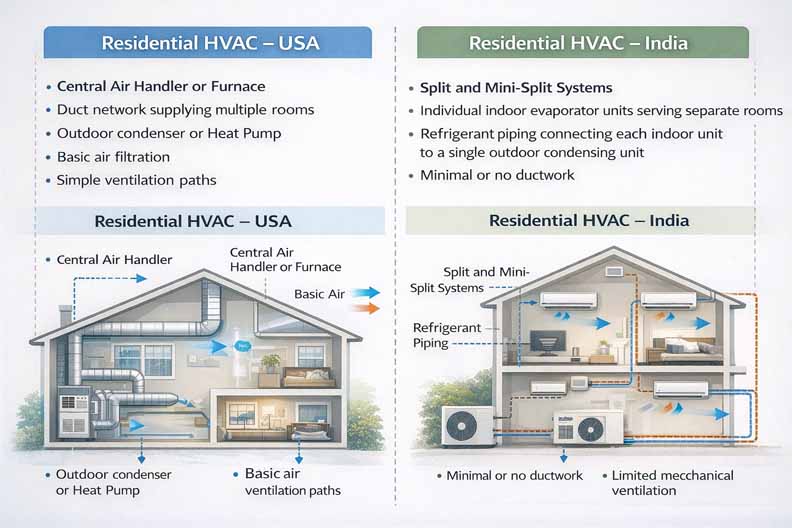
A residential HVAC system schematic in both India and the USA is typically simple and compact, designed to serve a limited number of occupants and spaces. In the USA, residential schematics commonly show a central air handler or furnace connected to a duct network supplying all rooms, paired with an outdoor condenser or heat pump, along with basic ventilation and filtration.
In India, residential schematics more often depict split or mini-split systems, where indoor evaporator units serve individual rooms and are connected by refrigerant piping to an outdoor unit, with minimal or no ductwork and limited mechanical ventilation. In contrast, commercial HVAC schematics in both countries are significantly more complex, illustrating multiple air-handling units, extensive duct and piping networks, dedicated outdoor air systems, zoning controls, and often chilled-water or VRF systems.
Integration of Smart Controls and BMS for Energy-Efficient Residential HVAC in India and the USA
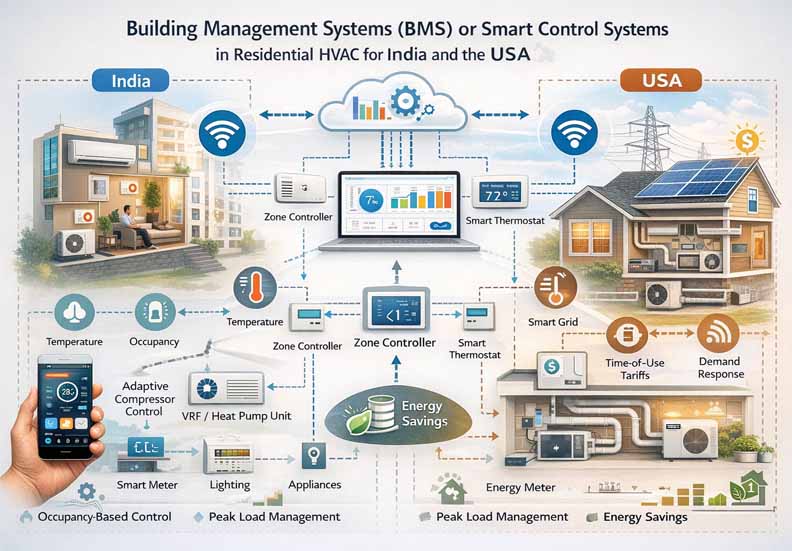
Building Management Systems (BMS) or smart control systems can be integrated into residential HVAC systems in both India and the USA through smart thermostats, zone controllers, sensors, and cloud-based platforms that communicate with HVAC equipment, lighting, and other energy-using appliances. In the USA, integration is commonly achieved via smart thermostats connected to central HVAC or heat pump systems, enabling scheduling, occupancy sensing, demand response, and utility-driven load control. These systems can interface with smart grids and time-of-use tariffs to shift or reduce energy use during peak hours. In India, smart controls are increasingly integrated with split ACs, VRF, and heat pump systems through Wi-Fi–enabled controllers, inverter drives, and room-level sensors, allowing precise temperature control, adaptive compressor operation, and remote monitoring.
The energy-saving benefits are significant in both markets. Smart controls optimize setpoints based on occupancy, weather, and usage patterns, reducing unnecessary operation and overcooling or overheating. Zonal control ensures that only occupied spaces are conditioned, lowering overall energy consumption.
Advanced analytics and fault detection help maintain equipment efficiency by identifying performance degradation early. In the USA, these systems further support electrification and grid interaction by responding to utility signals and integrating with rooftop solar and storage. In India, where cooling demand is rapidly growing, smart controls help manage peak loads, reduce energy bills, and improve comfort while supporting national energy efficiency and sustainability goals
Future Trends
In the USA, residential HVAC trends are increasingly shaped by decarbonization and energy efficiency goals. There is wider adoption of heat pumps to reduce dependence on fossil-fuel-based heating, particularly in new and retrofitted homes. As building envelopes become tighter, the need for controlled mechanical ventilation and Indoor Air Quality (IAQ) systems has grown significantly. Additionally, electrification initiatives and the emergence of grid-interactive HVAC technologies are enabling better demand response and integration with renewable energy sources.
In India, HVAC development is driven by rapid urbanisation and rising cooling demand. There is a growing implementation of energy and HVAC design codes aimed at improving efficiency and standardization across regions. Heat pump adoption is increasing, especially alongside district cooling systems in large developments. Furthermore, smart and connected HVAC technologies are gaining traction to enhance energy efficiency, occupant comfort, and system monitoring
Conclusion
Residential HVAC systems are critical for comfort, health, and energy performance in homes. While both India and the United States rely on a mix of standards and codes, the U.S. framework is more formalised and widely enforced, whereas India’s framework is emerging and gaining strength through updated NBC provisions, IS codes, and new mechanical codes.
Understanding these systems, codes, and local regulatory environments helps engineers, designers, contractors, and homeowners make better decisions from system selection to energy compliance and long-term comfort quality.

Dipanwita Samaddar is a Subject Matter Expert – HVAC from ZURU Tech India Pvt. Ltd.