

India’s healthcare sector is undergoing a tectonic shift. Driven by rising incomes, greater health awareness, and increasing access to insurance, the Indian healthcare market – which was valued at USD 110 billion in 2016 – is projected to reach USD 638 billion by 2025. This growth translates into over one hundred million square feet of new hospital infrastructure under construction across Tier 1, 2, and 3 cities.
Unlike standard commercial buildings where HVAC is primarily about occupant thermal comfort, HVAC&R systems in health care settings are mission-critical life-support systems. They are crucial for defence against Hospital-Acquired Infections (HAIs), maintaining sterile environments in Operating Theaters (OTs), preserving vaccines and biological samples, and aiding in patient recovery rates in wards and ICUs.
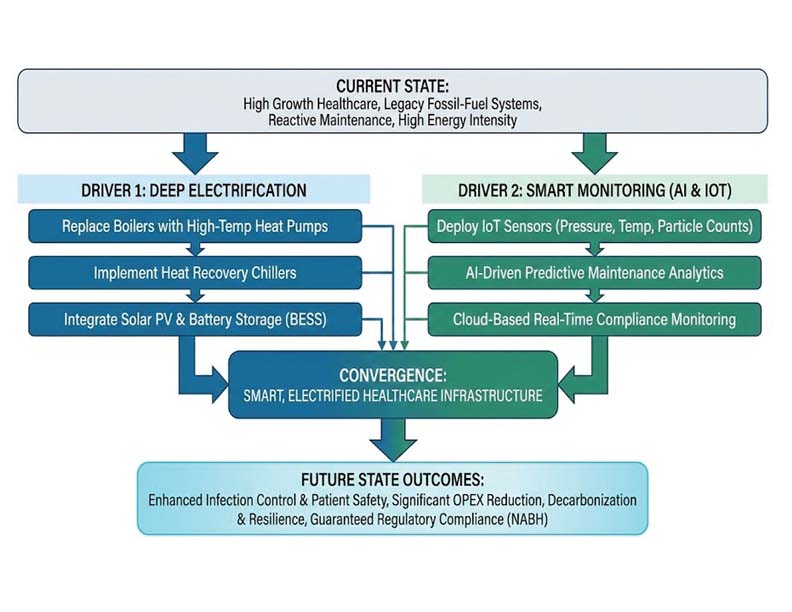
However, this critical reliance comes at a high cost. Hospitals are among the most energy-intensive commercial buildings, often operating on a 24/7 basis. In India, Energy Usage Intensities (EUI) for hospitals can range from 250 to over 400 kWh/m²/year, with HVAC&R accounting for 40% to 55% of this total load. Furthermore, given the absolute necessity of 100% uptime, Indian hospitals have historically relied heavily on Diesel Generator (DG) sets for backup power, contributing significantly to localised pollution and carbon emissions.
As India strives to meet its climate commitments while simultaneously expanding healthcare access, the traditional models of hospital infrastructure are proving unsustainable. A new paradigm is emerging, driven by two synergistic forces: Deep Electrification and AI-Driven Smart Monitoring. This article explores how these technologies are converging to redefine the future of healthcare HVAC&R in India, moving from reactive energy sinks to proactive, resilient, and sustainable assets.
The Unique Demands of the Indian Healthcare Environment
To understand the necessity of this transition, we must first appreciate the complexity of the load. A hospital is not a monolith; it is a collection of diverse micro-climates, each with stringent regulatory requirements governed by bodies like the National Accreditation Board for Hospitals & Healthcare Providers (NABH) and adapted international standards like ASHRAE 170.
- Critical Zones (OTs, ICUs, Isolation Rooms): These require precise control of temperature (often lower than comfort cooling), strict humidity parameters (typically 40%-60% RH to prevent bacterial growth), high Air Changes per Hour (ACH– often 20+ for OTs), and crucial pressure differentials. An isolation room for airborne infections (like TB or COVID-19) requires negative pressure to keep pathogens contained, while an operating theater requires positive pressure to keep contaminants out.
- Diverse Thermal Loads: A hospital needs simultaneous high-grade chilling for air conditioning and MRI machine cooling, alongside massive amounts of hot water for sterilization (CSSD), laundry, kitchen operations, and patient hygiene.
- The Resilience Requirement: In many parts of India, grid reliability remains a challenge. A power dip of even a few seconds can reset sophisticated medical equipment. Therefore, the HVAC&R system must be seamlessly integrated with robust backup power solutions.
Historically, meeting these diverse needs meant oversized chillers, inefficient fossil-fuel-fired boilers for heating, and a reliance on manual logs for compliance checking. This approach is no longer viable in an era of rising energy costs and ESG mandates.
The Electrification Imperative in Healthcare
Electrification in the hospital context is about more than just connecting to the grid; it is about strategic decoupling from on-site fossil fuel combustion to improve efficiency, reduce emissions, and enhance resilience through modern technology. Therefore, the following sections provide information about methods to improve energy sustainability in hospital settings.
The High-Temperature Heat Pump Revolution
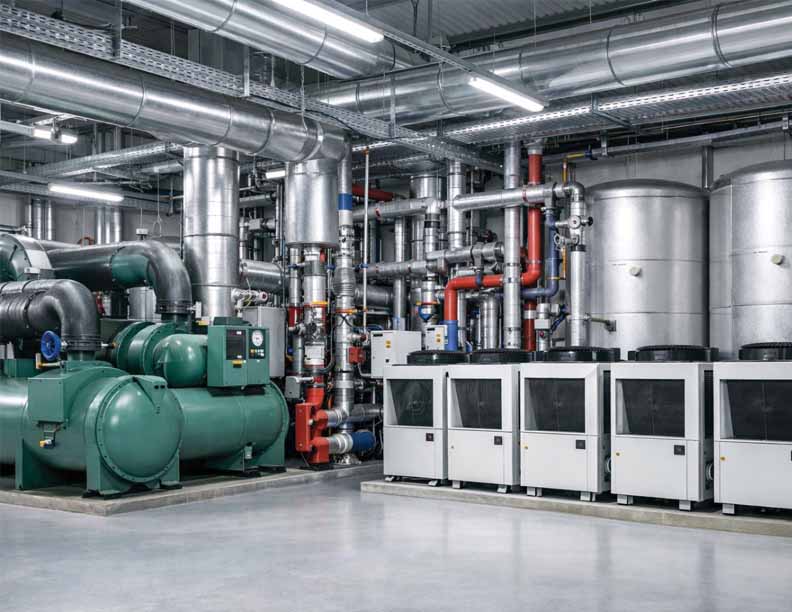
The most significant immediate opportunity for healthcare electrification lies in water heating. Indian hospitals currently rely heavily on diesel or natural gas boilers for sanitation and sterilization needs. These systems rarely exceed thermal efficiencies of 85-90%. A much more effective means for electrification lies in industrial-grade, high-temperature air-to-water or water-to-water heat pumps. By utilizing the refrigeration cycle, these units can deliver hot water at 65°C to 80°C – sufficient for most hospital applications outside of steam sterilization – with Coefficients of Performance (CoP) ranging from 3.0 to 4.5. By replacing a diesel boiler with an electric heat pump, a hospital reduces primary energy consumption by a factor of three to four. In climate zones like Bengaluru or Pune, heat pumps can provide cooling simultaneously with heating (heat recovery chillers), utilizing the waste heat from the condenser side to preheat water for the laundry, thus achieving extremely high system efficiencies.
Electrifying Resilience: Beyond the DG Set
Hospitals must have 100% power availability. Traditionally, this has meant massive diesel generator farms on site. The electrified future points toward Battery Energy Storage Systems (BESS) allow hybridization with on-site solar PV and grid power. While BESS may not yet replace DG sets entirely for multi-day outages due to cost density, they are increasingly being used for “peak shaving” during high-tariff hours and providing instant, seamless bridging power during grid switching. This eliminates the momentary blackouts that disrupt sensitive electronic medical and HVAC control systems.
Smart Monitoring: The Digital Immune System
Smart monitoring powered by IoT and AI is helpful regarding clinical risk management. The Indian healthcare smart HVAC market is expanding rapidly, moving away from basic Building Management Systems (BMS) that only turn devices on and off toward analytics-driven platforms.
Precision Infection Control via IoT
In legacy systems, verifying pressure differentials in an isolation room involves a technician manually checking a magnehelic gauge once per shift. If the exhaust fan belt slips within five minutes after the check, the room could lose negative pressure, potentially spreading airborne pathogens for hours undetected.
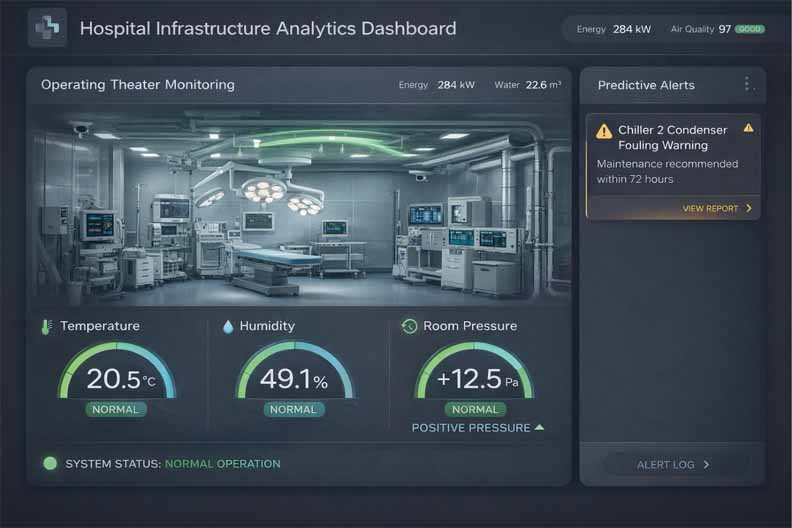
Today’s smart monitoring involves installing networked differential pressure sensors, particle counters, and humidity sensors directly in critical zones. These sensors feed real-time data to the cloud-based BMS. If pressure drops below the required pascal threshold in an isolation room, the system instantly alarms the nursing station and facility manager while automatically ramping up the exhaust Variable Frequency Drive (VFD) to compensate. This is automated compliance and real-time biological safety.
Predictive Maintenance for Critical Assets
A chiller failure in a hospital during peak summer hours can lead to cancelled surgeries and patient evacuation. Smart monitoring shifts hospital maintenance from reactive (fixing broken things) or preventive (replacing parts based on a calendar) to predictive. AI algorithms analyze vibration spectra on compressor bearings, monitor current draw profiles on fan motors, and track approach temperatures on chiller condensers. By establishing a baseline “health signature” for critical equipment, the AI can detect subtle deviations – such as a 3% increase in motor amperage indicating early winding degradation – weeks before a catastrophic failure. This allows facility managers to schedule repairs during low-census periods so that uninterrupted critical care is ensured.
Convergence: The New Standard of Care
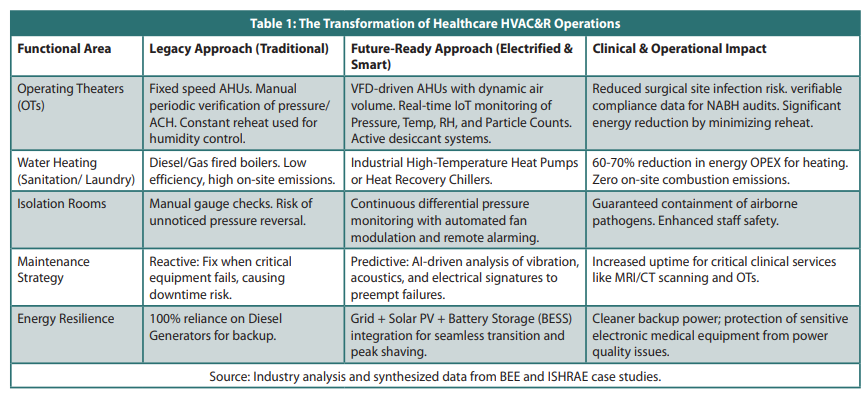
The true power of quality energy in a hospital is realized when electrification and smart monitoring are integrated. An electrified heat pump system connected to a smart grid-interactive BMS can pre-heat enormous volumes of water during off-peak night hours when electricity tariffs are low. This allows thermal energy to be stored for the morning demand surge. Table 1 provides a comparative look at how these technologies change hospital functional areas.
Challenges and the Path Forward for India
While the technological case is undeniable, the translation to the Indian ground reality faces hurdles, such as the following:
- The CAPEX Barrier vs. OPEX Reality: Tier 2 and Tier 3 hospitals often operate on razor-thin margins. On one hand, electrified, smart systems offer massive OPEX savings (often achieving ROI in 3-5 years). However, the initial capital expenditure is nonetheless higher than conventional systems. Innovative financing models are needed to bridge this gap, such as Energy Service Company (ESCO) models specifically tailored for healthcare.
- Retrofitting Complexities: India has a vast stock of existing hospitals. Retrofitting hospital that is opened on a 24/7 basis with new duct sensors, VAV boxes, and basement boilers with heat pumps is logistically complex. Such a setup requires phased execution to avoid disrupting patient care.
- The Skill Gap: The hospital facility manager of the future needs to take on tasks typically expected from a mechanical engineer, IT network specialist, and data analyst combined. Currently there is a significant shortage of technicians skilled in maintaining both advanced inverter-based refrigeration systems and IP-based sensor networks. Therefore, training institutes must update curricula to reflect this convergence.
Conclusion
The narrative of healthcare HVAC&R in India is shifting from a story of necessary cost to one of strategic value. By embracing electrification, hospitals can rid themselves of volatile fossil fuel costs and on-site pollution. Also, adopting smart monitoring allows unprecedented visibility into infection control parameters and asset health.
In the Indian context – in which patient loads are immense and resources must be optimized – these technologies are essential tools for building a robust, safe, sustainable healthcare ecosystem for the coming decades. The future hospital building will not just treat patients; it will intelligently, actively protect them.

Dr. Kaushik K. Shandilya is an environmental engineer, chemist, and sustainability scientist whose career spans more than two decades across academia, government, and industry. As a national award-winning researcher, his career reflects a rare breadth—air quality, particulate chemistry, wastewater treatment, algal biotechnology, energy systems, and sustainable materials—all unified by a focus on practical, scalable solutions for global environmental challenges. His global work spans India, the United States, Korea, and China, among others. He has held research and teaching appointments at Baylor University, the University of Toledo, South Florida, Clarkson University, and multiple U.S. and Indian colleges, mentoring students and advancing work in alternative fuels, air pollution exposure, and algae-based technologies.

Dr. S. N. Bansal @ Sharad is President, Institution of Government Approved Valuers and Chief Executive Officer, L & Q Surveys Private Limited has about 50 years of experience. He received a degree in Building & Quantity Surveying from the Institution of Surveyors (India) and M. Tech (Civil) in Transport Planning. Dr. Bansal is an M.B.A. (Disaster Management) from Institute of Advanced studies in Education (Deemed University) in 2006. He is a Chartered Engineer, having membership of RICS (UK). Also, he is an active member of 27 professional bodies/ institutes. He has Published 85 papers. He delivered lectures as a visiting faculty at Institution of Surveyors, INTACH, Institution of Government Approved Valuers, Institution of Valuers etc.