
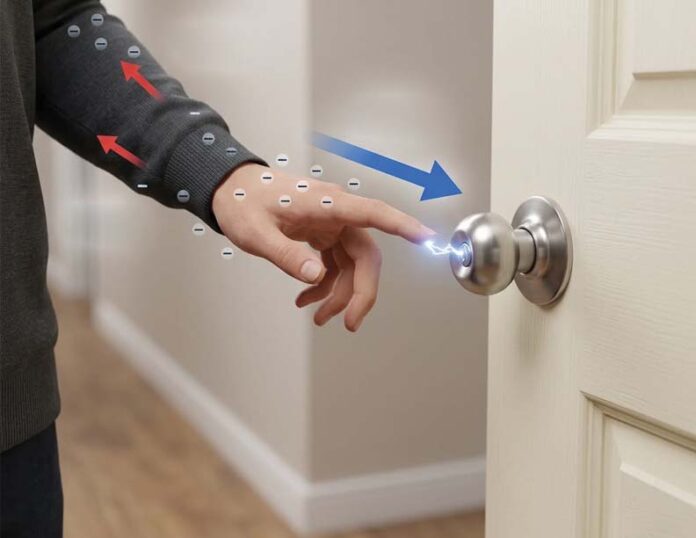
In regions like Vidarbha, and Rajasthan where extreme heat and low humidity prevail – often seeing temperatures soar to 47 degrees Celsius and relative humidity as low as 15% the accumulation of electrostatic charges becomes a significant phenomenon. This occurs because dry air dramatically reduces the natural conductivity of materials, leading to the build-up of static electricity on various surfaces, both metallic and non-metallic.
When a person encounters these charged surfaces, he/she might experience a mild electric shock or witnesses a small spark as the accumulated static electricity discharges into their body. While these shocks are generally harmless, they can be surprising and somewhat scaring. Figure – 1 represents the above-described incident.
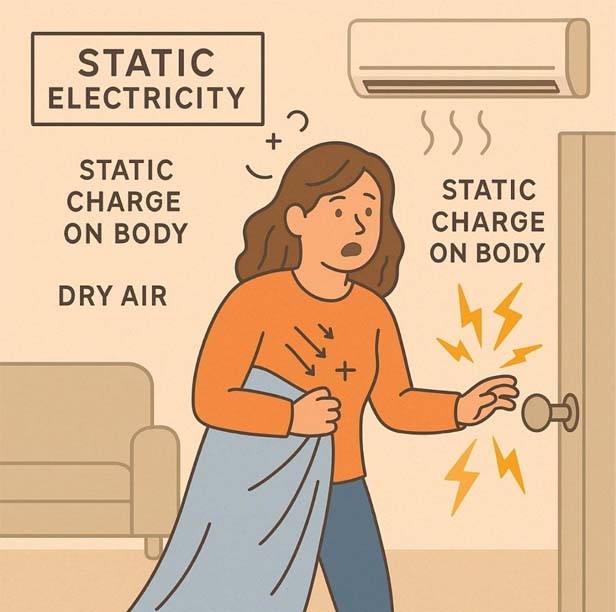
Electric shocks are common in low Relative Humidity (RH) places because dry air acts as an excellent insulator, preventing the safe dissipation of static electricity.
When the air lacks moisture, human body easily accumulates and retains a static charge – known as triboelectric charging – rom walking on carpets or rubbing against fabrics. Because the air is too dry to conduct this charge away from human skin, it builds up until you touch a conductive object (like a doorknob or another person), resulting in a sudden, rapid discharge of electricity.
I was consulted regarding an incident reported by the maintenance supervisor of a prominent hotel in Nagpur in the year 1990. Guests and staff members had been experiencing mild electric shocks when operating the door locks. The hotel’s maintenance team initially investigated to identify potential leakage currents within the electrical circuits. A comprehensive inspection was performed to detect any short circuits between the electrical system and metallic surfaces, including the doors. However, when these efforts yielded no conclusive results, my technical intervention was sought.
Upon conducting a detailed audit of the facility, I observed that the hotel’s air-conditioning system utilized water-cooled chillers integrated with Air Handling Units (AHUs), which serviced all floors and guest rooms. As part of my assessment, I placed a bucket of water in the AHU room and allowed the units to operate continuously. Subsequent testing revealed that neither electric shocks nor sparking between metallic rings and door locks occurred when doors were opened. This experiment was replicated across all AHU rooms, and within hours, the issue was successfully resolved.
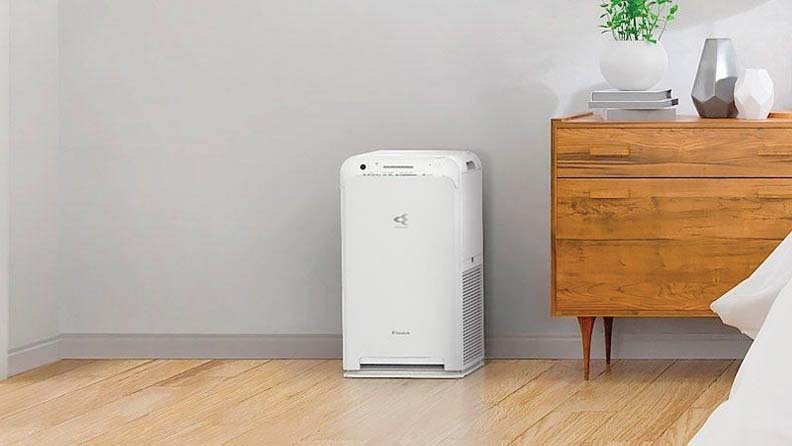
Based on these findings, I recommended that the maintenance team install mini humidifiers in all the rooms wherever minor electric shocks are being experienced on touching metallic surfaces to regulate humidity levels in air-conditioned spaces and prevent recurrence of electrostatic discharge incidents. Figure – 2 represents the placement of mini dehumidifiers in the room.
The installation of humidifiers can incur significant costs, potentially straining household finances, particularly in environments where Electrostatic Discharge (ESD) poses a concern. However, cost-effective alternatives exist to mitigate static issues without substantial expenditure. One such solution involves the strategic placement of dampened curtains across windows during periods of low humidity.
In regions such as Jaisalmer, Ganganagar, Sikar, Nagpur, Wardha, Amravati, Brahampuri & Akola, where ambient air conditions are notably arid, indoor Relative Humidity (RH) levels frequently decline to a point where static accumulation becomes problematic—affecting fabrics, furnishings, and even metallic surfaces like door handles.
Damp curtains introduce localized moisture near windows, elevating RH in the immediate vicinity and reducing the charge separation responsible for static shocks. Unlike whole-room humidification systems, this method specifically addresses areas where dry air ingress occurs and requires minimal setup: a thick cotton curtain, lightly moistened and suspended to permit airflow, gradually releases moisture through evaporation, thereby increasing humidity. Figure – 3 demonstrates the suspension of moistened curtain.

Key advantages of this approach include affordability, ease of implementation, and immediate effectiveness. To optimize results, absorbent materials such as towels or trays may be placed beneath curtains to manage excess moisture, with periodic re-dampening recommended during peak daytime heat. Enhanced outcomes can be achieved by concurrently sealing window and door gaps and avoiding synthetic fabrics known to retain static charges.
While this technique does not substitute for comprehensive humidification systems in settings requiring precise humidity control, it provides a practical and economical solution for residential interiors and small office spaces experiencing seasonal static-related challenges.
Understanding electrostatic charge accumulation is crucial for implementing preventive measures. Solutions such as humidifiers can increase air moisture, improve conductivity and reduce static buildup. Similarly, evaporative cooling systems positioned along return air tracks can effectively dissipate static charges, enhancing comfort, particularly in extreme climates. Awareness of these factors enables proactive mitigation of electrostatic-related issues.

J. Jiwani is a post graduate mechanical engineer (Thermal Engineering) from IIT Delhi, a fellow of Institution of Engineers (India) and a chartered engineer. He pursued his career as an HVAC consultant since 1985 onwards in the Vidarbha region. He is regarded as a prominent icon for ventilation systems and evaporative cooling systems. He is the Founder President of ISHRAE Nagpur chapter. He has been conferred with Lifetime Service Award and honoured with the title Chapter President Emeritus by ISHRAE.