

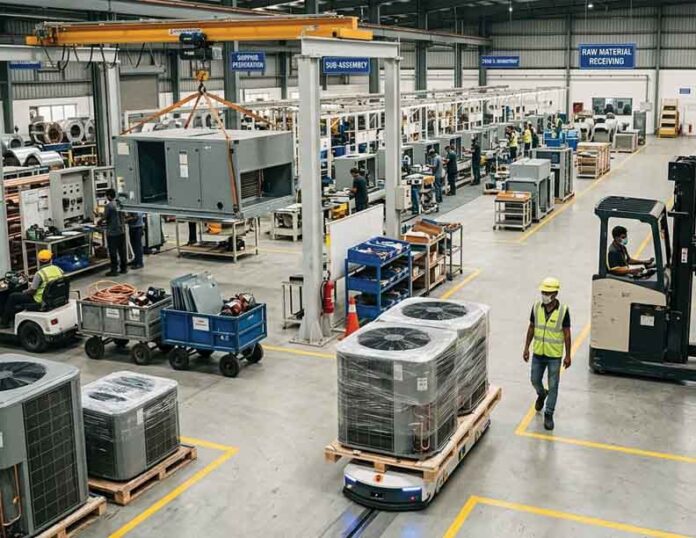
When conversations turn to HVAC engineering, attention naturally gravitates toward compressor efficiency, refrigerant chemistry, coil design or controls intelligence. Comparatively little is said about a function that quietly determines whether all that engineering ever reaches a working plant room intact: material handling and transportation logistics. For an industry built around bulky, heavy and often fragile equipment – air handling units the size of shipping containers, chillers weighing several tonnes, precision-balanced fan wheels, and finned coils that bend under a careless grip –logistics is not a peripheral concern. It is a core engineering discipline in its own right.
From the moment sheet steel and copper tube enter a fabrication shop to the moment a rooftop unit is craned onto its curb, HVAC equipment changes hands, vehicles and storage locations dozens of times, and every handoff is an opportunity for damage, delay or added cost. As the Indian HVAC industry scales to meet demand from data centres, pharmaceutical clean rooms, metro systems, airports and a rapidly expanding real estate sector, the logistics backbone supporting that growth deserves the same rigour that goes into thermal design.
Why HVAC Equipment Demands a Different Logistics Approach
Unlike many manufactured products, HVAC equipment is rarely small, light or forgiving of rough handling. A central air handling unit can weigh from a few hundred kilograms to several tonnes, span multiple metres in length, and combine components with very different tolerances for shock and vibration in one assembly. A centrifugal fan wheel is statically and dynamically balanced to fine tolerances before it leaves the factory; a hard knock during a fork-lift transfer can throw that balance out and introduce vibration and noise that only becomes apparent after commissioning. A finned coil, similarly, is essentially a lattice of thin aluminium fins wrapped around copper tube – strong in compression along its face but easily crushed if a strap, chain or careless hand presses against the fin pack.
Chillers and packaged units add another layer of complexity because they frequently arrive with a factory refrigerant charge or a holding charge of nitrogen. That makes the equipment, in effect, a sealed pressure vessel in transit – an impact severe enough to fracture a joint or valve is not just a dent to buff out but a potential refrigerant release, a safety incident and a warranty claim rolled into one. Ducting and other sheet-metal fabrications present a different problem again: dimensionally awkward, easily dented, and prone to racking out of square if stacked or strapped incorrectly.
None of this is unique to any one product category – it runs across the entire HVAC bill of materials, from raw sheet coil stock to the most finished packaged unit. That is precisely why logistics planning has to begin long before a truck is booked. It starts on the shop floor.
Material Handling inside the Plant
Material handling inside a manufacturing facility is the first and most controllable link in the chain. Raw material – coil stock, structural extrusions, sheet metal, copper tube and insulation panels – moves through cutting, forming, brazing, assembly and testing stations before it becomes a finished product, and every internal move is a chance to introduce a scratch, a dent or a misalignment that a customer will eventually notice.
Overhead EOT (Electric Overhead Travelling) cranes and gantry systems handle heavier sub-assemblies between work centres without dragging them across the floor. For finished coils, purpose-built lifting beams with padded slings distribute load evenly across the header pipes rather than the fragile fin face. Forklifts remain essential for palletised components and truck loading, but operators need training specific to the product: where the true centre of gravity sits on an asymmetric casing, how to avoid puncturing insulation panels with fork tines, and when a load is better handled with a crane instead.
Ergonomics matters as much as mechanical handling – repetitive manual handling of sharp-edged sheet-metal parts is a leading cause of injury in fabrication shops, and roller conveyors, tilt tables and standardised lifting points reduce both damage rates and injury rates together. Manufacturers are also rethinking how much internal handling a unit needs in the first place: skid-mounting components early and sequencing production progressively closer to the packaging area both reduce the number of touches, and therefore the chances of damage, between fabrication and dispatch.
Packaging and Load Securing
Packaging is where a great deal of transit damage is either prevented or invited. HVAC packaging has to protect against impact, guard against moisture ingress during monsoon-season transport, prevent shifting inside a vehicle, and – for export or long-haul moves – survive multiple handling cycles across different modes of transport.
For finished units, timber crating remains the default beyond a certain size or value, with corner and edge protectors absorbing point loads that would otherwise transmit into the casing panel. Coils are typically wrapped in corrugated sheet or fin guards before crating, and control panels are often removed and shipped separately to avoid damage to protruding parts. Sea freight and long-duration storage call for vapour-barrier wrapping and a desiccant charge inside the packaging – particularly important for electrical enclosures and motor windings.
Load securing inside the vehicle is a separate discipline: equipment needs to be blocked and braced against longitudinal movement under braking, not merely tied down vertically – a poorly restrained unit can shift several centimetres under hard braking, enough to crush an adjacent load or damage its own base frame. Lifting lugs or forklift pockets built into the base frame should be used as restraint points rather than improvised sling points on the casing itself, and chains or straps need corner protection wherever they cross a panel edge.
Transportation Modes and Route Planning
Road transport carries the overwhelming majority of HVAC equipment within India, since most sites are not located next to a railhead or port and road offers door-to-door flexibility no other mode can match. But large air handling units, chillers and packaged rooftop units very often fall into the Over Dimensional Cargo, or ODC, category – cargo exceeding the standard length, width, height or axle-weight limits set for ordinary vehicles under the Central Motor Vehicles Rules.
Moving ODC cargo is a project in itself, typically beginning with a route survey to identify low bridges, overhead lines, narrow carriageways and weak culverts that a wide or tall load might not clear. Based on dimensions and weight, the right vehicle is selected – a low-bed trailer, a multi-axle hydraulic trailer for very heavy indivisible loads such as large chillers, or an extendable flatbed for long items like duct sections. Movement permits then have to be obtained from the National Highways Authority of India for national highway stretches and from state transport departments for state roads, and requirements differ enough between states that interstate moves are planned with a generous lead-time buffer. Escort vehicles, police coordination, and restrictions on travel during peak traffic or high-wind conditions are common permit conditions.
Rail offers economies of scale for long-distance, high-volume movement of bulk raw material, though road transport at both ends to bridge the first and last mile means it is rarely a complete solution for finished equipment. Sea freight becomes relevant for imported components or export shipments and brings its own packaging discipline, while air freight is reserved for urgent, high-value, low-bulk items such as replacement control boards, where the cost premium is justified by the cost of downtime at a live site.
Whichever mode is chosen, planning increasingly happens before a unit is even finished being built, so its dimensions and site access requirements are checked against real road, crane and lift-shaft constraints – rather than discovered when a truck cannot make a turn on the approach road.
Warehousing and Inventory Management
Between manufacture and installation, HVAC equipment frequently sits in a warehouse or staging yard, and how that storage is managed has a direct bearing on cost and equipment condition. Finished units are bulky and expensive to store for long periods, which pushes manufacturers and contractors toward just-in-time delivery – but construction timelines slip often enough that some buffer stock or staging capacity is a practical necessity.
Warehousing for HVAC equipment differs from generic goods storage: stacking is rarely possible for large casings and coils, so storage footprint has to be planned around floor area rather than cubic volume. Coils, control panels and electronic components need to be kept under cover and off bare ground to avoid moisture damage and corrosion. Refrigerant cylinders held for servicing follow a strict first-in-first-out rotation and are stored upright, segregated by hazard class, and kept away from heat and ignition sources.
Inventory accuracy also matters more in HVAC than in many other categories because units are frequently customised – a chiller or AHU built to one project’s specification cannot simply be substituted with the next unit off the line. Warehouse systems tied to serial numbers and configuration details prevent the costly mix-up of despatching the wrong unit to the wrong site, which for a large custom-built AHU can mean weeks of delay while a replacement is fabricated.
Site Delivery, Rigging and Installation Logistics
The final leg of the journey – from the site gate to the final mounting location – is often the most logistically demanding part of the entire process, and the one with the least room for error. By the time equipment reaches site, damage is far more expensive to rectify than it would have been at the factory, and any delay directly holds up dependent construction and MEP trades.
Site delivery has to be sequenced against the site’s own readiness: access roads may still be under construction, cranes may be shared across contractors, and plant-room openings, rooftop hatches or lift-shaft dimensions constrain what size of unit can physically reach its final position. A large AHU is often specified in multiple knock-down sections precisely because the access route – a stairwell, a service lift, a wall opening – cannot accommodate it as a single piece, and coordinating that sectional delivery, with each piece labelled and matched to an assembly drawing, is itself a logistics exercise layered on top of transportation.
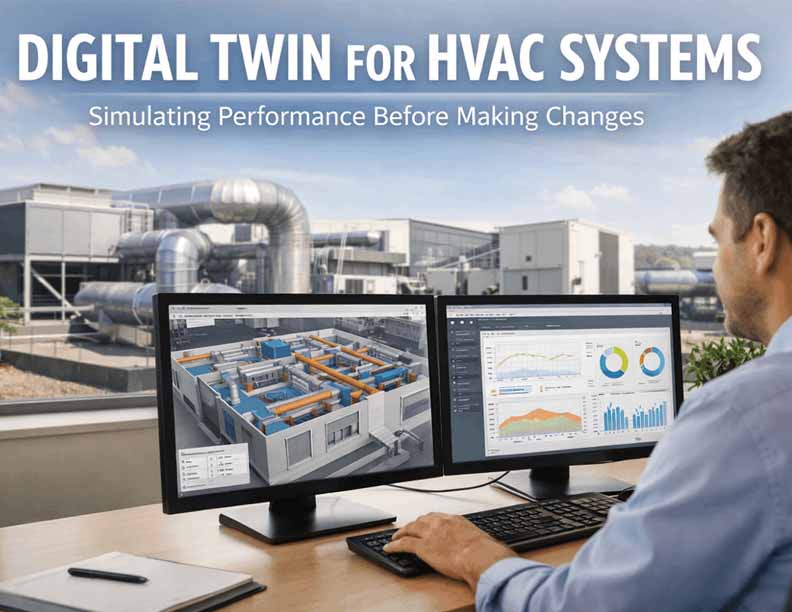
Rigging and lifting at site brings specialist requirements of its own: crane time has to be booked and coordinated with other trades, lifting plans need to account for the unit’s actual centre of gravity – which may differ from its geometric centre once coils and motors are factored in – and rooftop placements require careful assessment of wind loading during the lift itself. Site teams increasingly use pre-lift surveys and 3D coordination models to confirm clearances before a unit ever leaves the yard, reducing aborted lifts and the standby costs that come with them.
Timing the last mile against the broader construction programme is as much a scheduling discipline as a physical one. Delivering a rooftop unit before the roof structure can take its load simply shifts the storage burden – and the risk of weather exposure and damage – onto the site instead of the warehouse.
Technology and Digitalisation in HVAC Logistics
Logistics technology that has become standard in other industries is steadily making its way into HVAC supply chains. GPS-based fleet tracking gives project teams real-time visibility of where a critical delivery actually is, which matters enormously when a chiller’s arrival is the pacing item for a commissioning schedule. Shock and tilt sensors, built into low-cost IoT tags, can be affixed to sensitive components to log any impact or unusual orientation during transit – turning a simple visual check on delivery into an auditable record that can settle damage disputes and identify which leg of a journey caused a problem.
Transport and warehouse management systems, often integrated with the manufacturer’s ERP, let logistics planning start from the same production schedule that governs the factory floor, so packaging materials, vehicles and permits are arranged against a realistic dispatch date rather than reactively. Digital documentation – e-way bills, permit applications, packing lists tied to serial numbers – has cut down considerably on the paperwork delays that used to be routine in interstate equipment movement in India.
None of this technology replaces experienced planning – a route survey still has to be walked, and a rigging plan still has to be checked by an engineer who understands the equipment – but it closes the visibility gap that used to leave project teams guessing about equipment that was, quite literally, out of contact for days at a time.
Regulatory, Safety and Environmental Compliance
HVAC logistics sits at the intersection of several regulatory frameworks, and a compliance failure in any one of them can stop a shipment cold. Over-dimensional and overweight road cargo requires permits from national and state transport authorities, with axle-load limits, escort requirements and route restrictions that vary by jurisdiction. Refrigerant cylinders and any equipment carrying a factory refrigerant charge fall under hazardous-goods transport rules – internationally harmonised around the UN Model Regulations, under which most common HVAC refrigerants are classified as Division 2.2 non-flammable compressed gases, with the newer mildly flammable A2L refrigerants classified as Division 2.1 and subject to additional precautions around ignition sources and ventilation. Cylinders must travel upright, secured against movement, properly labelled with the refrigerant identity, and accompanied by the relevant safety documentation.
Driver and handling-crew training is a compliance requirement as much as a safety one: personnel loading, escorting or rigging heavy and hazardous cargo need to understand load securing, emergency response for a refrigerant leak, and the specific permit conditions attached to an ODC movement, such as restricted travel hours. Transit insurance for high-value equipment typically requires documented evidence of appropriate packaging and securing methods as a condition of any claim.
Environmental compliance is a growing consideration too. Packaging waste from timber crating and plastic wrapping is coming under increasing scrutiny, prompting a shift toward reusable crating systems on regular contract routes. Refrigerant handling during any transfer or recovery operation is governed by ozone- and climate-protection regulations that require certified recovery equipment and prohibit venting – a rule logistics and service personnel need to know as well as design engineers.
Best Practices and Emerging Trends
Several practices consistently separate HVAC supply chains that run smoothly from those that generate recurring damage claims and schedule slippage. Early coordination between design, packaging and logistics teams – checking a unit’s transport dimensions and site access constraints before final design freeze rather than after – prevents the costly surprise of a finished unit that cannot physically reach its plant room. Standardising lifting points, forklift pockets and rigging attachments into the product design itself, rather than treating handling as an afterthought, reduces damage risk across every subsequent touch point.
Modular and skid-mounted construction, where practical, reduces the number of separate handling and lifting operations by combining more components into fewer, better-protected assemblies before they ever leave the factory. Reusable and returnable packaging is gaining ground on high-frequency routes between a factory and its major project sites, cutting both cost and waste compared with single-use timber crating. And more manufacturers are building simple transit-damage feedback loops into their quality systems, so a coil damaged in transit is traced back to the specific packaging or handling step responsible, rather than simply replaced and forgotten.
Looking ahead, the direction of travel is toward greater visibility and less waste: real-time tracking and condition monitoring becoming standard rather than exceptional; packaging designed for reuse rather than disposal; and closer digital integration between production scheduling and logistics planning, so a unit’s journey to site is planned with the same precision as its thermal performance.

Aman Taluja is the Operations Head at Brightflow Engineers Pvt. Ltd. With hands-on experience in executing complex commercial and industrial projects, he specializes in delivering practical, performance-oriented HVAC solutions. At Brightflow, the focus is on the design, manufacturing, and execution of Air Handling Units (AHUs), Air Washers, ventilation systems, and air quality solutions, catering to a wide range of industries including hospitality, manufacturing, healthcare, and infrastructure. Over the years, he has been associated with reputed projects such as Le Méridien Hyderabad, NTPC Dadri, HAL Nashik, and Marriott Amritsar, delivering projects on time, within budget, and with a strong emphasis on quality.