


This world is truly a strange place: on one side, driven by ego, there is an ongoing endeavour to severely damage the climate through wars; on the other side, a group of climate-conscious scientists are striving wholeheartedly to curb environmental pollution through their novel discoveries and/or innovations.
Standing today amidst the frenzy of ever-increasing environmental pollution, perhaps no one can accurately predict what the climatic conditions of this world will be in the days to come. Still majority of the global population is hopeful that the scenario will improve. And as I mentioned in the previous paragraph, some scientists are making tireless efforts – to the best of their abilities – to save the global climate from collapse, their R&D works are certainly worthy of praise. I hope, their contributions will certainly push our HVAC-R industry towards more environment-friendliness in the coming days. Thus, let us take a look today at two such recent developments.
A High Potential AI data centre cooling method
Hadi Ghasemi, J. Willard Gibbs Distinguished Professor of Mechanical & Aerospace Engineering, University of Houston, has found that thin films designed into tree-like, or branched shapes release heat at least three times better than today’s best methods.
High-power AI data centres generate substantial heat due to dense GPU and accelerator deployments operating at extreme power densities. Efficient dissipation of that extreme heat is critical to ensure the operational stability, reliability and longevity of these systems.

Ghasemi reported his findings in two articles in International Journal of Heat and Mass Transfer. There he said, “Beyond achieving record performance, these new findings provide fundamental insight into the governing heat-transfer physics and establishes a rational pathway toward even higher thermal dissipation capacities.” In a big way, two of Ghasemi’s doctoral candidates, Amirmohammad Jahanbakhsh and Saber Badkoobeh Hezaveh contributed to the development.
Thin film evaporation
Significant advances in modern electronics, photonics and power systems have led to remarkable increases in power density while simultaneously introducing complex challenges related to thermal management.
Traditional cooling methods, including microchannels flow and spray cooling, have shown limitations when exposed to extreme heat flux because the liquid layer over the heat can become unstable as it evaporates, impeding its ability to carry away heat.
According to Ghasemi, “Thin film evaporation is a promising thermal management strategy due to its inherent ability to sustain high heat fluxes with minimal thermal resistance.”
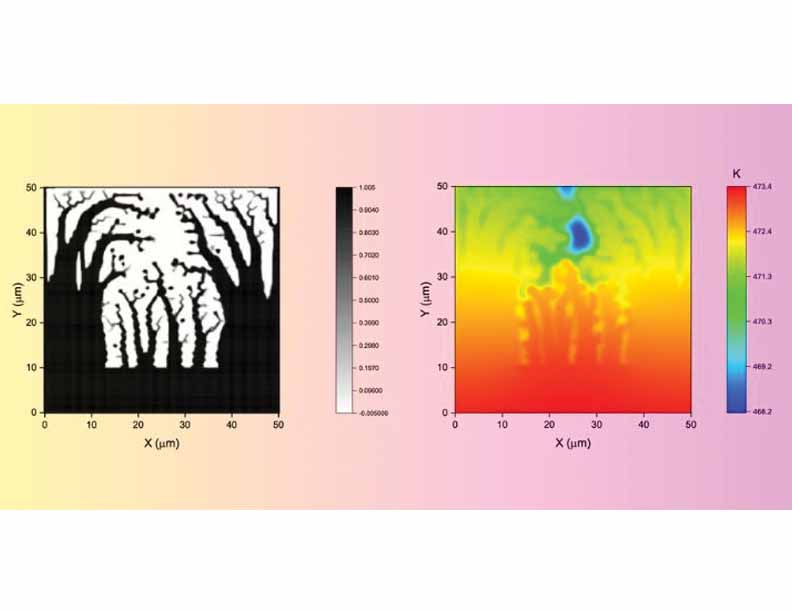
Image Courtesy: University of Houston
Still, scientists are figuring out how best to design thin film evaporation structures for their best efficiency. To address this, Ghasemi used two advanced computer methods – coupled topology optimisation and an AI model – to determine that the best shapes for thin film efficiency are branches like those on a tree that are about 50% solid and 50% empty space.
He said, “These structures could achieve high critical heat flux at much lower superheat compared to traditionally studied structures. The new structures can remove heat without having to get as hot as previous removal systems.”
According to him, the results demonstrate how physics-aware AI design can enable validated, high-impact cooling solutions for next-generation electronics and photonics.
(I acknowledge the contribution of Laurie Fickman for basic information on above.)
World’s first sub-zero Celsius elastocaloric green freezer
Elastocaloric devices are innovative, solid-state cooling and heating systems that utilise shape memory alloys (like nickel-titanium, or nitinol) to provide eco-friendly cooling without harmful refrigerants. They function by applying mechanical stress to ‘stretch’ or compress the metal, causing it to release heat, and releasing the stress to absorb heat, creating a high-efficiency cooling cycle.
Researchers at the School of Engineering of The Hong Kong University of Science and Technology (HKUST) have developed the world’s first Sub-Zero Celsius elastocaloric freezing device, capable of reaching temperatures as low as -120C. This represents a significant milestone in expanding green solid-state elastocaloric refrigeration technology into the global freezing industry, offering a promising solution to combat climate change and accelerate low-carbon transformation of the global freezing market. The findings have recently been published in the international journal Nature, under the title “Sub-zero Celsius Elastocaloric Cooling via Low-transition-temperature Alloys.”
As global warming intensifies, the demand for freezing has been growing rapidly and accounts for a significant portion of global electricity consumption. Mainstream freezing based on vapour compression cooling technology relies on refrigerants with high Global Warming Potential (GWP). As an eco-friendly alternative, solid-state cooling technology based on the elastocaloric effect of Shape Memory Alloys (SMAs) has drawn substantial attention from both academia and industry due to its zero greenhouse gas emissions and high energy efficiency potential. The technology harnesses the latent heat from cyclic phase transition of shape memory alloys to provide cooling without greenhouse gas refrigerants, offering a promising path to decarbonise the freezing sector of cooling industry and to mitigate global emissions and climate change.
However, the existing elastocaloric devices have been limited to air conditioning scenario for room temperature applications, it is important to expand the technology into the freezing segment that has the same market size as the air-conditioning segment.
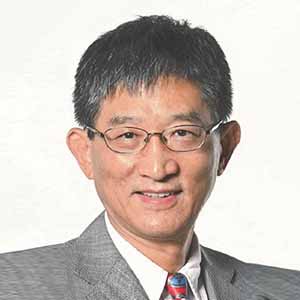
A research team led by Prof. Sun Qingping, Chair Professor from the Department of Mechanical and Aerospace Engineering at HKUST, has achieved a breakthrough in Sub-zero Celsius elastocaloric cooling. This advancement results from a synergistic combination of materials, heat transfer fluid and refrigeration structures. The features include:
- Super-elastic alloy: employing a binary low-transition-temperature nickel-titanium (NiTi) alloy with a high nickel content (51.2 at %) and lowering its austenite finish temperature (Af) to -20.80C. This alloy maintains excellent super-elasticity and a substantial latent heat even at -200C, with a peak adiabatic temperature change of 16.30C at 00C and a functional temperature window of 48.50C.
- Freezing-resistant heat transfer fluid: using a 30wt% aqueous calcium chloride solution as the working fluid. Its low freezing point ensures that it remains fluid in sub-zero operation, while its good wettability on the NiTi surface enhances heat exchange efficiency.
- Cascaded tubular architecture: the regenerator operates on a compression-based active Brayton cycle and consists of eight cascaded units, each containing three thin-walled NiTi tubes. This design offers a high surface area-to-volume ratio (8.68 mm-1) and withstands a compressive stress of 900MPa without buckling, as verified by X-ray computed tomography.
Research findings
Operating at 1Hz, the desktop-scale device achieved a cold-source temperature of -120C from a room-temperature heat sink (240C), establishing a temperature lift of 360C. This is the first reported sub-zero Celsius performance in elastocaloric cooling.
In a real-world demonstration, the system was integrated into a package measuring 1.0×0.5×0.5 m3 and tested outdoors at temperature between 20 and 250C. It successfully cooled an insulated chamber down to a stable -40C air temperature within 60 minutes and froze 20ml of distilled water into ice within 2 hours, validating its real-world freezing capability. The device demonstrated a specific cooling power of up to 1.43W g-1 under zero-temperature-lift conditions. In addition, the system’s coefficient of performance can reach 3.4 under ideal work-recovery assumption, highlighting its potential energy efficiency.
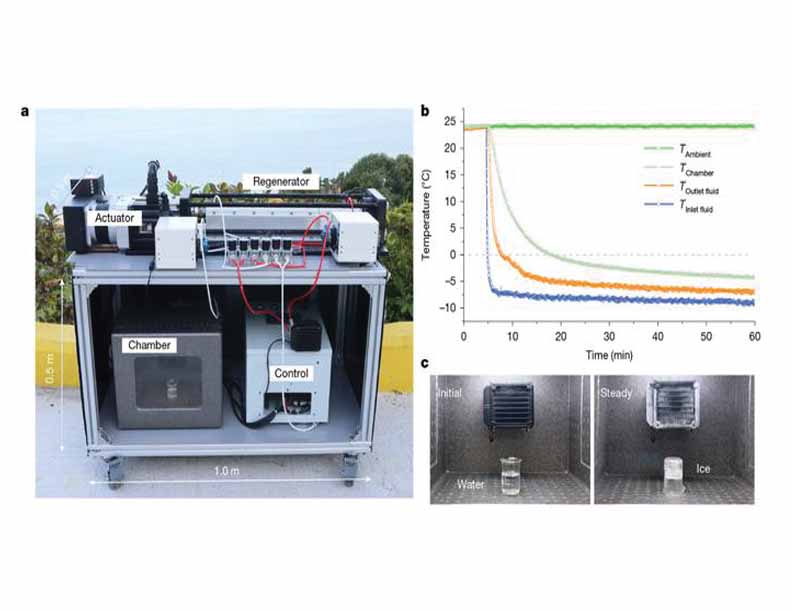
C from a room-temperature heat sink at 240 C, establishing a temperature lift of 360 C…
The work has significant impact on global decarbonisation to battle the climate change. According to published data, global Hydrofluorocarbon (HFC) emissions are projected to exceed 1.2 gigatons of CO2 equivalent annually by 2025, with roughly 27% originating from sub-zero freezing applications. This translates to approximately 330 million tons of CO2 equivalent each year. The successful demonstration of sub-zero elastocaloric cooling provides a viable, emission-free alternative for these applications. Widespread adoption of this technology could, therefore, potentially mitigate around 330 million tons of CO2 equivalent emissions annually, contributing substantially to global climate goals.
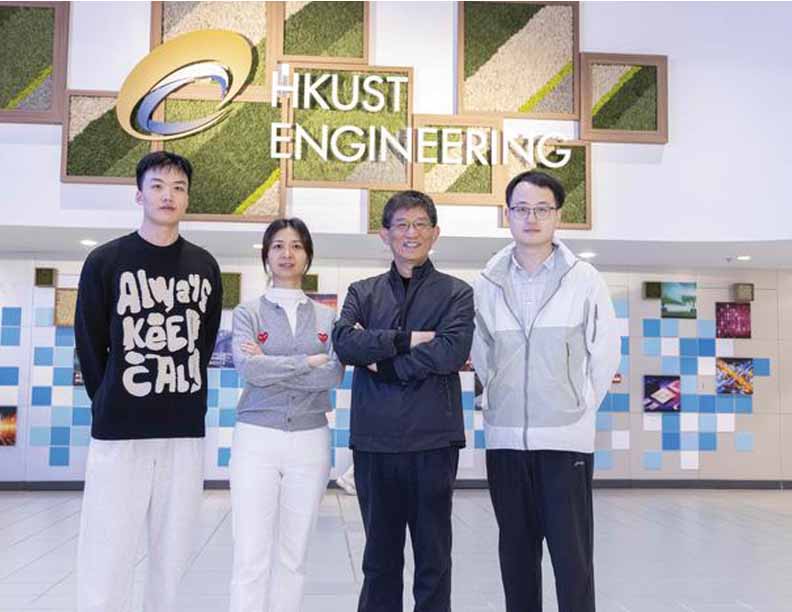
Zhou Guoan, Research Assistant Professor (1st right); and Li Zexi, PhD (1st left) – all from the Department of Mechanical
and Aerospace Engineering at HKUST…
Image Courtesy: H
Highlighting the importance of the research, team leader Prof. Sun Qingping, said, “This achievement demonstrates the potential for large-scale application of elastocaloric freezing technology. We are collaborating with industry to drive its commercialisation. As global regulations on HFCs tighten, this zero-emission, energy-efficient freezing technology is poised to reshape the freezing sector of the refrigeration industry and provide a key technical solution for carbon neutrality. Looking ahead, we will focus on optimising system efficiency, power density, and cost-effectiveness through advances in shape memory alloy materials, manufacturing, heat exchange design, and system integration and optimisation to achieve larger cooling power and high energy efficiency.”
By P. K. Chatterjee (PK)