
Advanced high-temperature alloys, such as nickel-based superalloys and titanium composites, are widely used in jet engines, heat shields, and propulsion systems. These materials need to undergo cleanroom-based processing to eliminate oxygen contamination.
The assembly and integration of spacecraft, missiles, and defence systems require cleanroom environments to prevent particulate contamination, Electrostatic Damage (ESD) and chemical degradation.
Missile guidance systems and hypersonic weaponry demand contamination-free assembly since any electrostatic discharge, dust particles, or molecular contamination could disrupt sensor accuracy and missile trajectory.
Inertial navigation sensors, radar seekers, and infrared detectors require cleanroom-based assembly to maintain their high precision and reliability in combat environments.
Secure electronic systems used in military applications require rigorous cleanroom fabrication protocols to prevent data corruption, cyber vulnerabilities, and Electromagnetic Interference (EMI).
Advanced encryption hardware, high-frequency communication chips, and guidance systems used in missile defence rely on contamination-free semiconductor fabrication to ensure their performance in hostile environments.
HVAC systems for temperature, humidity, and particle control
The indoor design temperature range for aerospace and aircraft manufacturing cleanrooms is 23 ± 0.30C, with the higher temperatures commonly used in summer, and the lower ones in winter. However, the user should provide guidance on specific required space temperature requirements. In Flat Panel Display (FPD) and semiconductor crystal pulling cleanroom design, space temperature is usually required at a constant level of
22 ± 0.30C, though FPD temperature tolerance is normally within ±1 K.
For aerospace and aircraft manufacturing cleanrooms, relative humidity (ɸ) should not exceed 60%; FPD and semiconductor crystal-pulling cleanrooms usually require indoor ɸ to be 50 ± 5% as design base.
High-Efficiency Particulate Air (HEPA) and Ultra-Low Particulate Air (ULPA) filters remove contaminants down to 0.12 microns, making them essential for semiconductor production, optical lens manufacturing, and spaceborne electronics assembly. HEPA filters for recirculating air should be protected with Minimum Efficiency Reporting Value (MERV) 11 bag or rigid media filters with as few other prefilters as required. Makeup air should include a minimum MERV 11 filters on the fan inlet and minimum MERV 16 filters on the fan discharge.
Requirements for high-bay cleanrooms
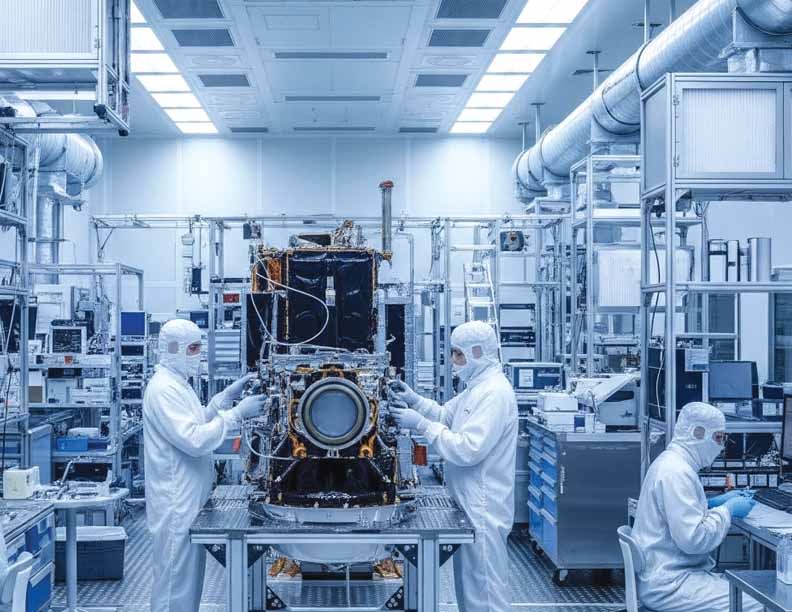
High-bay cleanrooms have ceiling heights between 12 and 50 m, with the higher ceilings used primarily in the aerospace industry for producing and testing missiles, launch vehicles, rocket engines, and communication and observation satellites, and lower ceilings primarily used in jet aircraft assembly, painting, and cleaning operations; flat panel display manufacturing; and in crystal-pulling areas in semiconductor chips manufacturing facilities.
Most high-bay cleanrooms are designed to meet ISO Class 7, Class 8 or higher as required by some U.S. Air Force and U.S. Navy specifications. FPD factories may require ISO Class 5, 6, or 7. Crystal-pulling cleanrooms for semiconductor microchips are usually specified in Class 5 to Class 6 range.
Air Velocity and Air Change Rate
For a given cleanroom, ACPH = 3600v/H, where
H = room height, ft.
v = average vertical air velocity, fpm
ACPH = air changes per hour
From the given equation, the ACPH α (1/H). The exception is a clean space where contamination is generated at a considerable height above the finished floor. Examples include semiconductor and FPD transport systems and aerospace product assembly. In these situations, the v may need to remain high to sweep away particles, and ACPH may be fixed regardless of the height of the space.
Source: Image generated using Google Gemini
Airflow pattern control
Non-unidirectional or turbulent airflow
- Aspects: Conventional flow cleanrooms, Class 8 or Class 7, have air flow patterns and velocities that are non-unidirectional. They rely on air dilution and filtration to continuously remove contaminants generated within the room. These types of rooms are typically used when the stringent controls of a unidirectional flow cleanroom are not required.
- Advantages: They are generally more energy efficient and less costly to operate than laminar flow cleanrooms.
- Disadvantages: The currents and eddies found in these rooms may carry contaminants generated in any area of the room and deposit them on the critical hardware requiring more attention to operational control.
- Applications: These types of clean rooms are utilised to repair sensitive electromechanical, electronic, and optical systems such as gyros, velocity meters, and reconnaissance cameras, etc.
Unidirectional or laminar airflow
Downflow or vertical airflow pattern
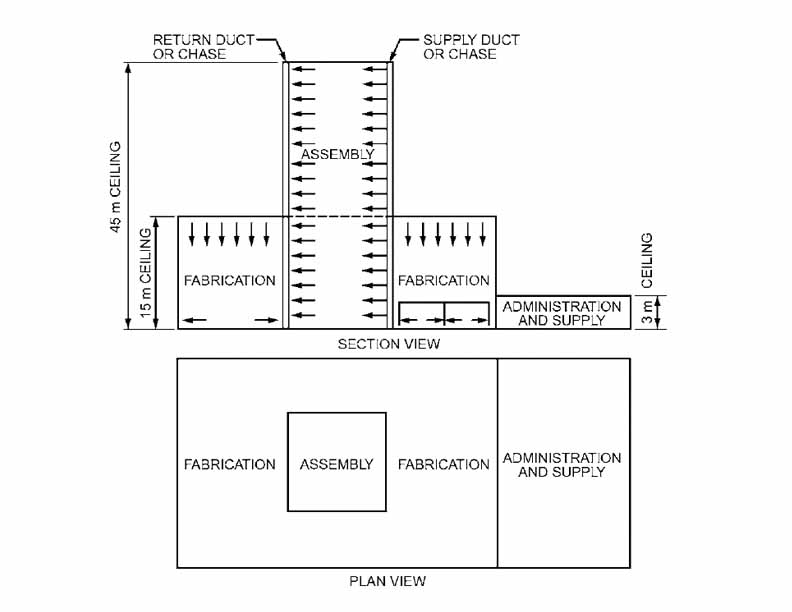
- Aspects: In downflow designs, air is delivered in a unidirectional pattern from the ceiling and returned through floor return openings or low sidewall returns. The objective is to shower the object from above so that all particles are flushed to the returns.
- Advantages: Downflow spaces allow space flexibility because more than one device may be worked on in the space at the same air cleanliness level. This air-flow design provides the greatest contamination control over an entire working area because airborne contamination is carried down and out of the room as soon as it is generated. These types of cleanrooms also take advantage of the force of gravity on larger particles for removal; therefore, the air velocity can be less than in a vertical airflow room (50 fpm) than the horizontal airflow room (100 fpm).
- Disadvantages: The disadvantage is the relative difficulty of balancing airflow. Any activity in the cleanroom that generates even a small amount of heat produces updrafts from buoyancy effects in downward-flowing air supply, resulting in the possibility of unforeseen turbulence. This design requires a perforated floor which limits the load capability to accommodate large aerospace structures.
- Applications: Downflow spaces are used for jet aircraft assembly, painting, and cleaning operations; FPD manufacturing and in crystal-pulling areas in fabs.
Source: ASHRAE
Crossflow or horizontal airflow pattern
- Aspects: In this design, air flows in parallel lines from one wall to an opposite exit wall. The most sensitive hardware is placed in front of the wall of HEPA filters with no obstructions in between to disturb the airflow. Some degree of air cleanliness will be sacrificed toward the exhaust end of the room.
- Advantages: Properly designed horizontal spaces are easier to balance than vertical flow spaces because supply and return air volumes may be controlled at different horizontal levels in the clean space.
- Disadvantages: Less contamination control than for downflow designs.
- Applications: Horizontal flow spaces are useful for producing and testing missiles, launch vehicles, rocket engines, and communication and observation satellites.
Mixed airflow
This design combines unidirectional and nonunidirectional airflow in the same room. Separative enclosures such as unidirectional cabinets (clean benches), isolators, or minienvironments can be used to enhance the air cleanliness for more critical zones. For aerospace manufacturing, laminar flow clean workstations, clean tents and other unidirectional flow clean air devices are used.
- Controlled Areas: These areas are intended to provide a semi-clean atmosphere for equipment and hardware that requires some degree of contamination control, but which does not require a high degree of temperature or humidity control. Some existing manufacturing areas in good condition can be converted to controlled areas with relatively minor modifications. For aerospace manufacturing, Class 8.5 controlled areas are used.P.S. Class 8.5 is not an identified classification in ISO 14644-1, but is used to designate facilities, commonly used in the aerospace industry.
Clean Work Areas (CWAs)
These areas having environmental requirements like cleanrooms, are not cleanrooms. They are permitted greater latitude in design features and operations than cleanrooms. For aerospace manufacturing, Class 8 CWAs are used.
Conclusion
For the manufacturing of various aerospace and defence products, in addition to cleanrooms officially classified by ISO while using high bay cleanrooms, internal classifications of clean spaces such as Class 8.5 controlled areas and Class 8 clean work areas have been instituted by the industry as per the requirements.

Rushikesh Jog possesses a bachelor’s degree in mechanical engineering and a post-graduate diploma in HVAC. He is currently working as an HVAC Design Engineer at Proficient, a pharmaceutical consultancy firm. Proficient provides various services such as pharmaceutical facility design, validation, Good Manufacturing Practices (GMPs) compliance, etc.