
Over the past decade, the cooling demand in India has grown steadily, often at rates of 15–20% annually in urban areas. Commercial buildings dominate electricity use for cooling, whereas hospitals and data centres operate chillers continuously, with little flexibility during peak hours. Summer afternoons routinely see overloaded transformers, rising demand charges, and an increased reliance on diesel generators.
Energy efficiency assessments indicate that India’s cooling-related peak electricity demand could approach 200 GW by 2030 if current trends continue. Meeting this demand using only conventional electric chillers would significantly strain the grid and increase the emissions. This reality has prompted a growing interest in cooling technologies that reduce dependence on grid electricity, particularly during periods of peak demand.
Solar-based cooling systems directly address this challenge. In India, solar availability aligns closely with peak cooling demand, allowing renewable energy to offset electricity use precisely when the grid is under the greatest stress.
Solar Absorption Cooling: Technology and Performance
Most solar absorption cooling installations in India are based on lithium bromide–water absorption chillers driven by solar thermal collectors. These systems use heat rather than electricity to produce chilled water, requiring only small amounts of electrical power for pumping and control.
Single-effect absorption chillers are the most widely deployed configuration. Operating at generator temperatures of approximately 85–1050C, typically supplied by evacuated tube collectors, these systems achieve coefficients of performance in the range of 0.65–0.75. Double-effect absorption chillers are used when high-temperature heat is available. These systems operate above 1500C, generally with concentrating collectors, and deliver higher efficiencies, with COP values in the range of 1.0–1.2.
In practice, single-effect systems dominate the installed base in India, particularly in solar-driven applications. Their lower cost, simpler design, and compatibility with moderate-temperature collectors make them well suited to Indian conditions. Double-effect systems are a smaller but important segment, especially in larger commercial and industrial facilities, where higher efficiency justifies the added complexity. Although triple-effect chillers are commercially available, their use in India is largely limited to steam- or process-heat-driven applications rather than solar systems.
Recent improvements in component design, heat recovery, and control strategies have significantly enhanced system reliability. Modern absorption systems can now operate stably under variable solar conditions, making them suitable for hospitals, campuses, and industrial facilities that require continuous cooling.
Solar Collectors, Costs, and Water Benefits
From a deployment perspective, Evacuated Tube Collectors (ETCs) are the most common choice in India. The typical installed costs range from `13,000 to `17,000 per square meter, translating to approximately `0.45–0.70 lakh per ton of refrigeration for absorption systems.
Parabolic troughs and Scheffler dish concentrators are used for high-temperature applications. Although these involve higher upfront costs, they enable a greater solar contribution and support double-effect chillers in large installations.
A key benefit of solar absorption cooling is the reduction in water consumption. By allowing systems to use dry or hybrid heat rejection, these solutions can significantly decrease reliance on cooling tower water, which is an especially valuable advantage for water-stressed urban areas.
Policy support further improves specific financial benefits. The MNRE programmes offer capital subsidies of up to 30–40% for approved solar thermal installations, particularly for institutional and industrial users. Favourable GST treatment and accelerated depreciation benefits also help shorten payback periods.
Evidence from Indian Installations
Several Indian projects have demonstrated that solar absorption cooling has shifted beyond the experimental stage.
At the Muni Seva Ashram in Gujarat, a 100 TR hospital cooling system powered by Scheffler concentrators has operated reliably for many years, reducing both conventional fuel use and grid electricity consumption.
At Mahindra & Mahindra’s Pune facility, solar-assisted absorption cooling integrated with paint-shop operations has delivered 20–25% reductions in daytime energy costs, thereby validating the industrial relevance of the technology.
A notable early urban example is the 160 TR absorption cooling system installed at the Chhatrapati Shivaji Hospital in Kalwa (Thane). Powered by parabolic solar concentrators, the system supplies chilled water for hospital use. Based on typical hospital load profiles, a system of this scale can offset approximately 200–300 kWh of grid electricity per day during peak operating hours, thereby reducing both the peak demand and diesel generator usage during summer afternoons.
Hybrid Absorption–Compression Cooling Systems
In many Indian projects, absorption systems are not deployed in isolation. Instead, they are integrated with conventional electric chillers in hybrid absorption–compression configurations. In these systems, the absorption chiller handles the base cooling load during daytime hours, whereas electric vapour-compression chillers meet the peak and nighttime demands.
This approach reduces the peak electrical demand while preserving operational reliability, which is an important consideration for hospitals, commercial buildings, and campuses. In practice, many Indian installations already operate in this hybrid mode, even if they are not formally labelled as such.
In the Indian context, hybrid solar cooling systems are most effective in medium-to large-scale installations (above approximately 50–100 TR) with stable daytime loads, whereas smaller systems are generally better served by photovoltaic-driven compression cooling.
Hybrid configurations include reduced peak electricity demand, lower compressor run hours, and improved resilience during grid disturbances.
Hybrid Photovoltaic Solar Cooling with Low-GWP Refrigerants
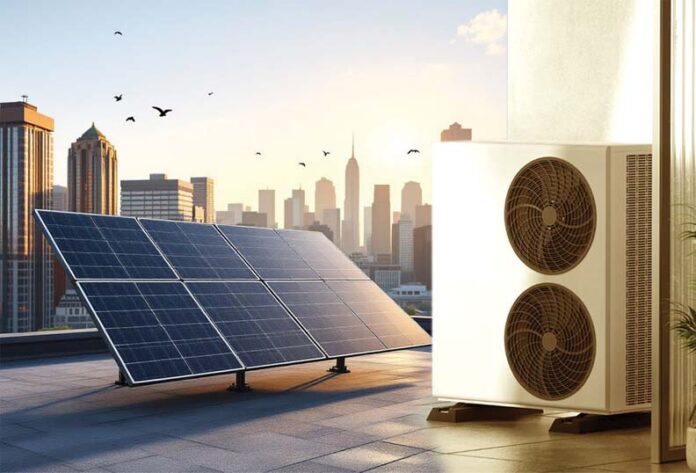
In India, hybrid Photovoltaic (PV) solar cooling systems are becoming increasingly popular alongside solar-thermal methods. These systems utilise PV panels installed on rooftops or the ground to directly power high-efficiency compression chillers, thus decreasing reliance on the electrical grid during peak daytime cooling periods.
PV-hybrid systems, when paired with refrigerants like R1234ze or R1233zd that have low Ozone Depletion Potential (ODP) and low Global Warming Potential (GWP), can greatly diminish both the indirect emissions from electricity consumption and the direct emissions from refrigerant leaks. Depending on the Photovoltaic (PV) capacity and the load profile, these systems can achieve reductions in peak grid demand by 20–30% and annual electricity savings ranging from 25–45%. Notably, PV-based hybrids require minimal modifications to existing HVAC systems, making them an appealing option for retrofitting.
Thermal Storage and the Role of PCM
Thermal storage significantly enhances the use of solar cooling. In India, most systems depend on sensible hot-water storage because it is straightforward and cost-effective. Researchers are investigating Phase Change Materials (PCM) as advanced storage solutions that offer greater energy density and better temperature regulation. Nevertheless, in India, their application is mostly confined to research and pilot initiatives, with sensible storage still being the predominant choice in existing systems.
Looking Ahead
In India, the next stage of solar cooling expansion is expected to be propelled by the broader use of hybrid systems featuring low-GWP refrigerants, enhanced control mechanisms, and the gradual incorporation of advanced storage solutions as their costs decrease.
Rather than completely replacing traditional cooling methods, solar-based systems are increasingly being utilised to alleviate peak loads, reduce operational expenses, and enhance system resilience.

Mir Aqueel Ali, Associate Professor in Babasaheb Naik College of Engineering, Pusad, has thirty-four years of teaching experience. He has published several research articles in International Conferences and journals. His interests include refrigeration and Air conditioning.