

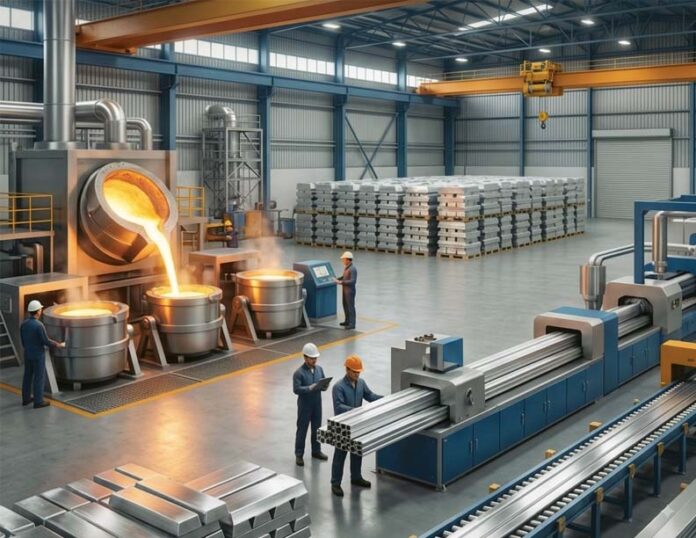
The world is entering a new era defined by electrification, sustainability, and energy efficiency. Governments, industries, and consumers across the globe are increasingly embracing cleaner technologies to reduce carbon emissions, improve energy utilization, and build a more sustainable future. At the centre of this transformation is aluminium—a material that has quietly evolved into one of the most indispensable engineering resources of the modern industrial age.
Its exceptional combination of lightweight properties, superior thermal conductivity, corrosion resistance, excellent formability, durability, and complete recyclability makes aluminium ideally suited for the technologies shaping the future. These characteristics enable manufacturers to design products that are lighter, stronger, more energy-efficient, and environmentally sustainable.
Aluminium – The Metal of the Future
Aluminium is widely recognised as the ‘Green Metal’ because of its remarkable contribution to sustainable manufacturing and the circular economy. Unlike many engineering materials, aluminium can be recycled repeatedly without any loss of its original properties. Moreover, recycling aluminium requires approximately 95% less energy than producing primary aluminium from bauxite ore, making it one of the most environmentally responsible materials available today.
Its engineering advantages extend far beyond sustainability. Aluminium combines low density with a high strength-to-weight ratio, allowing manufacturers to reduce product weight without compromising structural integrity. The material also offers excellent thermal and electrical conductivity, outstanding corrosion resistance, superior formability, and excellent machinability. In addition, its long service life and complete recyclability further enhance its value across diverse industrial applications.
These characteristics make aluminium an ideal choice for industries striving to improve operational efficiency, lower production and operating costs, enhance product performance, and reduce environmental impact. As industries continue to transition towards cleaner technologies and energy-efficient solutions, aluminium is expected to play an increasingly vital role in enabling innovation and sustainable industrial growth
Aluminium in Electric Vehicle Batteries
Electric Vehicles (EVs) represent one of the fastest-growing segments of the global automotive industry, driven by increasing environmental awareness, government incentives, and rapid technological advancements. Since battery systems account for a significant proportion of an EV’s total weight, the use of lightweight yet durable materials has become essential for improving driving range, energy efficiency, and overall vehicle performance. Aluminium has consequently emerged as the preferred material for several critical battery components owing to its unique combination of strength, lightweight characteristics, corrosion resistance, and excellent thermal conductivity.
Battery Enclosures
Battery enclosures form the primary protective structure surrounding lithium-ion battery packs. Their role is to safeguard battery cells against impacts, moisture, vibration, and external debris while maintaining the structural integrity of the vehicle.
Aluminium has become the material of choice for battery enclosures because it provides high structural strength and excellent crash protection without adding unnecessary weight. Its corrosion-resistant properties ensure long-term durability, while its superior formability allows manufacturers to produce complex enclosure designs with greater manufacturing efficiency. By significantly reducing the weight of battery enclosures, aluminium directly contributes to improved driving range and enhanced overall vehicle efficiency.
Battery Cooling Plates
Effective thermal management is essential for maintaining battery performance, charging efficiency, operational safety, and service life. Since battery temperature has a direct impact on vehicle reliability, efficient cooling systems are indispensable in modern electric vehicles.
Aluminium cooling plates are extensively used because of their exceptional thermal conductivity, enabling rapid heat dissipation and uniform temperature distribution throughout the battery pack. This improves charging performance, enhances battery safety, and extends battery life. As ultra-fast charging technologies continue to evolve, efficient thermal management solutions based on aluminium will become even more critical in next-generation electric vehicles.
Busbars and Electrical Connections
Modern EV battery packs contain numerous electrical connections responsible for efficiently transferring power between battery cells and other electrical systems. Aluminium busbars have gained widespread acceptance due to their lightweight nature, competitive cost, good electrical conductivity, and high operational reliability.
With continuous advancements in joining techniques and engineering design, aluminium has emerged as a highly attractive alternative for many electrical applications, enabling manufacturers to achieve an optimal balance between performance, weight reduction, and cost efficiency.
Battery Tray Structures
Battery trays serve as the structural foundation of an EV battery pack, supporting its considerable weight while maintaining the vehicle’s rigidity and overall structural stability.
Aluminium battery trays provide several engineering advantages, including superior crash energy absorption, excellent fatigue resistance, reduced overall vehicle weight, and an extended structural service life. These characteristics contribute not only to improved vehicle safety but also to enhanced long-term durability and operational efficiency.
Vehicle Lightweighting
Vehicle weight has a direct influence on several critical performance parameters, including driving range, energy consumption, acceleration, battery size, and operating costs. Consequently, lightweight vehicle design has become one of the primary objectives of EV manufacturers worldwide.
By replacing heavier conventional materials with aluminium, manufacturers can substantially reduce vehicle mass without compromising structural performance or safety. This reduction in weight improves energy efficiency, extends driving range, enhances vehicle dynamics, and supports the development of smaller, more efficient battery systems, ultimately contributing to lower operating costs and a better overall driving experience.
Aluminium in EV Thermal Management
Thermal management has become one of the most critical aspects of modern electric vehicle design, particularly as battery capacities increase and charging technologies continue to advance. Maintaining optimum operating temperatures is essential for ensuring battery efficiency, safety, reliability, and long-term performance.
Aluminium plays a central role in EV thermal management systems and is extensively used in battery cooling channels, heat exchangers, refrigerant piping, chillers, cooling manifolds, power electronics cooling systems, and motor cooling assemblies. Its outstanding thermal conductivity enables efficient heat transfer while keeping system weight to a minimum.
As future electric vehicles increasingly adopt sophisticated liquid-cooled thermal management systems, aluminium will continue to provide a significant engineering advantage by delivering superior thermal performance, enhanced reliability, and improved overall system efficiency.
Importance of Aluminium in the HVAC Industry
The HVAC industry has relied on aluminium for decades, and its importance continues to grow as the sector moves towards higher energy efficiency, improved system performance, and more sustainable cooling technologies. With increasingly stringent environmental regulations and rising demand for energy-efficient buildings, aluminium has become one of the most critical engineering materials in modern HVAC equipment.
Today, aluminium is extensively used in a wide range of HVAC applications, including evaporator coils, condenser coils, aluminium finstock, microchannel heat exchangers, refrigeration systems, air handling units, heat pumps, and chilled water systems. Its excellent thermal conductivity, lightweight nature, corrosion resistance, and ease of fabrication enable manufacturers to design compact, high-performance systems that consume less energy while delivering superior cooling efficiency.
As global demand for residential, commercial, and industrial air-conditioning continues to rise, aluminium will remain central to the development of next-generation HVAC technologies.
Aluminium Finstock
Aluminium finstock is one of the most essential materials used in heat exchanger manufacturing and plays a vital role in determining the overall efficiency of HVAC systems. By increasing the effective heat transfer surface area, finstock enables faster and more efficient heat exchange between refrigerants and the surrounding air.
In addition to enhancing cooling performance, aluminium finstock helps reduce the overall size of HVAC equipment while improving airflow and lowering energy consumption. The use of hydrophilic-coated finstock further enhances system performance by promoting efficient condensate drainage, reducing water retention, and maintaining long-term operational efficiency. These characteristics make aluminium finstock indispensable in the production of compact, reliable, and energy-efficient cooling systems.
Microchannel Heat Exchangers
Microchannel heat exchanger technology has transformed the HVAC industry by delivering significantly higher performance compared to conventional tube-and-fin systems. Manufactured primarily from aluminium, these advanced heat exchangers provide superior heat transfer efficiency while requiring a lower refrigerant charge.
Their compact design and lightweight construction enable manufacturers to develop smaller and more efficient HVAC equipment without compromising performance. In addition, aluminium microchannel heat exchangers offer excellent corrosion resistance and lower manufacturing costs, making them an increasingly preferred solution across residential, commercial, and industrial cooling applications.
As the industry continues to prioritise energy efficiency and equipment miniaturisation, microchannel technology is expected to become even more widely adopted.
Aluminium and Sustainable Cooling
Growing environmental awareness and increasingly stringent global regulations are accelerating the adoption of sustainable cooling technologies across the HVAC industry. The transition towards low-global warming potential (Low-GWP) refrigerants, high-efficiency heat pumps, advanced chillers, green buildings, and net-zero energy projects is creating unprecedented demand for high-performance aluminium components.
Aluminium heat exchangers have become integral to these technologies because they combine exceptional thermal efficiency with lightweight construction and complete recyclability. Their ability to improve system performance while reducing environmental impact makes aluminium a key enabler of sustainable cooling solutions.
As governments and industries continue to pursue ambitious carbon reduction targets, aluminium will play an increasingly significant role in supporting the development of environmentally responsible, energy-efficient HVAC systems that meet the evolving demands of modern infrastructure.
Aluminium in Renewable Energy
Beyond its expanding role in electric vehicles and HVAC systems, aluminium has become a fundamental material supporting the global transition towards renewable energy. As countries invest heavily in clean energy infrastructure to achieve carbon neutrality, the demand for aluminium continues to rise across multiple renewable energy applications.
Today, aluminium is widely used in solar panel frames, wind turbine components, battery energy storage systems, hydrogen infrastructure, transmission equipment, and electric vehicle charging stations. Its lightweight nature, corrosion resistance, structural strength, and excellent durability make it ideally suited for installations that require long service life with minimal maintenance.
As renewable energy deployment accelerates worldwide, aluminium will continue to play a crucial role in enabling reliable, efficient, and sustainable energy systems.
Why Aluminium Will Dominate the Next Twenty Years
Several global megatrends strongly support the long-term growth of aluminium demand. Rapid industrial transformation, electrification, sustainability initiatives, and advances in manufacturing technologies are expected to position aluminium as one of the most strategically important engineering materials over the next two decades.
Rapid EV Adoption
Electric vehicle production continues to expand across passenger vehicles, commercial vehicles, buses, and two-wheelers. Every new electric vehicle incorporates significant quantities of aluminium in its structural components, battery enclosures, thermal management systems, and battery packs. As global EV adoption accelerates, aluminium consumption within the automotive sector is expected to increase proportionately.
Expansion of Battery Manufacturing
Large-scale battery manufacturing facilities are being established across the world to meet the rapidly growing demand for electric mobility and energy storage solutions. These facilities rely extensively on aluminium for battery foil, cooling systems, structural components, electrical interconnections, and various production equipment. Consequently, the continued expansion of battery manufacturing will remain a major driver of aluminium demand.
Growth of the HVAC Market
The global HVAC industry is experiencing sustained growth, supported by rapid urbanisation, rising living standards, increasing investments in data centres, commercial buildings, industrial refrigeration, pharmaceutical manufacturing, and cold chain logistics. Each of these sectors requires substantial quantities of aluminium products to improve energy efficiency and thermal performance, further strengthening long-term market demand.
Smart Buildings
Future buildings will increasingly integrate intelligent HVAC controls, energy-efficient cooling systems, heat recovery technologies, and advanced building automation. High-performance aluminium heat exchangers will remain central to these integrated systems, enabling greater energy savings, improved operational efficiency, and enhanced occupant comfort.
Opportunities for Indian Manufacturers
India is rapidly emerging as a global manufacturing hub, supported by government initiatives promoting domestic production, infrastructure development, and industrial self-reliance. This transformation presents substantial opportunities for Indian aluminium manufacturers to strengthen their presence in both domestic and international markets.
Key growth opportunities include the production of HVAC finstock, battery foil, aluminium rolling products, brazing sheets, extruded battery enclosures, EV thermal management components, and other export-oriented aluminium products. As global OEMs continue to diversify their supply chains, Indian manufacturers capable of consistently delivering international quality standards, technological innovation, and competitive pricing will be well positioned to become trusted partners in the global aluminium value chain.
Challenges Ahead
Despite the industry’s exceptionally strong growth prospects, aluminium manufacturers must address several critical challenges to remain competitive. These include volatile raw material prices, rising energy costs, increasingly stringent quality expectations, supply chain disruptions, intense competition from low-cost imports, and the continuous need for technological innovation.
Successfully overcoming these challenges will require sustained investment in advanced manufacturing technologies, robust process control systems, quality assurance, operational efficiency, and customer-focused product development. Organisations that proactively adapt to these evolving market conditions will be better equipped to capitalise on future growth opportunities.
Conclusion
Aluminium has evolved into one of the most strategic materials driving the global shift towards electrification, sustainability, and energy efficiency. Its lightweight properties, excellent thermal conductivity, corrosion resistance, durability, and recyclability make it indispensable across electric vehicles, HVAC systems, renewable energy, and modern infrastructure.
As demand for electric mobility, energy-efficient cooling, and clean energy continues to grow, aluminium will play an increasingly important role in developing high-performance, sustainable solutions. At the same time, recycling and low-carbon manufacturing will further strengthen its position in the global industrial landscape.
For manufacturers and technology providers, the next two decades present significant opportunities for growth through innovation, quality, and sustainable production. More than just an engineering material, aluminium is set to become a key enabler of future transportation, cooling technologies, renewable energy, and industrial development.

Bhupendra Ojha, a dedicated HVAC expert at Marudhar Industries Limited, Ahmedabad, brings 12+ years of experience, striving to shape the future of sustainable cooling in India.