
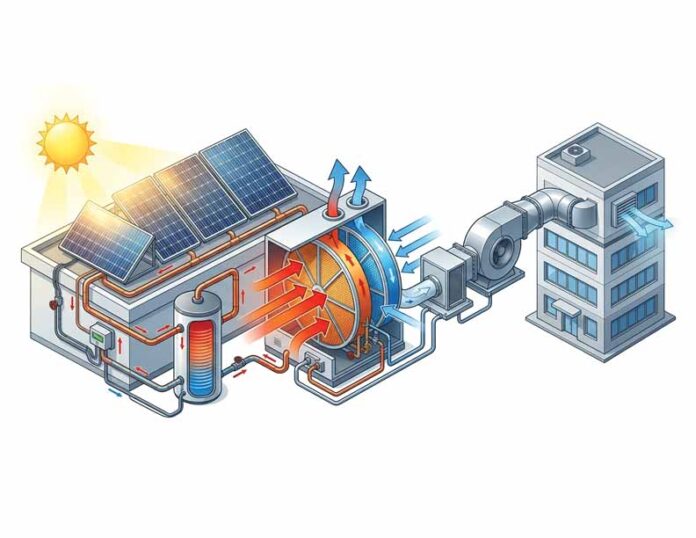
The growing demand for space cooling and humidity control in residential, commercial, and industrial buildings has led to a rapid increase in energy consumption associated with conventional air-conditioning systems. These systems, primarily based on vapour compression technology, rely heavily on electricity and often use refrigerants with high global warming potential, contributing to environmental concerns such as greenhouse gas emissions and climate change.
A solar-assisted regeneration system is integrated with a rotary solid desiccant wheel, where low-grade heat from solar collectors is utilized to desorb moisture from the desiccant material. Furthermore, this result into the potential for energy savings, reduced operational costs, and lower carbon emissions. The previous findings confirm that integrating solar thermal energy with desiccant cooling systems offers a viable pathway toward sustainable air-conditioning solutions, particularly in hot and humid regions.
In hot and humid regions, where latent cooling loads dominate, conventional systems become less efficient due to the additional energy required for dehumidification. Consequently, there is a pressing need to explore alternative, energy-efficient, and environmentally sustainable cooling technologies that can effectively handle both sensible and latent loads.
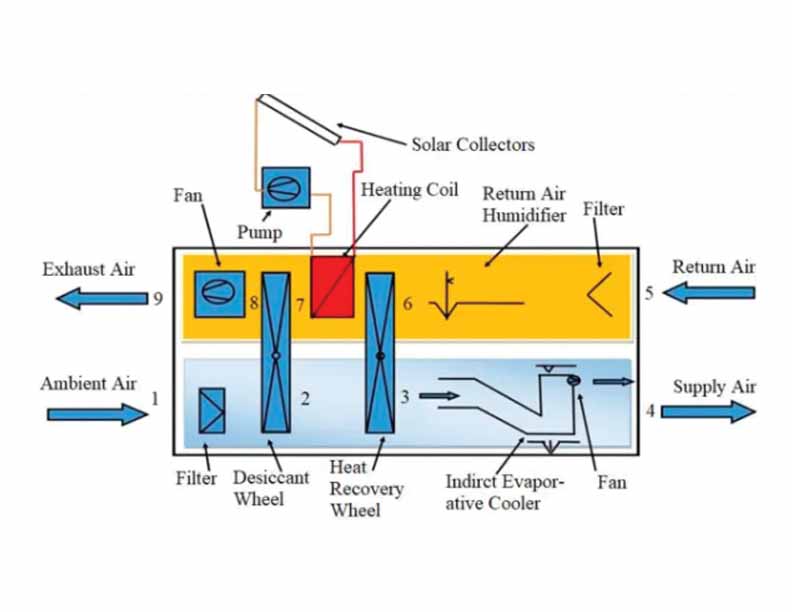
Desiccant-based dehumidification and cooling systems have emerged as a promising solution to address these challenges. These systems utilize hygroscopic materials, such as silica gel or molecular sieves, to remove moisture from the air, thereby improving indoor air quality and thermal comfort. By separating the latent and sensible cooling processes, desiccant systems can significantly enhance overall system efficiency. However, the performance of desiccant cooling systems is highly dependent on the regeneration process, in which the desiccant material is dried by removing the adsorbed moisture.
This regeneration typically requires a continuous supply of thermal energy, which is often provided by electrical heaters or fossil fuel sources, thereby limiting the overall sustainability of the system.
To overcome this limitation, the integration of solar thermal energy into the regeneration process has gained considerable attention in recent years. Solar energy is abundant, renewable, and particularly well-suited for cooling applications, as peak solar availability coincides with maximum cooling demand. Solar thermal collectors can provide low- to medium-grade heat, typically in the range of 50–90°C, which is adequate for regenerating most solid desiccant materials.
By utilizing solar energy for regeneration, the dependency on conventional energy sources can be significantly reduced, leading to lower operational costs and minimized environmental impact.
Recent advancements in solar thermal technologies, including flat plate collectors, evacuated tube collectors, and thermal energy storage systems, have further enhanced the feasibility and reliability of solar-assisted desiccant systems. Additionally, the use of rotary desiccant wheels and hybrid system configurations has improved heat and mass transfer characteristics, enabling more efficient operation under varying climatic conditions.
Despite these advancements, challenges remain in achieving consistent regeneration performance under fluctuating solar radiation, optimizing system design parameters, and ensuring economic viability. In this context, the present study focuses on enhancing the regeneration process of desiccant materials using solar thermal techniques.
The research aims to evaluate the performance of a solar-assisted desiccant regeneration system under different operating conditions, with particular emphasis on regeneration temperature, moisture removal efficiency, and overall system effectiveness. By addressing the key limitations associated with conventional regeneration methods, this work contributes to the development of sustainable and energy-efficient cooling technologies suitable for modern building applications, especially in regions characterized by high temperature and humidity.
Working of Solar Powered Desiccant Dehumidification and Cooling System
A solar-powered desiccant dehumidification and cooling system is an energy-efficient alternative to conventional air-conditioning, particularly suitable for hot and humid climates. It operates by separating the latent (moisture removal) and sensible (temperature reduction) cooling processes, using solar thermal energy to regenerate the desiccant material.
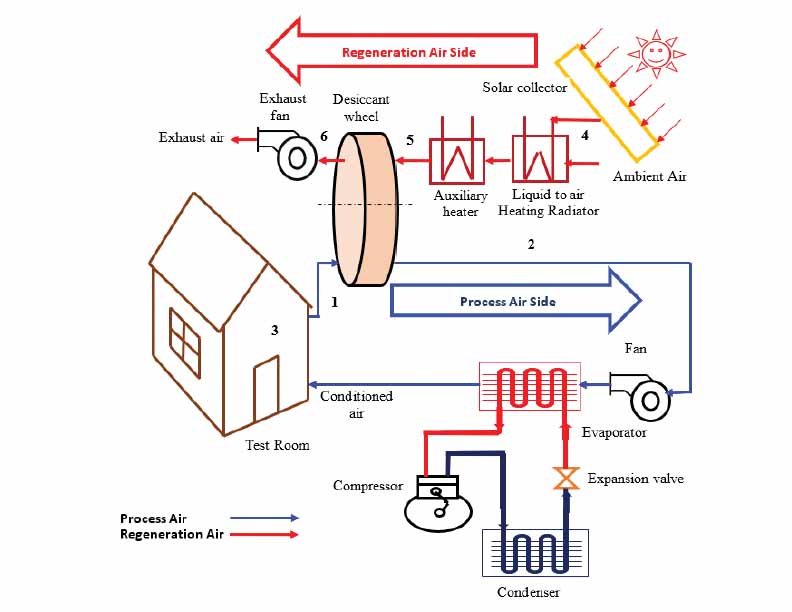
The schematic diagram as shown in Fig. 1 consists of a rotary solid desiccant wheel, process air side duct, regeneration air side duct, conventional vapour compression air conditioning system, conventional plate type air heater, liquid to air heat exchanger, solar evacuated tube collector and measuring devices.
From process air duct return room air stream at state 1 passes through the rotary solid desiccant wheel as a process air side. Moisture from the process air is absorbed by rotating solid desiccant wheel because of the difference between partial pressure of moisture in the air and that in desiccant material. Thus, a warm and dry air stream exits the dehumidifier at state 2. An air conditioning system runs on a conventional vapour compression refrigeration system reduces the temperature of process air to state 3 without affecting its humidity ratio. At the regeneration side, ambient air at state 4 first passes through a liquid to air heating radiator and conventional heater.
The ambient air is heated by a radiator using solar energy and also has an option for heating by a plate-type conventional heater to a required regeneration temperature at state 5. At last, hot regeneration air extracts humidity from the desiccant wheel and exits to ambient at state point 6. After regenerating the desiccant wheel, the air is finally exhausted to the atmosphere by an exhaust fan.
One of the most widely explored advanced methods is solar thermal regeneration, where flat plate collectors, evacuated tube collectors, or concentrating solar collectors are used to provide the necessary heat energy for desorption, allowing systems to operate sustainably with minimal environmental impact and making them particularly attractive for regions with high solar insolation.
Desiccant Regeneration by Waste Thermal Heat
Regeneration of the desiccant material at low temperature will give more benefits in terms of energy efficiency. The use of waste heat from any system will also reduce the operation cost of the desiccant system. Common regeneration methods use industrial waste heat or condenser waste heat.
A condenser based desiccant regeneration is categorized as an energy-efficient drying system due to its low energy consumption. The combination of a condenser waste heat system and a desiccant system in drying applications improves energy efficiency and produces air with lower humidity. This combined system is commonly referred to as a hybrid desiccant system.
The heat released by the VCR condenser through the exhaust can be utilized to regenerate the desiccant materials. An evaporator and a desiccant material together carry out the dehumidification process, producing processed air with improved conditions at low energy consumption. A hybrid system combining a condenser waste heat and a desiccant wheel to produce low-cost drying and supply air at low dew point temperatures (DPT). This system is used for rapid surface drying to avoid re-condensation at low DPT and low Dry Bulb Temperatures (DBT), in the ranges of −10°C to −20°C and 20°C to 30°C, respectively, after a product is dried.
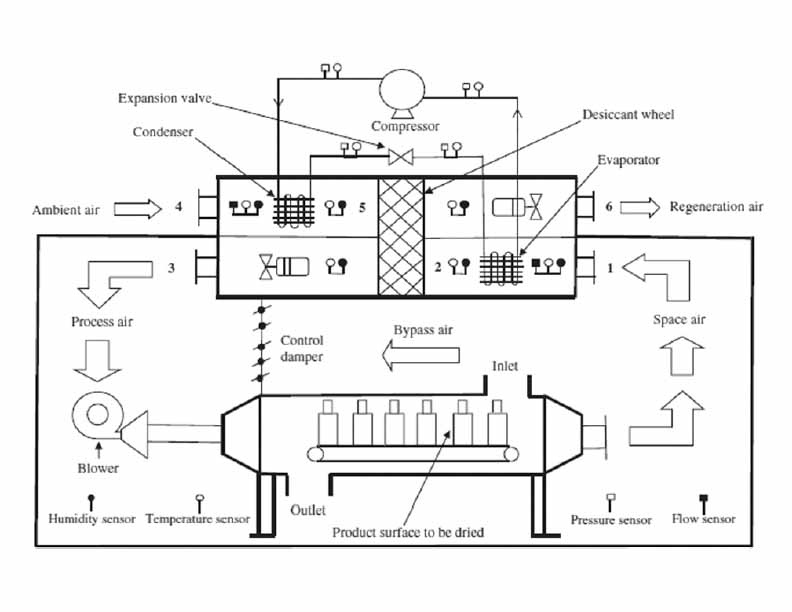
The heat dissipated by the condenser is used to regenerate the desiccant wheel. Moisture from the ambient air is removed through a dehumidification process involving condensation in the evaporator and adsorption using a solid desiccant, thereby producing dried air. The schematic diagram for the hybrid system is shown in Fig. 2. This system is capable of saving heat energy by up to 30–60% compared to conventional desiccant wheel system. Additionally, the inclusion of the desiccant wheel improves the Specific Moisture Extraction Rate (SMER) by 12–20%.
Conclusions
The use of solar energy or waste thermal energy for the regeneration of desiccant materials has been extensively studied due to its availability as a free and renewable energy source. Although the initial investment in solar energy systems is relatively high, it offers significant cost savings over the long term.
Therefore, the economic feasibility of such systems should be evaluated by considering the payback period. However, solar radiation is inherently weather-dependent, which introduces variability in system performance. As a result, a backup energy source or thermal energy storage system is necessary to ensure continuous operation of the drying process during periods of low or unavailable solar radiation.

Dr. (Prof.) D.B. Jani received Ph.D. in Thermal Science (Mechanical Engineering) from Indian Institute of Technology (IIT) Roorkee. Currently he is a recognized Ph.D. Supervisor at Gujarat Technological University (GTU). He has published more than 280 Research Articles in reputed International Conferences and Journals. He has also published 25 reputed books/book chapters and patents in area of thermal engineering. He has been working as an Academic Editor for the Journal of Materials Science Research and Reviews. Presently, he is an Associate Professor at GEC, Bhavnagar, Gujarat Technological University, GTU, Ahmedabad (Education Department, State of Gujarat, India). He has obtained his Master of Engineering in Automobile Engineering from Gujarat University, Ahmedabad, Gujarat. He has more than 26 years of experience in teaching at various institutions at undergraduate and postgraduate/PhD level in mechanical engineering. He is a life member in professional societies and bodies like ISTE, ISHRAE, MTTF, REST, Green ThinkerZ etc. He is a recipient of Best Teacher award (2020), Excellent researcher award (2020), Innovative academician award (2024). His area of research is Desiccant cooling, ANN, TRNSYS, and Exergy.