
The Indian cold chain logistics sector is undergoing a profound structural transformation, signaling a shift away from conventional, incremental diesel-based improvements toward a deeply integrated paradigm defined by electrification and intelligent monitoring. This transition is not driven solely by environmental preferences but is rooted in a fundamental re-engineering of the supply chain, supported by verifiable operational economics, accelerating policy mandates, and burgeoning market demand. This synthesis report analyzes the converging forces of Battery Electric Trucks (BETs) and Artificial Intelligence of Things (AIoT) systems that are poised to establish a resilient, efficient, and zero-emission cold transport backbone for India.
The Exponential Growth Trajectory and Climate Pressure
The strategic importance of the cold chain sector is underscored by its exponential growth trajectory. Market research indicates that the Indian cold chain logistics market is estimated to exhibit a robust Compound Annual Growth Rate (CAGR) of 23% from 2024 to 2030. This expansion is fueled by rising demand for high-quality perishable goods, the rapid expansion of organised retail, and the booming e-commerce food delivery sector, the latter of which is expected to surpass 28 billion USD by the end of 2025. In parallel, the broader logistics market is forecasted to sustain a 13.46% CAGR through 2034. The scale of this logistical expansion necessitates substantial capital outlay in supporting infrastructure. For instance, cold storage construction is projected to grow at a 15.8% CAGR through 2029. This magnitude of growth, while economically vital, creates a significant challenge regarding India’s national climate commitments. If this massive scaling were to proceed using conventional diesel or high Global Warming Potential (GWP) refrigerants, the resultant growth in absolute emissions could rapidly undermine the national Net-Zero 2070 targets.
Consequently, the shift to electrification is not merely a sustainable choice but a mandatory scaling requirement necessary to contain the carbon footprint of this booming sector. Modernising cold transport is an urgent requirement given that food loss and waste contribute significantly to India’s overall carbon emissions. Regulatory and development bodies, such as the National Centre for Cold Chain Development (NCCD), actively promote the mandatory transition away from high GWP refrigerants (including Chlorofluorocarbons, Hydrochlorofluorocarbons, and Hydrofluorocarbons) toward sustainable, natural alternatives (such as Ammonia, Carbon Dioxide, and Hydrocarbons). The simultaneous imperative to manage unprecedented growth and achieve deep decarbonisation creates an urgent policy window that requires immediate, policy-driven intervention to channel capital toward sustainable pathways before legacy technologies lock in high-emission logistics networks.
Policy Acceleration: PM E-DRIVE and the Mobilisation of Commercial EV Investment
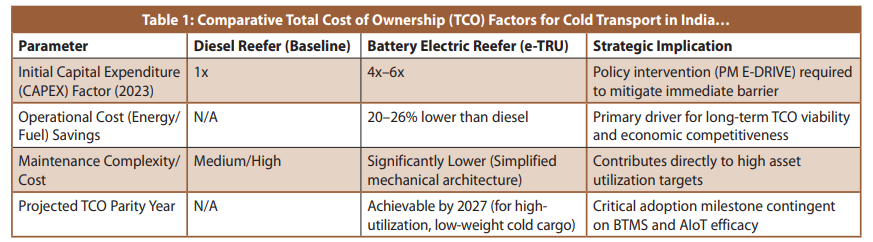
Indian government policy has acted to bridge the financial gap required for a sector-wide transition. The recently launched PM E-DRIVE (PM Electric Drive Revolution in Innovative Vehicle Enhancement) scheme marks a historic national-level intervention providing direct financial support for electric trucks (e-trucks). This strategic approach targets the segments that form the logistical core of the cold supply chain and contribute most significantly to road transport emissions: the N2 (Gross Vehicle Weight (GVW) 3.5 to 12 tonnes) and N3 (GVW 12 to 55 tonnes) categories. The policy provides significant incentives – up to `9.6 Lakh per e-truck – acting as a critical de-risking mechanism. This intervention immediately mitigates the current 4x to 6x higher initial Capital Expenditure (CAPEX) faced by fleet operators when compared to purchasing a diesel truck.
Analysis indicates that BETs could achieve Total Cost of Ownership (TCO) parity with diesel trucks as early as 2027 based on expected long-term battery cost declines. Also, the PM E-DRIVE scheme functions as a governmental expense calculated to bridge the CAPEX gap between the present and 2027. By accelerating the adoption curve, the policy effectively purchases several years of accelerated decarbonization, ensuring that immediate investment needed to meet climate goals is mobilised without waiting for slower, natural market forces to close the CAPEX differential. This strategic use of public funds transforms an impending economic viability into immediate policy feasibility, underscoring the political recognition that climate deadlines cannot wait for market evolution; targeted incentives are necessary to front-load capital investment in the heaviest-emitting vehicle categories.
These national efforts are complemented by a variety of state-level supports, including capital subsidies, exemption from stamp and electricity duties for manufacturers, and reimbursement of State Goods and Services Tax (SGST) for fleet leasing and charging infrastructure providers. Crucially, logistical hubs are actively expanding their charging infrastructure. Cities such as Delhi are establishing charging facilities (including 240 kW fast chargers) at existing transport corporation depots to support heavy commercial vehicles, further validating and enabling the shift towards electrification.
Total Cost of Ownership (TCO) Dynamics: The Economics of Transition
The core argument supporting the transition to electric refrigerated transport rests on a clear economic calculation rooted in the Total Cost of Ownership (TCO). This model demonstrates that operational savings rapidly negate the high initial capital outlay.
Mitigating the Upfront Capital Expenditure Barrier
The primary barrier to adoption remains the high initial investment; the upfront CAPEX for a BET currently ranges 4 to 6 times higher than that of a comparable diesel truck. However, this substantial initial disparity is rapidly neutralised by dramatically lower operational costs (OPEX). Electric trucks offer verified energy cost savings in the range of 20% to 26% compared to their diesel counterparts.
Furthermore, the simplified mechanical architecture inherent to electric vehicles (which involves fewer moving parts and the absence of complex transmission or exhaust systems) translates directly into significantly lower maintenance requirements over the asset’s lifespan. This substantial reduction in operational costs provides the necessary pathway for TCO parity, shifting the economic focus from the purchase price to lifetime operating expenditure.
The 2027 TCO Parity Crossroads: Sensitivity to Utilization
The analysis projects that for specific use cases involving high-volume, low-weight cold cargo (such as last-mile pharmaceutical or specialised food delivery) TCO parity with diesel trucks is anticipated to be achieved by 2027. This milestone, however, is critically sensitive to a single variable: maximum asset utilisation. The lower operating costs of Electric Transport Refrigeration Units (e-TRUs) mean that fleet profitability is directly tied to maximising kilometers driven and minimising downtime. This operational necessity is already being institutionalised across the industry. Large organised fleets, which are outpacing individual owners with an 8.73% CAGR, increasingly adhere to national contracts that specify mandatory telemetry uptime.
The realisation of TCO parity is conditional on guaranteeing sustained, predictable operational performance. Therefore, the investment in digital monitoring (AIoT) and predictive maintenance (P-Maint) is not an optional enhancement but a mandatory TCO prerequisite. Without a digital backbone to guarantee high utilisation by anticipating and predicting mechanical failures, the foundational economic model of electrification – based on low OPEX and high asset utilization – cannot be consistently realised.
Optimisation Strategy: The Hidden Cost of Heat and Battery Sizing
A critical technical factor that impacts TCO in the Indian environment is the energy demand required for cooling. Unlike standard freight, refrigerated transport must account for the substantial energy drain imposed by the Transport Refrigeration Unit (TRU), especially under India’s high ambient temperatures. This competitive demand for battery power reduces the effective driving range and can necessitate more frequent charging, increasing OPEX. Engineering strategy must therefore focus on the optimal sizing of the battery pack. Maximising TCO savings requires designing a battery range that is slightly smaller than the typical daily demand and relying on strategic en-route or depot charging to meet additional distance requirements.
Unnecessary increases in battery capacity only elevate the initial CAPEX without providing proportional gains in efficiency, potentially delaying the anticipated TCO parity timeline. This preference for optimised CAPEX over theoretical maximum range reflects an engineering strategy sensitive to the cost structure of the Indian logistics market, emphasising frequent, optimised charging over high upfront investment. The realisation of the 2027 TCO parity hinges directly on optimising this balance between battery capacity, cost, and the rapid deployment of the supporting fast-charging infrastructure. The following table summarises the projected financial shifts underpinning cold transport modernisation. Table 1 compares Total Cost of Ownership (TCO) factors for cold transport in India.
Engineering Solutions for Thermal Resilience in High-Ambient Climates
The operational viability of electric cold transport in the Indian environment depends entirely on specialised engineering solutions that ensure system resilience against extreme thermal conditions. These solutions address the dual reliability risk faced by fleet operators: the failure of the motive system and the failure of cargo integrity maintenance.
Figure 1 shows a conceptual diagram of the integrated system architecture illustrating the flow of Sensors, Edge Hub (TinyML), using Telematics/4G with Cloud Platform (AI Analytics) and Fleet Manager Dashboard. Simultaneously, the main battery powers both the Traction Motor and the active BTMS, which are managed by the Smart Controller governing the e-TRU.

Innovations in Electric Transport Refrigeration Units (e-TRU)
Modern Transport Refrigeration Units require their performance to be entirely decoupled from the variable output of the Internal Combustion Engine (ICE). This decoupling is achieved by implementing several key innovations. E-TRUs utilise tailor-made inverters to maintain constant refrigeration capacity regardless of vehicle speed as shown in figure 1. They employ variable speed compressors, which provide precise temperature control, decrease energy consumption, and enhance overall reliability.
Furthermore, these systems are managed by smart controllers equipped with power management intelligence, optimising the delicate supply-and-demand balance between the traction motor’s power requirements and the refrigeration unit’s needs.
For heavy-duty operations, strategies often incorporate hybrid elements to enhance range and operational assurance (including utilising integrated shore power capabilities during loading and unloading, and installing solar panels on trailer roofs to generate auxiliary electricity) thereby reducing the TRU’s dependence on the main traction battery.
This engineering shift from a mechanically driven system to an electrically controlled, constant-capacity system improves energy efficiency, provides superior, non-fluctuating temperature maintenance, and facilitates strict regulatory adherence.
To be continued…

Dr. Kaushik K. Shandilya is an environmental engineer, chemist, and sustainability scientist whose career spans more than two decades across academia, government, and industry. As a national award-winning researcher, his career reflects a rare breadth—air quality, particulate chemistry, wastewater treatment, algal biotechnology, energy systems, and sustainable materials – all unified by a focus on practical, scalable solutions for global environmental challenges. His global work spans India, the United States, Korea, and China, among others. He has held research and teaching appointments at Baylor University, the University of Toledo, South Florida, Clarkson University, and multiple U.S. and Indian colleges, mentoring students and advancing work in alternative fuels, air pollution exposure, and algae-based technologies.

Dr. S. N. Bansal @ Sharad is President, Institution of Government Approved Valuers and Chief Executive Officer, L & Q Surveys Private Limited has about 50 years of experience. He received degree in Building & Quantity Surveying from the Institution of Surveyors (India) and M. Tech (Civil) in Transport Planning. He is M.B.A. (Disaster Management) from Institute of Advanced studies in Education (Deemed University) in 2006. Dr. Bansal is a Chartered Engineer, having membership of RICS (UK) also active member of 27 professional bodies/ institute. He has Published 85 papers. He received several awards, presented papers in National & International seminars, conferences. Delivered lectures & visiting faculty at Institution of Surveyors, INTACH, Institution of Government Approved Valuers, Institution of Valuers. He is practising Transport Planner, Valuer, Land & Quantity Surveyors. On the panel of DDA, CPWD, PWD, DSIIDC, Delhi High Court, Income Tax (Investigation Team) and various financial Institutes.