


The Critical Role of Battery Thermal Management Systems (BTMS)
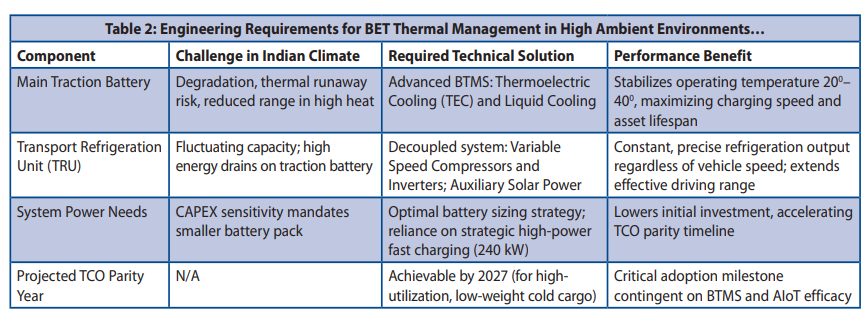
High ambient temperatures in India significantly exacerbate the reliability risk by degrading the performance and lifespan of lithium-ion batteries. Regarding the impact of efficient EV battery thermal management, it has been found that operating outside the optimal temperature range (typically between 200 and 400) increases internal resistance, reduces power output and range, accelerates cell degradation, and, in extreme cases, can lead to dangerous thermal runaway. Therefore, effective BTMSs are a non-negotiable requirement for e-reefer (i.e., essentially an electric, battery-powered refrigerated trailer unit that keeps cargo cold without relying on diesel) deployment. The BTMS is the engineering foundation that guarantees the longevity and performance necessary for the electric vehicle model’s TCO calculation to hold true in the tropics. If the BTMS fails in a high-heat environment, the battery degrades, leading to reduced range, longer charging times, and premature battery replacement, directly undermining the TCO projection based on low OPEX and extended asset lifespan.
It was also found in research that advanced cooling methods provide thermodynamic superiority over basic air cooling for managing battery temperature. Specifically, methods such as Thermoelectric Cooling (TEC) combined with liquid cooling and forced convection are preferred. Research suggest that the liquid-based systems are superior because liquids possess higher thermal conductivity and higher specific heat capacity than air, allowing for more efficient heat transfer and precise temperature control at lower mass flow rates.
These advanced systems actively regulate the operating temperature of the main battery pack, which is crucial for maximising charging speed, preventing thermal safety issues, and ensuring that the promised vehicle range is consistently achieved, safeguarding both the high-value asset investment and the perishable cargo. Table 2 illustrates the engineering requirements for BET thermal management in high ambient environments such as India.
Localisation and the Circular Economy Mandate
Scaling this specialised technical ecosystem requires aggressive localisation of high-value components. Key domestic manufacturers are prioritising vertical integration, establishing battery assembly units, and localising critical components to reduce dependence on expensive imports and mitigate logistical risks from global supply chain disruptions. This localisation effort must extend to advanced e-TRU and BTMS components to scale e-reefer deployment economically. This strategy serves a dual function: it secures the supply chain and reduces costs, which helps achieve TCO parity, and it allows for the indigenous development of BTMS specifically tuned for the unique and aggressive thermal profile of the Indian environment, ensuring optimised performance beyond generic global designs.
Furthermore, sustainable growth mandates a robust circular economy for batteries. When analysing EV battery recycling in India, it is found that the Government of India’s Battery Waste Management Rules (2022) mandate Extended Producer Responsibility (EPR) for Li-ion batteries and set two ambitious targets to be achieved by 2027: a minimum of 90% materials recovery and the mandated use of 5% recycled materials in new batteries (rising to 20% by 2030–31).
Similarly, when exploring options of a sustainable battery manufacturing industry, planning for second-life applications, such as using retired batteries for energy storage, is essential to manage the estimated 128 GWh of recycling volume expected by 2030, reinforcing the long-term sustainability of the electrified fleet.
Digital Transformation: AIoT, Edge Computing, and Predictive Cold Integrity
The economic benefits of electrification are inherently secured and multiplied by a highly intelligent digital infrastructure that ensures cargo quality, regulatory adherence, and operational uptime.
Moving from Reactive Monitoring to Predictive Control
IoT-enabled telematics are transforming cold transport management from a reactive exercise into a proactive strategy. Strategic placement of sensors inside trucks and storage units provides 24/7, real-time data streams on temperature, humidity, and location. This constant stream generates instant alerts the moment conditions deviate from safe limits, enabling logistics managers to intervene immediately and prevent catastrophic product loss.
Beyond efficiency, smart monitoring is critical for navigating the stringent regulatory environment imposed by the Food Safety and Standards Authority of India (FSSAI) and the global standards of Good Distribution Practices (GDP) for temperature-sensitive goods like pharmaceuticals. IoT systems automatically generate audit-ready data logs, replacing outdated manual records and providing transparent, ‘Temperature Verified’ proof of cold chain integrity, reducing administrative burden and building customer trust.
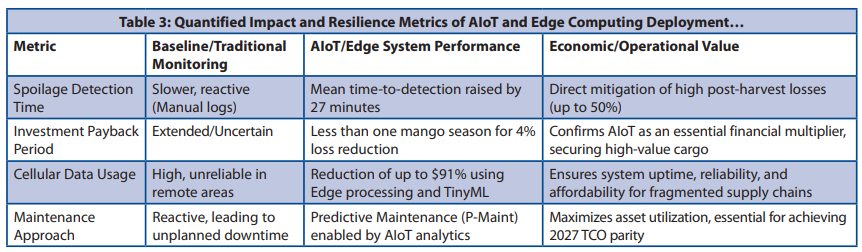
The integration of Artificial Intelligence (AI) algorithms into the IoT framework (AIoT) allows systems to move beyond simple monitoring toward predictive control. AI analyses temperature data patterns and equipment performance metrics to anticipate potential failure points, such as refrigerant leaks or compressor issues, enabling Predictive Maintenance (P-Maint). This predictive capability minimises unplanned downtime, which directly maximises the asset utilisation required for realising the TCO benefits.
Achieving Resilience with Edge Computing and TinyML
The full potential of AIoT must contend with India’s fragmented supply chain and varying connectivity infrastructure. Conventional cloud-only monitoring fails in areas with patchy cellular coverage, leading to data loss and delayed decision-making. Edge computing provides the solution to this vulnerability. In this architecture, small, localised hubs – often utilising platforms like Raspberry Pi – process sensor data instantly using simplified machine learning models (TinyML).
The research on Edge AI for real-time anomaly detection in smart homes establishes that this decentralisation allows for immediate, local anomaly detection and decision-making, with some hybrid architectures achieving inference latency of less than 50 milliseconds. The raw data is stored locally, and only summarised, actionable data – often transmitted via low-power, wide-area network technologies like LoRaWAN – is uploaded to the central cloud when connectivity is available.
This approach to achieving resilience yields significant operational advantages. For example, the approach also reduces cellular data usage by up to 91% in case studies. It also extends sensor battery life, making reliable, advanced monitoring affordable and scalable for micro and small-scale operators in rural corridors. By decentralising processing, Edge technology effectively democratises state-of-the-art predictive integrity, making it accessible outside the exclusive domain of large, organized fleets. This ensures that the benefits of smart monitoring can penetrate the deeper supply chain, which is critical for reducing massive post-harvest losses.
Economic Impact of Digital Resilience
The most compelling economic justification for smart monitoring is its quantified impact on loss reduction. High post-harvest losses, sometimes approaching 50% for fresh agricultural produce, still occur during the various stages of the cold chain. Field-testing validates the efficacy of digital intervention: utilising edge-enabled systems to flag anomalies raised the mean time-to-detection of spoilage risks by 27 minutes. Economic analysis confirms that achieving even a 4% reduction in cargo loss can provide a payback period of less than one mango season (summer) for the investment in digital monitoring technology.
This rapid return on investment confirms that the digital layer acts as an essential financial multiplier. Since the ROI is tied directly to high-value perishable cargo, the primary function of AIoT becomes ‘cargo loss mitigation’ rather than just logistics optimisation. This substantially lowers the risk profile of the entire cold chain operation, securing the high-value goods transported by the electrified fleet and safeguarding the resilience of India’s supply chain. Table 3 demonstrates the quantified impact and resilience metrics of AIoT and edge computing deployment.
Architecture and Outlook
Integrated System Architecture: A Unified Framework for Smart E-Reefers
The successful implementation of India’s electric cold chain requires the tight architectural integration of power management, thermal control, and digital intelligence across distinct yet interoperable layers. The architecture is founded upon the Traction and Power Layer, comprising the main high-voltage battery pack and the motive powertrain.
Layered above this is the Refrigeration and Thermal Management Layer, which includes the e-TRU (variable speed compressor) and the dedicated BTMS. The active cooling provided by the BTMS is the crucial physical link ensuring that high ambient temperatures do not compromise the efficiency or longevity of the main battery pack.
The Sensing and Edge Layer provides the intelligence, where IoT sensors (monitoring temperature, humidity, and location) feed data into a local Edge Hub. Local processing at this level runs TinyML algorithms to detect immediate temperature or humidity anomalies, assuring data integrity and real-time decision-making even when communication links malfunction.
Finally, the Connectivity and Cloud Layer utilise telematics to transmit summarized, actionable data to the centralised cloud platform, which hosts fleet-wide AI algorithms for predictive maintenance, long-term trend analytics, and automated regulatory reporting. This architectural synthesis ensures that zero-emission mobility is inherently resilient, data-driven, and financially optimised, thus positioning the e-reefer as a unified, intelligent asset.
Conclusion: The Data-Driven Path to Zero-Emission Cold Logistics
The profound structural transformation of India’s cold transport system is predicated on a symbiotic convergence where the verifiable operational cost savings generated by electric mobility are unlocked and secured by the predictive assurance provided by AIoT.
The immediate capital barrier to adoption is being strategically addressed by government intervention, notably the PM E-DRIVE scheme, which functions as a de-risking mechanism to accelerate investment. However, sustaining this transition and realising the 2027 TCO parity requires dual focus from fleet operators. These operators must address unique engineering challenges inherent to high-ambient climates through the mandatory implementation of advanced BTMSs to ensure both vehicle range and cargo integrity are maintained. Also, they must maximise asset utilisation, which mandates the integration of AIoT-based predictive maintenance.
Investment in AIoT, specifically utilising edge computing and TinyML, is not secondary; it is an essential financial multiplier and a strategic necessity for resilience. By decentralising processing, this technology addresses the critical infrastructure gap of fragmented connectivity and ensures regulatory compliance across India’s vast geography.
The demonstrable return on investment from quantifiable spoilage reduction secures the high-value cargo and guarantees the necessary operational uptime. The integrated approach – combining policy support, climate-specific engineering solutions, cost-optimized battery sizing, and decentralized digital intelligence – positions India to meet its ambitious climate goals while simultaneously safeguarding a rapidly growing logistics sector vital for national food and pharmaceutical security. Thus, the future of India’s cold transport is intrinsically zero-emission, data-driven, and resilient.
Concluded

Dr. Kaushik K. Shandilya is an environmental engineer, chemist, and sustainability scientist whose career spans more than two decades across academia, government, and industry. As a national award-winning researcher, his career reflects a rare breadth—air quality, particulate chemistry, wastewater treatment, algal biotechnology, energy systems, and sustainable materials – all unified by a focus on practical, scalable solutions for global environmental challenges. His global work spans India, the United States, Korea, and China, among others. He has held research and teaching appointments at Baylor University, the University of Toledo, South Florida, Clarkson University, and multiple U.S. and Indian colleges, mentoring students and advancing work in alternative fuels, air pollution exposure, and algae-based technologies.

Dr. S. N. Bansal @ Sharad is President, Institution of Government Approved Valuers and Chief Executive Officer, L & Q Surveys Private Limited has about 50 years of experience. He received degree in Building & Quantity Surveying from the Institution of Surveyors (India) and M. Tech (Civil) in Transport Planning. He is M.B.A. (Disaster Management) from Institute of Advanced studies in Education (Deemed University) in 2006. Dr. Bansal is a Chartered Engineer, having membership of RICS (UK) also active member of 27 professional bodies/ institute. He has Published 85 papers. He received several awards, presented papers in National & International seminars, conferences. Delivered lectures & visiting faculty at Institution of Surveyors, INTACH, Institution of Government Approved Valuers, Institution of Valuers. He is practising Transport Planner, Valuer, Land & Quantity Surveyors. On the panel of DDA, CPWD, PWD, DSIIDC, Delhi High Court, Income Tax (Investigation Team) and various financial Institutes.